How Small Failures Become Major Crises
The leak under the sink was never just a leak. It was a test of whether your system had any room to absorb it.
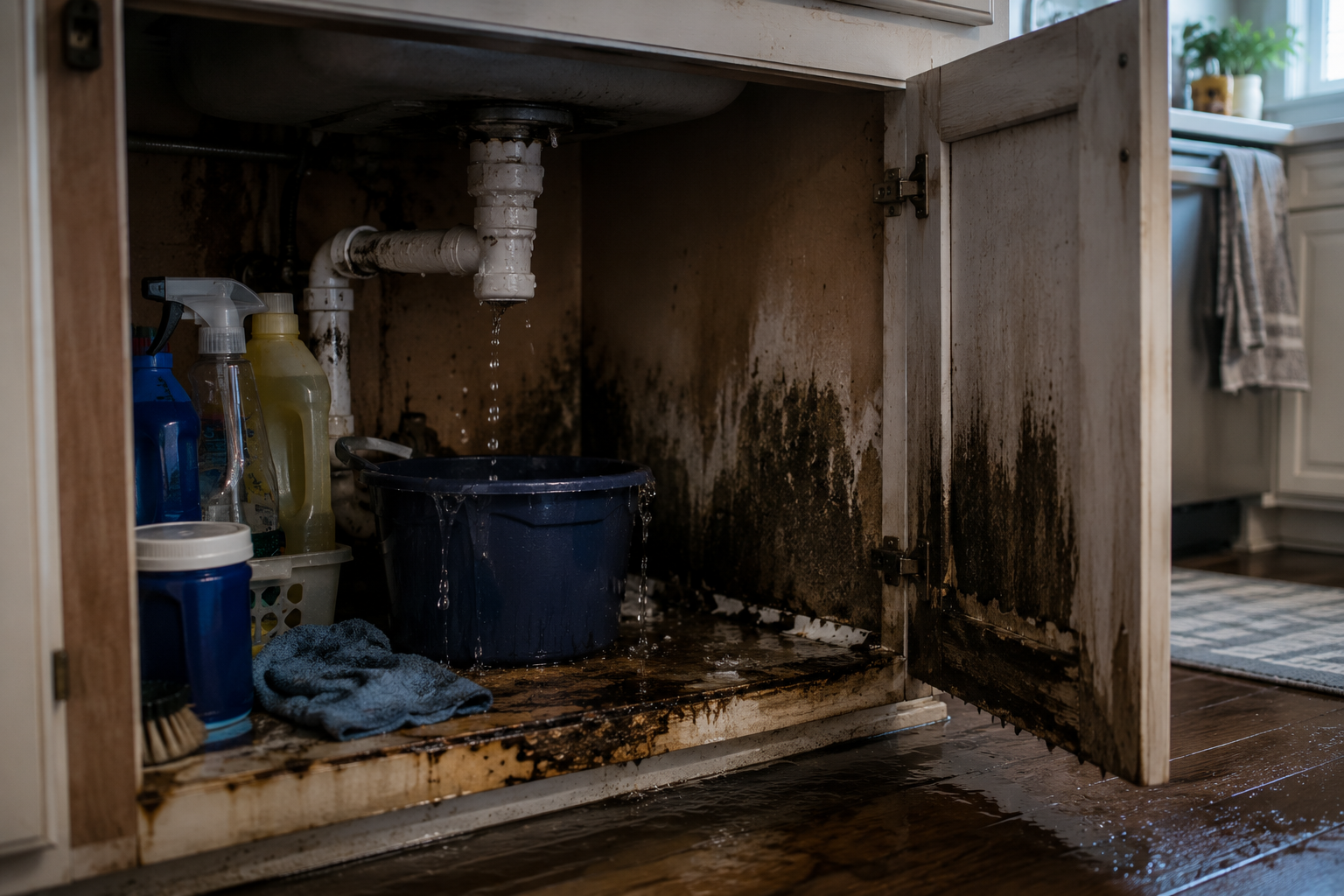
You noticed the leak under the sink three weeks ago. A few drops, easy to ignore, nothing urgent. You meant to look at it. Then work got busy, and your kid had a school thing, and the weekend disappeared the way weekends do. Today you open the cabinet and the particle board underneath is swollen and dark, the smell hits you before the sight does, and what would have been a ten-dollar washer and twenty minutes is now a contractor estimate with a number you don't want to say out loud.
Nothing about this story involves bad luck. The leak didn't get worse because you're careless. It got worse because it was never anything but small for as long as it was ignored — and the moment of ignoring it is the moment the failure actually happened. Everything after that was just the bill arriving on a delay.
The Root Cause: A System With No Resilience Layer
ROOT CAUSE: The system cannot tolerate disturbanceThis is the failure mode that hides best, because it doesn't look like a failure at the moment it happens. The moment of failure is quiet — a leak unaddressed, a credit card minimum paid instead of the balance, a checkup skipped because nothing hurts yet. None of these register as crises. They register as nothing at all, which is exactly the problem.
A system with a working resilience layer has buffers built in specifically so that small disturbances get absorbed before they propagate: a maintenance habit that catches the leak in week one, a savings cushion that makes the minimum payment irrelevant, a scheduled checkup that catches the issue before it has a name. Remove the buffer, and there is nothing standing between a minor disturbance and a major one except time and bad luck — and time, eventually, runs out.
The Mechanism: Why Small Problems Don't Stay Small
Disaster and emergency preparedness research treats this as a core principle, not a metaphor: the gap between a minor disruption and a major one is determined almost entirely by whether resilience capacity exists before the disruption occurs, not by how severe the disruption originally was. The Household Emergency Preparedness Instrument — a 51-item measure validated by a panel of 154 experts across 36 countries — was built specifically around this principle, treating preparedness as a measurable buffer that determines outcome, independent of the size of the initial event.
Community-level resilience research finds the same pattern at a larger scale: the agencies and frameworks that study disaster outcomes consistently identify the presence or absence of existing capacity — not the size of the initial shock — as the strongest predictor of whether a community recovers quickly or experiences cascading harm.
This is the same mechanism at every scale, from a household to a region: the size of the trigger matters far less than whether anything was in place to absorb it.Experts across 36 countries who contributed to validating the Household Emergency Preparedness Instrument — built on the principle that preparedness capacity, not event size, determines whether a disruption stays small.
What this means in practice is uncomfortable but useful: the leak under your sink was never a plumbing problem waiting to happen. It was a resilience-layer problem that had already happened, weeks earlier, the moment no system existed to catch it early. The plumbing was just where it became visible.
The Design: Catch It at the Cheapest Point in the Chain
Every escalating failure moves through the same basic chain: a minor, low-cost issue goes unnoticed or unaddressed, it compounds because nothing interrupts it, and it eventually resurfaces as a major, high-cost issue. The fix is not learning to respond faster once something becomes a crisis. The fix is building a checkpoint earlier in the chain, at the point where the cost of catching it is smallest.
Minor disturbance — a small leak, a missed payment, a vague symptom
No checkpoint exists → issue compounds unnoticed
Major, high-cost failure — now visible, now urgent
A resilience layer is just a deliberate checkpoint placed early in this chain — a monthly five-minute look under the sink, an automatic transfer that builds a buffer before the minimum payment becomes the only option, a scheduled checkup before symptoms appear. None of these require more effort than handling the eventual crisis. They require less. The entire economics of resilience design is that the checkpoint is always cheaper than the crisis it prevents — the only question is whether you build it before or after you find out the hard way.
Find the Cheapest Catch Point
Pick one area of your life where you've noticed something small and put off addressing it — a sound, a notice, a symptom, a balance. Write down the earliest point at which you could have caught it for the lowest possible cost, and put a specific date on your calendar this week to check it.