Systems Thinking for Everyday Life
Engineers see the world differently, not because they are smarter, but because they were taught a way of seeing that most people never encountered. Here is that way of seeing.
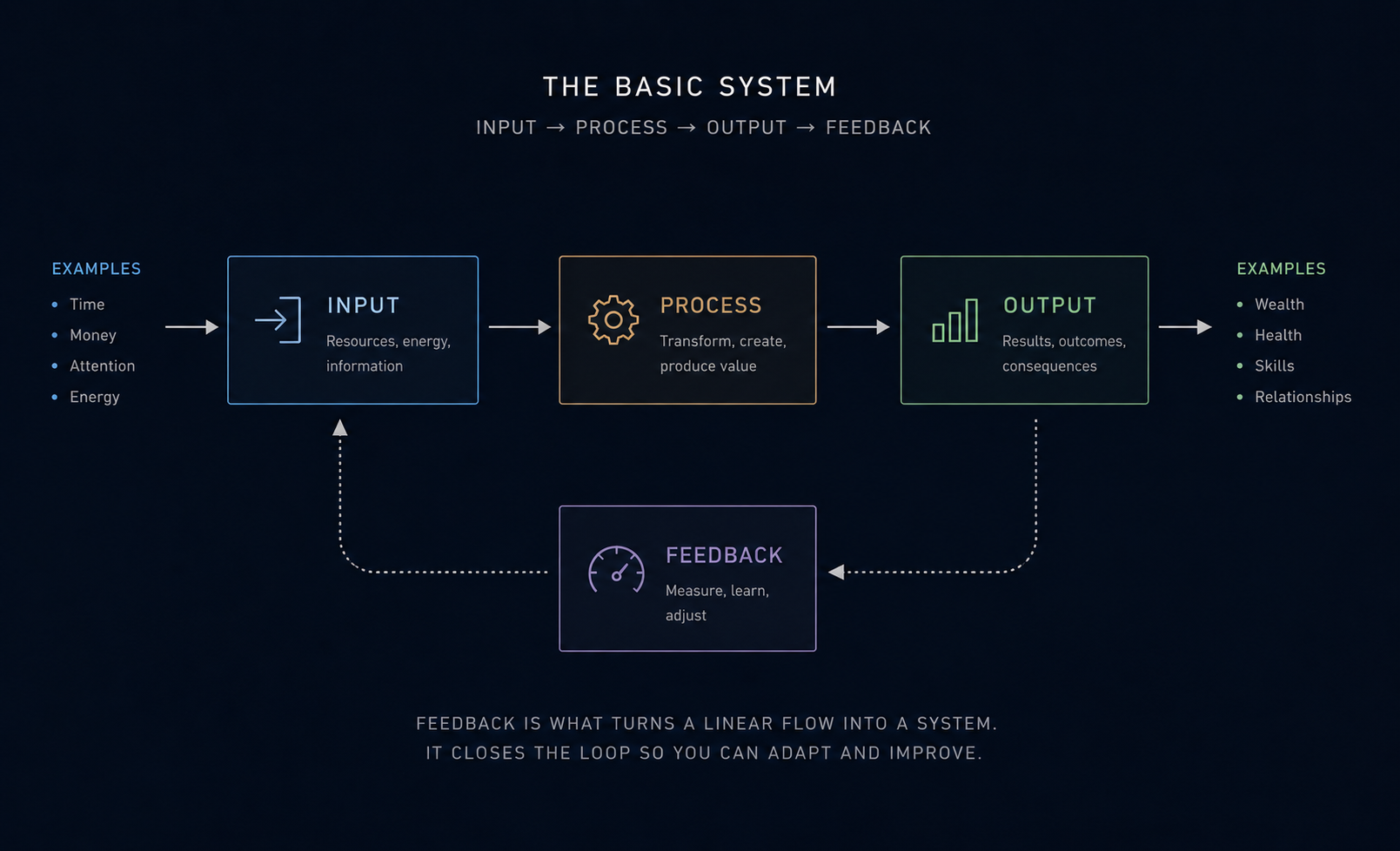
You have accepted the reframe. Your financial stress is not a willpower problem; it is a systems problem. Your health plateau is not a discipline problem; it is a design problem. You understand that intellectually. Yet, when you sit down to actually do something about it, you find yourself staring at a blank document with no clear idea of where to start.
The reframe is the first step. But a reframe without a method is just a better way of feeling stuck.
What you need is the lens. The specific way of looking at a problem that makes the system visible. A full view of its components, its connections, its failure points, and its leverage. That lens has a name: systems thinking. And unlike most things labeled with the word "thinking," it is not vague. It is a set of concrete, learnable skills that engineers and systems designers use every day to understand why things fail, and exactly what to change to make them work.
This article teaches you some of those basic skills. Not the textbook version. The version that applies to your actual life.
Why Most People Cannot See Their Own Systems
ROOT CAUSE: The system has no feedback loopThe reason most people cannot see the systems in their own lives is not that the systems are invisible. It is that they have never been given a vocabulary for describing them, or a framework for mapping them. Without vocabulary, you cannot distinguish between the symptom and the mechanism. Without a map, you cannot find the path to your successful destination.
Consider what happens when your checking account keeps running lower than you expect each month. The natural response is to examine individual expenses. You do things like cut out coffee, cancel the subscription, skip the dinner. This is symptom treatment. It focuses on specific outputs without ever examining the system that produces them. The checking account balance is a signal. The system is the entire process by which money enters, moves through, and leaves your financial life. Cutting a subscription addresses one data point. Understanding the system addresses the mechanism.
"You can't change a system you can't see, and you can't see a system you don't have language for."
Systems thinking gives you the language. Once you have it, you start seeing systems everywhere. More importantly, you start seeing exactly where they are breaking down.
The Four Concepts That Change How You See Everything
Systems thinking rests on a small number of foundational concepts. You do not need to master the entire academic field to use them. You need to understand four ideas well enough to apply them to the systems you are actually responsible for. Here they are: translated from engineering into life.
enters
happens
results
Every system you are responsible for has this anatomy. Your financial system takes income as an input, runs it through spending and saving decisions as a process, and produces a net worth trajectory as an output. Your health system takes food, sleep, and movement as inputs, runs them through your physiology as a process, and produces your physical state as an output. Mapping the anatomy is the first step. Now here are the four concepts that make the map useful.
A stock is anything that builds up or depletes over time: your savings balance, your physical fitness, your reputation, the structural integrity of your roof. Stocks change slowly. They are the memory of a system. In other words what it has accumulated over all the flows that have passed through it.
A flow is the rate at which a stock increases or decreases: your monthly savings rate, your weekly exercise frequency, the rate at which deferred maintenance compounds into structural damage. Flows are fast. They are the levers you can actually pull. However, flows only matter relative to the stock they are changing.
A feedback loop is the mechanism that reads the output and adjusts the input in response. Your thermostat is a feedback loop. A monthly budget review is a feedback loop. A health check-up is a feedback loop. Without feedback, a system cannot self-correct. It runs blind until the failure is large enough to be impossible to ignore.
A delay is the gap between a change in a flow and the visible effect on a stock. The consequences of poor diet do not appear overnight. The effects of deferred home maintenance arrive suddenly, years after the decision. Delays are why reactive management consistently under-responds until it is too late and then over-responds when the damage is already done.
The foundational text on systems thinking, written to be accessible to non-engineers. Meadows spent her career translating systems dynamics from technical models into clear explanations of how complex systems like economies, ecosystems, organizations, and families actually behave. The stock-flow-feedback framework above comes directly from her work. If you read one book after this article, it is this one.
How to Apply Systems Thinking to Your Own Life
Understanding the four concepts is necessary. It is not sufficient. The shift from understanding to competency happens when you apply the lens to a real system you are running — when you stop reading about stocks and flows and start drawing the actual map of your own financial system, or your own health system, or your own home.
Here is a four-step process for building your first system map. It takes under 30 minutes and produces something you can actually use: a documented picture of how your system is currently designed, where it is failing, and what to change.
Step 1 — Name the Stock
Pick one domain and identify what accumulates. For money: net worth. For health: physical capacity. For home: structural integrity and market value. For career: professional leverage. Write it down as a specific, measurable thing and not a feeling or a goal, but the actual resource the system is building or depleting.
Step 2 — Map the Flows
What are the rates that increase this stock? What are the rates that decrease it? For a financial system: income and investment returns increase net worth; spending and debt service decrease it. List both sides. Most people only manage the inflows and ignore the outflows, or vice versa. The map shows you both simultaneously.
Step 3 — Find the Missing Feedback Loop
Ask: how often do I look at the actual output of this system? How quickly does that measurement reach me? What do I do with it when it does? If the answer to any of these is "never," "rarely," or "nothing systematic," you have found your highest- leverage fix. A system with no feedback loop cannot self-correct. The fix is instrumentation: a monthly review, a quarterly check-in, a scheduled appointment. Not more effort. More signal.
Step 4 — Identify the Dominant Delay
Where is the longest gap between a decision you make and its visible consequences? That is where your system is running blind longest, and where the most expensive surprises will originate. Home systems have long delays. Health systems have long delays. Relationship systems have long delays. Naming the delay tells you how far in advance you need to think, and why reactive management in these domains is always inadequate.
Senge's foundational work on how systems thinking applies to human organizations, and by extension, to any structure where people make decisions inside complex feedback loops. His concept of "mental models" (the internal maps we use to interpret the systems we operate) is directly applicable to why most people misread their own life systems. The chapter on feedback delays alone is worth the read.
What Changes Once You Can See the System
The shift from event-based thinking to systems thinking is not gradual. It tends to happen suddenly, and once it does, it cannot be undone. You start seeing your monthly cash shortfall not as a bad month but as the predictable output of a spending flow that consistently exceeds the income flow which is a structural condition, not a series of individual decisions. You start seeing your health plateau not as a motivation problem but as a system producing exactly what it was designed to produce, which means changing the output requires changing the design.
The practical consequences are significant. Problems that felt personal become solvable. Decisions that felt arbitrary become legible. You can trace them back to specific flows and feedback loops and ask whether those are correctly designed. Surprises that felt random become predictable. You can see the delay that was accumulating and install an early-warning signal before the consequence arrives.
This is not a metaphor. This is the literal difference between operating a system you cannot see and operating one you can. Every domain of your life is a system. You were always the operator. Now you have the instrumentation and language to run it.
Map One System in Your Life
Pick the domain with the most friction in your life right now. Open a blank document or find a piece of paper. In under 20 minutes, answer these four questions (one per concept):
FLOWS: What are the two or three main things that increase it? What are the two or three main things that decrease it?
FEEDBACK: How often do I actually look at the output of this system? When did I last do that? What did I do with what I saw?
DELAY: What is the longest gap between a decision I make in this domain and the visible consequence I experience?
You now have a system map. It is rough. It is incomplete. It is still the most useful document you have produced about this area of your life, because it is the first one that shows you the mechanism rather than the symptom. Keep it. Everything you build from here will improve it.