What Is Root Cause Corrective Action?
Most fixes treat symptoms. Root Cause Corrective Action finds the mechanism that caused the failure — and eliminates it. That is a completely different kind of fix.
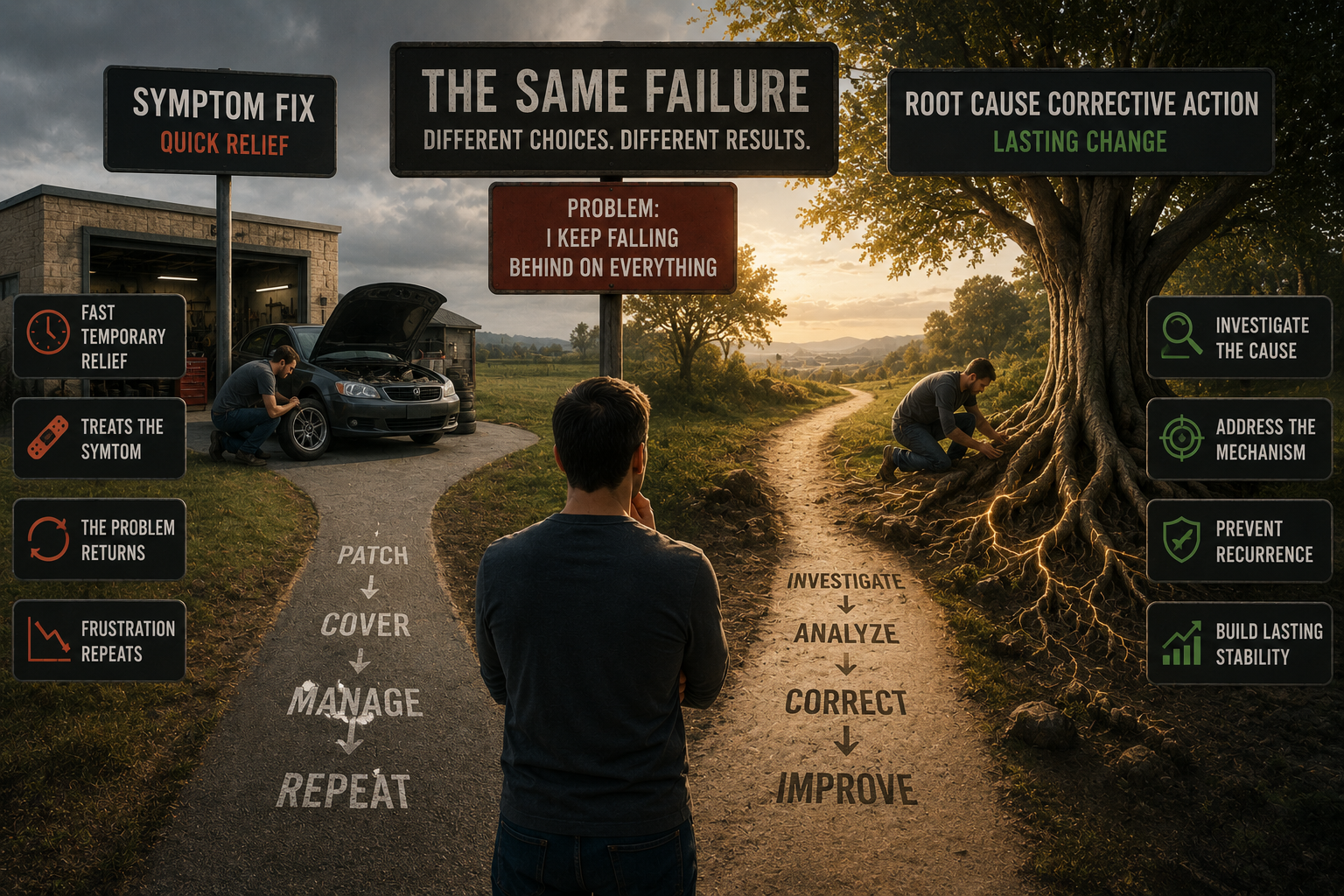
You have had this experience. Something in your life breaks like a budget shortfall, a relationship friction point, a recurring health problem, or a home repair that keeps coming back. So you fix it. You patch the budget. You have the difficult conversation. You take the medication. You call the contractor. Then, three months later, it breaks again. Same problem. Different week.
This is not bad luck. It is the predictable output of fixing the symptom instead of the system. The budget shortfall came back because the mechanism that creates it. The structural imbalance between fixed commitments and your variable income was never changed. The relationship friction came back because the communication pattern that produces it is still in place. The contractor fixed what was visible. The root cause is still running.
Root Cause Corrective Action — RCCA — is the methodology that ends this cycle. It is a formal, structured process used in engineering, manufacturing, and healthcare to permanently eliminate the source of a failure, not just its symptoms. It is also, with minimal translation, the most powerful problem-solving tool available for every domain of your personal life.
Why Most Fixes Don't Last
ROOT CAUSE: System optimized for wrong outputWhen something breaks, the natural human response is to remove the discomfort as quickly as possible. The overdraft hits equals rapid transfer of money from savings. The back pain arrives; take the painkiller. The smoke detector sounds; remove the battery. These are not irrational responses. In the moment, they work. The discomfort is gone. The problem appears solved.
The problem is that the system producing the failure is still running. The overdraft mechanism, the structural imbalance between outflows and inflows, has not changed. The back pain mechanism, the postural loading pattern or movement deficit that stresses a specific structure, has not changed. The smoke detector mechanism, the actual condition in the kitchen that keeps triggering it, has not changed.
A fix that addresses the symptom and leaves the mechanism intact is not a fix. It is a delay with extra steps.
RCCA is the antidote to this pattern. It insists on a complete diagnosis before a corrective action is designed, and it defines "complete" precisely: the causal chain must be traced from the symptom all the way back to the originating mechanism. Anything less is a shortcut that will cost you again.
How Root Cause Corrective Action Works
RCCA has been a formal methodology in engineering and quality management for decades. The American Society for Quality defines corrective action as action taken to eliminate the cause of a detected nonconformity, not the nonconformity itself, but the cause. That distinction is the entire methodology in one sentence.
The core diagnostic tool within RCCA that we will implement is the Five Whys. It is a deceptively simple technique developed by Taiichi Ohno at Toyota as part of the Toyota Production System. The method is exactly what it sounds like: starting from the observed problem, you ask "why did this happen?" and then ask why again to the answer you receive, until the actual mechanism is exposed rather than another downstream symptom.
The Five Whys in Practice
Here is a worked example in a real-life domain, personal finances. This way the method is concrete before you apply it to your own situation.
The problem: I am consistently overdrawn by the third week of every month.
Notice what happened. The surface problem "overdraft" led to a surface fix: transfer money, cut a subscription. The Five Whys revealed the actual mechanism: no aggregate review process for fixed commitments. The correct fix is not cutting one subscription. It is building a quarterly fixed-cost review into the financial system. That fix addresses the mechanism. It will not produce another overdraft two months later because the same subscription came back in a different form.
The Five Whys originated here. Ohno, who built the Toyota Production System, describes asking "why" repeatedly not as a technique but as a habit of mind. It is the refusal to accept a symptom as an explanation. His chapter on the Five Whys is three pages long and is one of the most useful three pages written about problem-solving in the last century. The rest of the book is about manufacturing, but the diagnostic logic applies to any system that produces unacceptable and consistent outputs.
The Five-Step RCCA Process
Here is the complete RCCA process as applied to personal life systems. Each step has a gating function, in other words, you cannot proceed to the next step without completing the previous step. The most common failure in applying RCCA is skipping Step 1 or rushing Step 2. Slow down on those two. Everything that follows depends on them.
What Changes After the First Complete RCCA
The first time you apply this process to completion, through all five steps, to a verified fix, something changes that does not change back. You stop experiencing recurring problems as bad luck or personal failure and start experiencing them as diagnostic opportunities. A problem that returns is a signal: the root cause analysis was incomplete, or the corrective action did not address the mechanism it claimed to.
That shift is not small. It is the difference between a life that happens to you and a life you are actively engineering. Problems become solvable by definition, because every problem has a mechanism, and every mechanism can be found and changed, given sufficient rigor in the diagnosis. Some root causes are harder to address than others. Some corrective actions take months to design and implement. But none of them are mysteries. They are engineering problems.
This is the methodology anchor for everything at Deadband Life. Every domain article within money, home, health, career, legal, or digital applies this same process to its specific failure modes. The domain changes. The methodology does not. Once you understand RCCA, you can diagnose anything.
Run a Five Whys on a Recurring Problem
Pick one problem in your life that has come back at least twice after you thought you fixed it. Open a blank document. Work through these five steps right now. Do not schedule this for later:
Step 2 — Write: "Why does this happen?" and answer it. Then write "Why does THAT happen?" and answer again. Repeat until your answer describes a missing process, an absent review, an inherited pattern, or a design that was never intentionally built. That is your root cause.
Step 3 — Classify it: No system / Inherited system / No feedback loop / Wrong output / No resilience layer.
Step 4 — Write one sentence: the corrective action that addresses the mechanism, not the symptom.
Step 5 — Write what you will measure in 90 days to confirm this failure mode has not recurred.
You now have your first complete RCCA. It is rough. The Five Whys chain may stop one step too early. The corrective action may need refinement. Keep the document. The process of finding its flaws is the next iteration and that is exactly how the methodology is supposed to work.