Continuous Learning and Career Growth
You've finished a dozen courses this year. Your career looks exactly the same. Here's the missing piece nobody mentions.
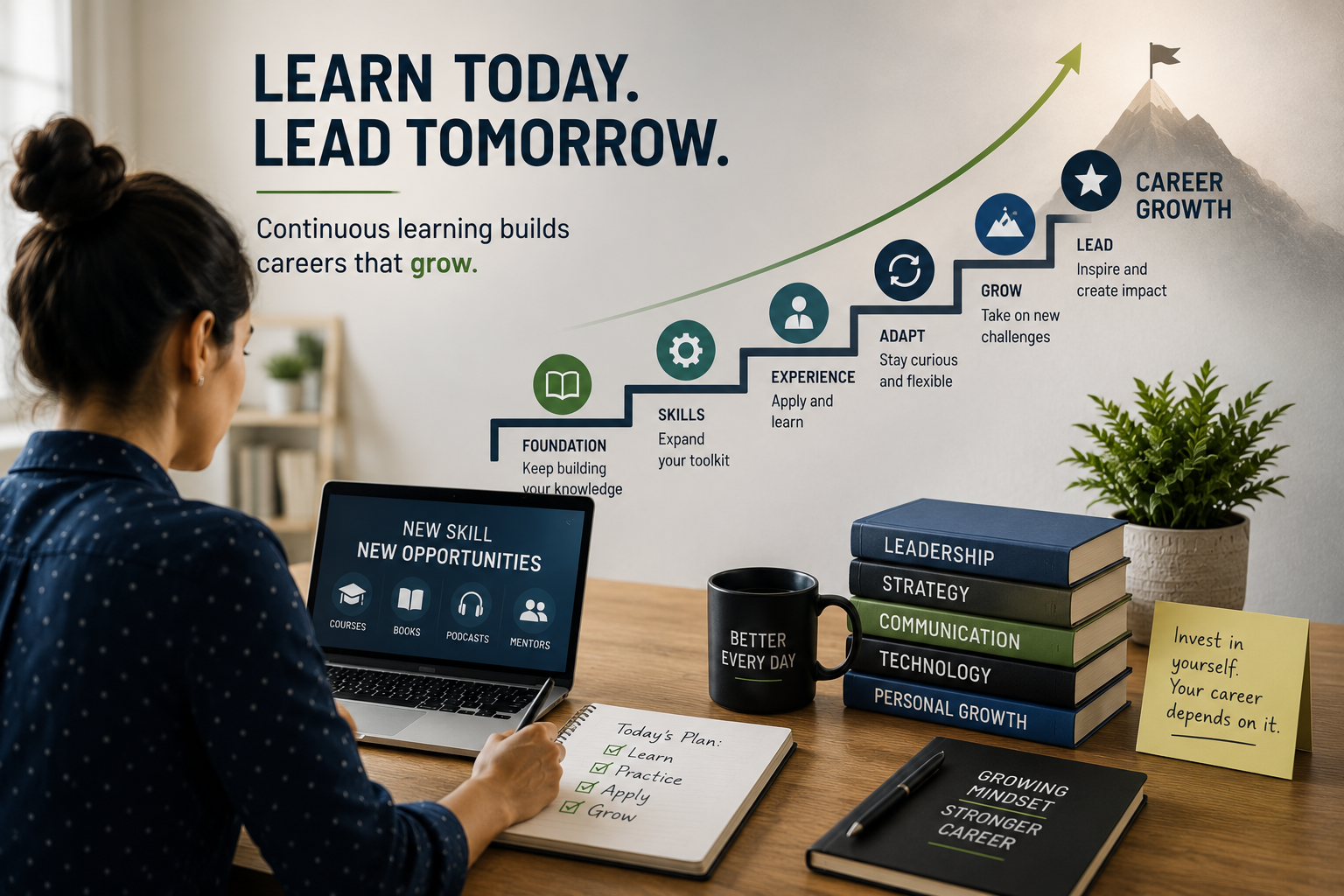
You finished another course last week. It's the fourth this year. You've got a folder of certificates, a bookmarks bar full of half-read industry newsletters, and a genuine, honest habit of learning. And yet, when you try to answer the question "has my career actually grown because of any of this," you go quiet.
You're not lazy, and you're not wasting your time exactly. You are doing the input, consistently. What you don't have is any way of knowing whether the input is producing an output. The learning is real. The growth is assumed.
That gap, between doing the learning and knowing whether it worked, is where most people's professional development quietly stalls out. It isn't a motivation problem. It's a missing measurement.
The Root Cause: Learning With No Feedback Loop
ROOT CAUSE: The system has no feedback loopContinuous learning has a marketing problem: it sounds inherently virtuous, so the act of doing it gets treated as the goal itself. Finish the course. Read the book. Attend the workshop. Check the box. What almost never happens afterward is the step that would actually tell you whether any of it changed your trajectory: measuring it against your career.
This is Root Cause 3: the system has no feedback loop. The person has a process, they are learning, consistently, in good faith, but the process produces no signal back to them about whether it's working. There's no review point where a course completed six months ago gets checked against a promotion earned, a scope expanded, or a rate increased. Without that signal, improvement is impossible and stagnation is invisible, because activity and progress start to feel identical.
The result is a very specific kind of frustration: someone who is doing more than most of their peers, and still isn't sure it's adding up to anything.
Why Feedback, Not Just Effort, Drives Career Growth
Research on employee development treats continuous learning as a motivational orientation, one that depends heavily on whether the learning feels personally relevant and whether the person can see its effect. Learning disconnected from a visible outcome doesn't sustain itself the same way learning tied to a clear signal does.
A related study looked specifically at what happens after structured feedback is introduced into someone's development process, rather than learning happening in isolation.
The mechanism connecting both findings is the same one behind every other domain covered in this series: a process without a feedback loop can run indefinitely without anyone knowing whether it's working. Learning is not the variable that predicts career growth. Learning plus a measurement of its effect is.
Designing a Learning System With a Feedback Loop Built In
The fix isn't to learn less, and it isn't to learn more. It's to add the one missing piece: a recurring checkpoint where learning gets measured against career outcomes instead of just accumulated.
Diagnose: Audit What You've Actually Learned This Year
List every course, certification, book, or structured learning effort from the past twelve months. For each one, ask a single question: what changed in my job, my scope, my compensation, or my options because of this? If the honest answer is "nothing yet," that's not a failure, it's your baseline.
Design: Learn Backward From the Outcome You Want
Instead of choosing learning based on what's interesting or available, start from the specific career output you're targeting, a role, a raise, a lateral move, and work backward to the smallest set of skills that closes the gap. This turns learning from an open-ended hobby into a designed input aimed at a defined output.
Implement: Attach Every Learning Effort to a Use Case
Before starting any course or certification, write down the specific situation where you intend to use it: a project you'll apply it to, a conversation you'll bring it into, a responsibility you'll request because of it. Learning with a pre-defined use case is far more likely to actually surface in your career than learning for its own sake.
Iterate: Review Quarterly, Not Just Annually
Build a short, recurring review, every few months, where you check recent learning against recent outcomes. Has anything you learned shown up in a conversation, a project, or an opportunity? If not, that's the feedback signal telling you to either apply it more deliberately or redirect your learning toward something that will actually move the number that matters.
Run Your Learning Audit
Open a blank document and list every course, certification, or structured learning effort from the past year. Next to each one, write one honest sentence about what it has actually changed in your job so far.