Legal Preparedness for Adults
Most adults are one bad week away from finding out, the hard way, which legal documents they never got around to creating.
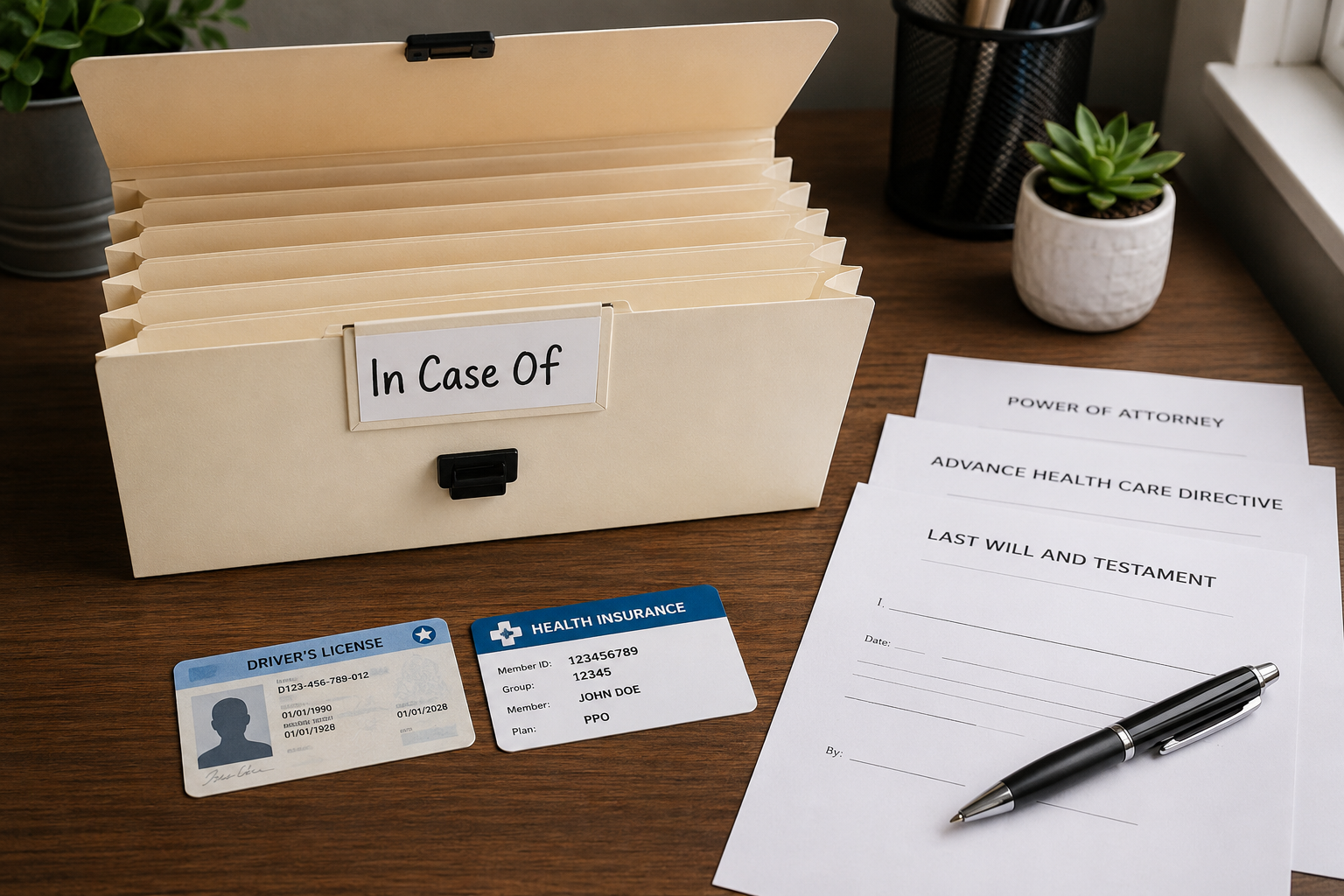
A car accident, a bad diagnosis, a sudden hospitalization: none of these announce themselves in advance. What they do instead is expose, instantly and without warning, exactly how prepared you actually were. Not how prepared you meant to be. Not how prepared you assumed you were because you're a responsible adult with a steady job and a decent credit score. How prepared you actually were, on paper, the moment it mattered.
For most adults, the honest answer is: not very. Not because they don't care about their families, but because "legal preparedness" was never broken down into anything concrete enough to act on. It got filed mentally next to "eventually" and "when things calm down," categories that, for most people, never actually arrive.
The Root Cause
ROOT CAUSE: No system was ever built"Get your legal stuff in order" is not an instruction. It's a vague gesture toward a category of tasks that has never been broken into discrete, completable steps. Compare that to how you'd approach any other system failure: you wouldn't tell someone to "get better with money," you'd tell them to track three categories of spending for a month. Legal preparedness deserves the same treatment, and almost never gets it.
The result is predictable. Adults delay legal preparedness the same way they delay any task with no defined starting point and no visible cost until the moment it's needed. There's no dashboard that shows you're unprotected. No notification. No error message. Just silence, right up until a hospital intake nurse or a probate court asks a question nobody in your family can answer.
This isn't a domain where the fix is "try harder." It's a domain where the fix is a short, finite list of documents, most of which take under an hour each to create, that nobody ever handed you as a list.
The Mechanism: The Five-Document Stack
Legal preparedness for an ordinary adult, not a business owner, not someone with a complex estate, comes down to five documents. Miss any one of them and a specific, predictable failure occurs: a decision gets made by a court instead of by someone you trust, or gets made by nobody at all until it's too late to matter.
- A will. Directs what happens to property that doesn't already have a named beneficiary or joint owner. Without one, state intestacy law decides for you, using a formula that has no idea who you actually wanted to provide for.
- A financial power of attorney. Names someone to manage your money and pay your bills if you're incapacitated. Without one, your family may need to petition a court for conservatorship, a slow and expensive process, just to keep your mortgage current while you recover.
- A healthcare power of attorney (advance directive). Names someone to make medical decisions on your behalf and records your treatment preferences. Without one, doctors and family may be left guessing, or disagreeing, at the worst possible moment.
- A document locator. A single page, not a legal document itself, that tells whoever needs it where the other four documents actually live, along with account access instructions. The best legal paperwork in the world is worthless if nobody can find it.
- Current beneficiary designations. The forms on file with your retirement accounts, life insurance, and bank accounts, which legally control those specific assets regardless of what your will says. Covered in full detail in Article #69.
The Design: Build the Stack One Document at a Time
You do not need to complete all five documents this weekend. You need to know which of the five you're missing, and build them in order of consequence, not in order of comfort.
Step 1 — Diagnose
Score yourself honestly against the five-document stack above. For each one, mark: exists and current, exists but outdated, or doesn't exist. Most adults find at least two documents in the "doesn't exist" column on their first honest pass.
Step 2 — Design
Prioritize by consequence, not difficulty. A healthcare power of attorney and a document locator are usually the fastest to build and protect against the most acute failures, so they go first. A full will, especially with real estate, minor children, or a blended family involved, often needs an attorney and belongs later in the sequence, not skipped entirely.
You don't need every document perfect. You need every category covered by something, today.
Step 3 — Implement
Build the document locator first, tonight, even if nothing else on the list exists yet. It costs nothing, takes fifteen minutes, and immediately reduces the worst-case outcome: a family that can't find anything at all. Then move to the healthcare power of attorney, which many states allow you to complete without an attorney using a standardized state form.
Step 4 — Iterate
Once the stack exists, it isn't finished, it's running. Review it after every major life event and at least once every one to two years, the same review cadence covered in Article #69 for beneficiary designations specifically. A legal preparedness system that isn't reviewed drifts out of date exactly like every other system that runs unattended.
Build Your Document Locator
Open a blank document tonight and list, for each of the five documents above, one of three statuses: exists and current, exists but outdated, or doesn't exist yet.
That list is your legal preparedness diagnosis. You now know exactly which document to build next, instead of a vague sense that you should "get your affairs in order" someday.