Organizing Critical Documents
"I know it's here somewhere" is not a filing system. It's a confession that one was never built.
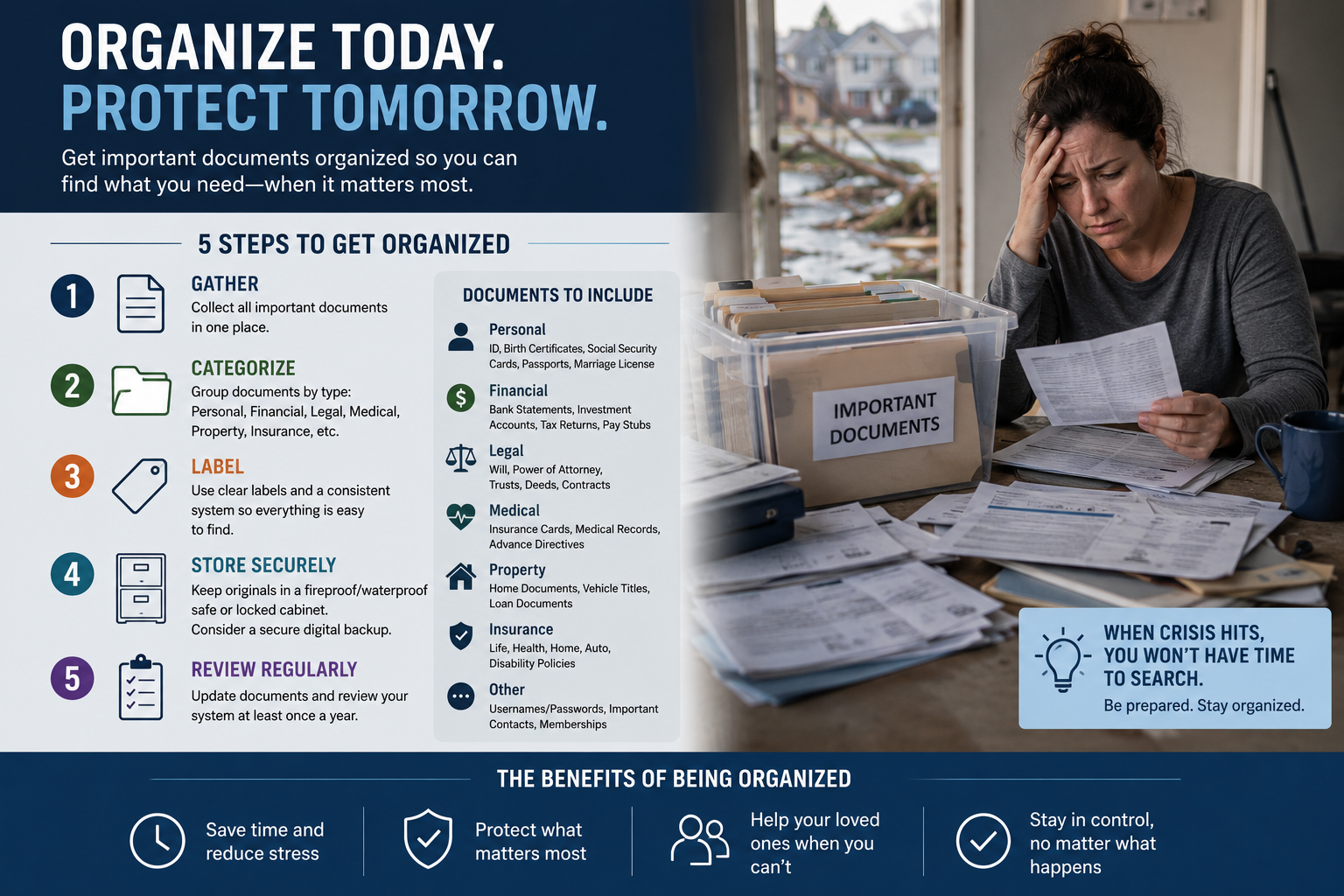
You're on the phone with an insurance adjuster, or standing at a hospital admissions desk, or sitting across from a loan officer, and they ask for a document. A policy number. A deed. Proof of something. You say "let me find that," and what follows is fifteen minutes of searching your email, a drawer, a folder on your laptop named "misc," and a shoebox that may or may not still have the right thing in it.
You eventually find it, usually. But the search itself, under pressure, at the exact moment you had the least bandwidth to search, tells you something important: your documents aren't organized. They're accumulated. There's a difference, and the difference only becomes visible at the worst possible time.
This isn't a tidiness problem. It's a design problem, and it has the same fix every other undesigned system in your life has: stop accumulating, and start organizing on purpose.
The Root Cause: An Inherited, Undesigned System
ROOT CAUSE: The system was inherited, not designedAlmost nobody sits down and deliberately designs how they'll store their passport, insurance policies, deed, and healthcare directive. Instead, a storage method arrives by default: the drawer your parents used, a "just email it to myself" habit, a folder that started organized and slowly became a junk drawer with a folder icon. None of it was chosen. All of it was inherited from whatever happened to be convenient at the time.
This is Root Cause 2: the system was inherited, not designed. An inherited system carries the assumptions of whoever or whatever built it originally, not the specific question that actually matters: if something happened to me tomorrow, could the people who need these documents find them, quickly, without me?
That question is the real test. A system that only works when you personally remember where everything is isn't a document system. It's a memory system with paper attached, and memory is exactly the resource that's least available during an emergency, a hospital visit, or a moment of grief.
What Emergency Preparedness Research Gets Right About Documents
Document organization sits at the intersection of Legal and Emergency Systems, and it's one of the few places where government preparedness agencies have done the work of building a structured, field-tested checklist rather than leaving people to invent their own from scratch.
The Consumer Financial Protection Bureau publishes a parallel, non-disaster-specific resource, aimed less at emergencies and more at everyday friction: loan applications, insurance claims, estate settlement, all of which move faster when documents are already organized rather than located under deadline pressure.
Both sources converge on the same underlying point this series has made about every other domain: the failure isn't a lack of documents. Almost everyone eventually accumulates the paperwork they need. The failure is that the paperwork sits inside a system nobody designed, which means it's only accessible under ideal conditions, and disasters, emergencies, and deadlines are never ideal conditions.
Designing a Document System That Works Under Pressure
A working document system has one job: make sure the right person can find the right document quickly, even if that person isn't you, and even if the moment they need it is stressful. That's the entire design brief.
Diagnose: Find Out What You Actually Have, and Where
Walk through your identification, financial, legal, medical, and property documents and note where each one currently lives: physical drawer, specific email, cloud folder, or "not sure." You're not organizing yet. You're mapping the current, undesigned state, the same way any diagnosis starts.
Design: One Physical Home, One Digital Home
The simplest working structure is two locations, not twenty: a single physical folder or fireproof box for original hard copies, and a single, clearly labeled digital folder or secure app for scanned copies. Everything gets sorted into a small number of categories, identification, financial, legal, medical, property, rather than left to accumulate by whichever app or drawer happened to be closest when it arrived.
Implement: Tell One Other Person Where It Is
A perfectly organized system that only you know about isn't resilient. The system is only complete once at least one trusted person, a spouse, an adult child, a close relative, knows both where the documents live and how to access them if you can't.
Iterate: Review Once a Year, Every Year
Set a recurring, low-effort review, once a year is enough, to add anything new, remove anything expired, and confirm the trusted person's access still works. A document system that isn't reviewed slowly drifts back toward the undesigned state it started in.
Locate Your Single Most Time-Critical Document
Pick the one document you'd need fastest in an emergency, your ID, your health insurance card, or your passport, and find exactly where it currently lives.