Creating a Personal Financial System
A budget is a plan for one month. A system is a structure that works for every month after it, without you rebuilding it from scratch each time.
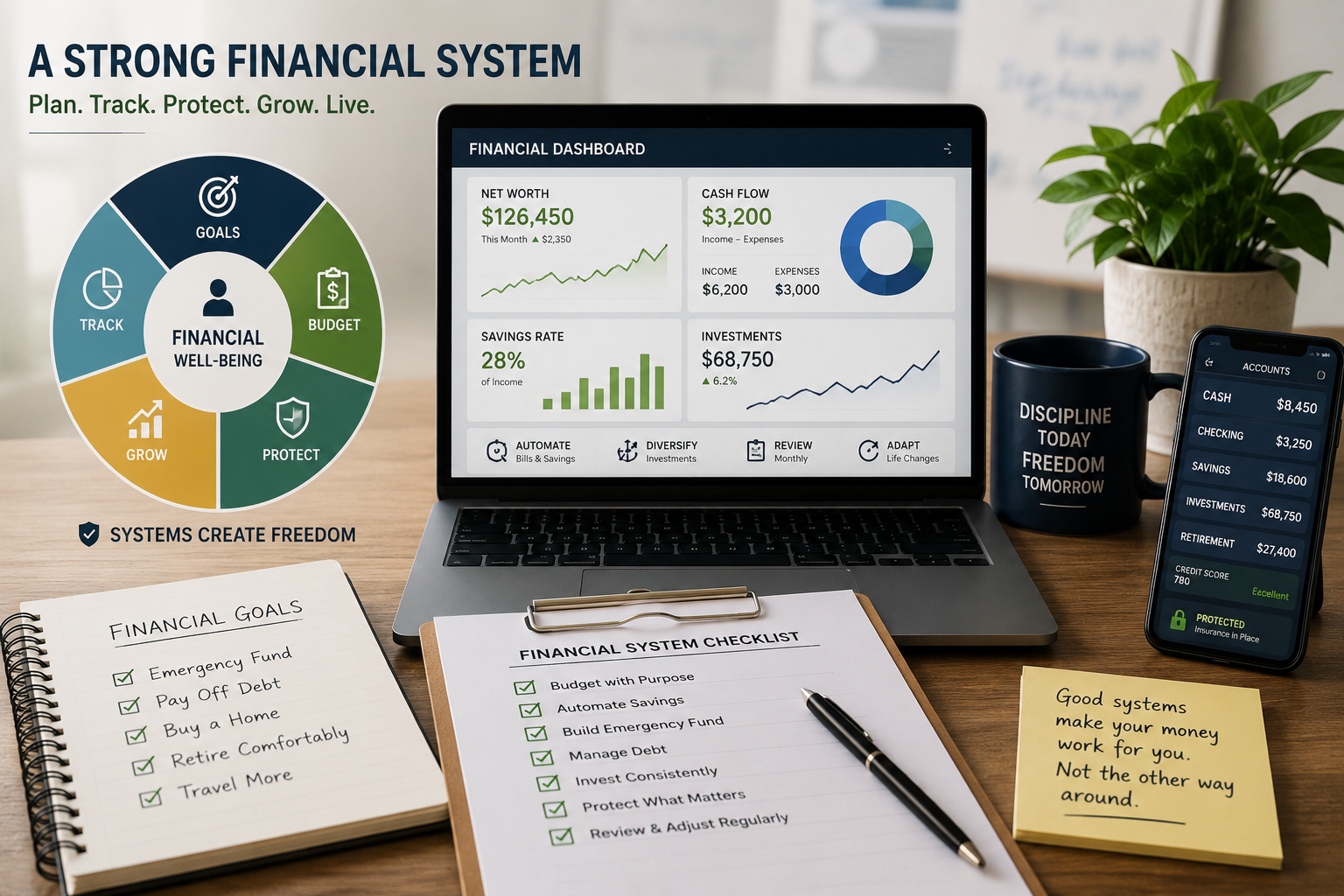
Feedback loop: a fixed monthly review compares actual output against the target and adjusts the allocation for next cycle.
You check your bank account the way some people check a smoke detector: only when something feels wrong. Payday arrives, money moves in and out on its own schedule, and by the third week you are doing math in your head at the grocery store. You have tried budgeting apps. You have tried the envelope method for exactly eleven days. None of it stuck, and you have quietly started to assume that is a personal failing.
It is not. What you have tried were plans, not systems. A plan tells you what to do this month. A system tells you what to do every month, automatically, whether or not you feel motivated on the day it matters. Almost nobody is taught the difference, which is why almost nobody builds one.
This article walks through how to design that system once, so money stops being a monthly emergency and becomes a background process you barely think about.
The Root Cause
ROOT CAUSE: No system was ever builtMost people managing their own money are not undisciplined. They are running no system at all, and reacting from scratch every time a financial decision arrives. A bill shows up, a purchase gets tempting, an unexpected expense lands, and each one is evaluated in isolation, under time pressure, with no standard to fall back on. That is not a discipline problem. It is a design problem, and it produces the same result every time regardless of how motivated the person is that particular week.
In control-systems terms, what is missing is a deadband, what we call the Steady Zone: a defined range where routine spending happens without triggering a full re-evaluation of your entire financial life. Without one, every transaction becomes a decision, and every decision costs attention. That is exhausting by design, not by accident.
There is a second, quieter version of this root cause worth naming separately: some people do have a system of sorts. They track spending in an app, or glance at a balance now and then. But the system has no feedback loop. Nothing is ever reviewed on a set cadence, so drift goes unnoticed until it becomes a crisis. A system without feedback is not really a system. It is a habit that happens to involve numbers.
Why Reactive Money Management Fails Predictably
This is not a motivation gap. It is a measurable, well-documented knowledge and structure gap that affects most adults, not a minority of "bad with money" people.
That fragility is the mechanism, not a coincidence. When there is no designed process for allocating income, every dollar is assigned a job at the moment it is spent rather than in advance. Fixed costs, discretionary spending, and savings all compete for the same undifferentiated pool of money in real time, which means the last category to get evaluated (almost always savings and buffer) is also the one that loses most often.
A designed system fixes this by moving the decision earlier. Instead of asking "can I afford this?" at the register, the system asks that question once, when the paycheck arrives, and then simply executes the answer for the rest of the cycle. That is the entire mechanical difference between a system and a habit: the decision moves from the point of temptation to the point of income.
The Design: Diagnose, Design, Implement, Iterate
Building a personal financial system follows the same four-step process as any other life system. It does not require a finance degree. It requires making three decisions once, writing them down, and reviewing them on a fixed schedule.
Step 1 — Diagnose
Before designing anything, find out what your money is actually doing right now. Pull the last 30 days of transactions and sort every line into one of three buckets: Fixed (rent, insurance, subscriptions), Variable (groceries, gas, discretionary spending), and Buffer (savings, debt paydown beyond the minimum). Most people have never actually seen this breakdown. It is the single most clarifying 20 minutes in personal finance.
Step 2 — Design
Assign each bucket a percentage of income, not a dollar figure. Percentages survive a raise, a job change, or a bad month without needing to be rebuilt. A common, defensible starting split is roughly 50% Fixed, 30% Variable, 20% Buffer, adjusted to your actual fixed-cost reality from Step 1. The specific numbers matter less than the fact that they now exist and are written down somewhere you will actually see them again.
Step 3 — Implement
Automate what you can: a standing transfer into a separate Buffer account on payday, before anything else happens. What cannot be automated (checking Variable spending against the allocation) gets a single recurring calendar event, not a daily habit you are relying on willpower to maintain. Do not redesign the system in the middle of its first cycle. Run it as built, flaws included, for one full pay period first.
Step 4 — Iterate
At the end of each cycle, compare actual output to the target: did Buffer actually grow by the intended amount? If not, the gap tells you exactly which root cause to revisit, not a vague sense that you failed.
A system that is never reviewed is not a system. It is a guess that happens to have a spreadsheet.
Run Your First Diagnosis
Open a blank spreadsheet or document. Pull your last 30 days of transactions and sort every single one into three columns: Fixed, Variable, and Buffer.
2. Total each column.
3. Write the three totals as percentages of your income for that period.
That spreadsheet is your first real diagnosis. You now know, in numbers, what your money system is actually doing, which is the only starting point a real design can be built from.