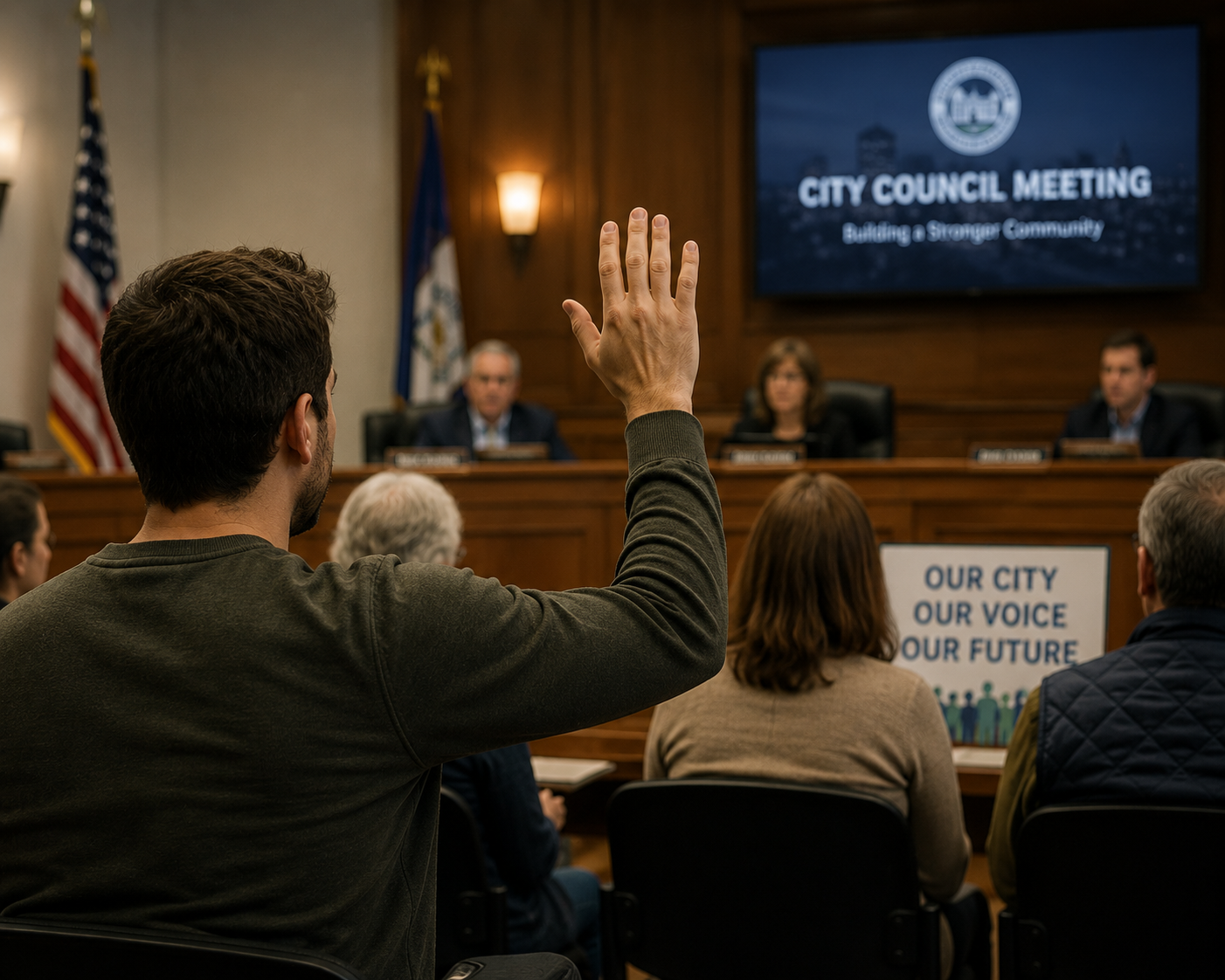
You care what happens to your community. You just don't have a system for
actually showing up in it — and neither does almost anyone else.
9 min readDeadband Life2026
Most civic disengagement isn't apathy. It's the absence of a system for finding out what's happening.
InputCivic Information & DecisionsLocal elections, city council votes, school board agendas, ballot measures
→
ProcessFollow → Understand → ParticipateOne reliable local source. A recurring check-in. One low-effort action per cycle.
→
OutputRepresented InterestsDecisions that affect you get made with your input in the room, not just around you.
Feedback loop: a quarterly civic check-in — the recurring moment that
catches the ballot measure, the zoning change, or the school board vote
you'd otherwise learn about only after it's decided.
The Civic System Loop. Most people already care about their community.
The missing piece is a repeatable way of finding out what's happening in it.
You find out about the new development going up two blocks from your
house from a neighbor's yard sign, three weeks after the public
comment period already closed. You didn't know there was a comment
period. You didn't know there was a meeting. You just know that
something is being built, it's going to change your street, and
apparently everyone else already had their say.
You vote in the big elections, the ones that show up in every
conversation and every headline. But you couldn't name who's on your
local school board, what your city council voted on last month, or
when the next town hall is happening. Not because you don't care.
Because nothing in your week ever surfaces that information, and you
have no process for going and finding it yourself.
This isn't apathy. Apathy would be not caring what happens to your
street, your schools, your taxes. What you actually have is a design
gap: no system for discovering the decisions being made around you
until after they're already made.
That's fixable, the same way every other undesigned system in your
life is fixable — not with more guilt about not caring enough, but
with one small recurring process.
The Root Cause
ROOT CAUSE: No system was ever built
Civic life doesn't announce itself the way national politics does.
There's no cable news cycle for a zoning variance or a school
budget vote. If you don't go looking for local civic information on
a recurring basis, it simply never reaches you — and most people
have never built a habit of going looking, because nobody ever
taught them one.
The gap isn't values. Most people want their community to function
well and want a say in decisions that affect them. The gap is
entirely mechanical: no standing source for local information, no
recurring check-in, no default action to take when something
relevant comes up. Civic participation, like every other undesigned
system, defaults to zero.
Below is how each of the five DB root causes shows up specifically
in the civic domain — and the corrective direction for each.
Root Cause TypeNo system was ever built
Observable Signal
You have no standing source for local civic information. You
find out about decisions that affect you secondhand, after the
window to weigh in has closed.
Corrective Action DirectionFix: Build the input.
Subscribe to one reliable local source — a city newsletter, a
school district email list, or a local paper's civic beat.
Root Cause TypeInherited system
Observable Signal
Your entire model of "civic participation" is voting in
presidential elections, because that's the version of civic
life you inherited from the news cycle you grew up watching —
not the local decisions actually shaping your daily life.
Corrective Action DirectionFix: Widen the definition.
Treat local elections, school boards, and city council with
the same standing as national races.
Root Cause TypeNo feedback loop
Observable Signal
You've never checked whether the local issues you cared about
a year ago actually moved. There's no recurring review of
what happened, what changed, or what still needs attention.
Corrective Action DirectionFix: Instrument it.
A quarterly 20-minute check-in: what's on the local agenda,
what changed since last time.
Root Cause TypeWrong output
Observable Signal
You optimize for feeling informed nationally rather than being
effective locally. Doomscrolling national news feels like
engagement, but it produces zero local influence and no actual
representation of your interests.
Corrective Action DirectionFix: Redefine the output.
The goal is influence where your voice actually carries
weight, not volume of information consumed.
Root Cause TypeNo resilience
Observable Signal
You have no existing relationship with any local institution —
no council member's office, no neighborhood association, no
local reporter. When a decision does affect you directly,
you're starting from zero with no channel to respond through.
Corrective Action DirectionFix: Build the buffer.
One standing local connection — a meeting attended, an email
sent — before you actually need it.
The Mechanism: A Knowledge Gap and a Trust Gap, Compounding
Civic disengagement isn't one problem. It's two gaps reinforcing
each other: people don't know the basic mechanics of how their
government works, and their trust in the institutions they do know
about keeps eroding. Each one makes the other worse.
70%
of U.S. adults can name all three branches of government — up
from 65% the year before, but still leaves nearly a third who
cannot.
Annenberg Constitution Day Civics Survey, 2025
41%
of U.S. adults have at least a moderate amount of trust that the
Supreme Court is operating in their best interests.
Annenberg Constitution Day Civics Survey, 2025
28.3%
of Americans formally volunteered through an organization in
the past year.
AmeriCorps & U.S. Census Bureau, Volunteering and Civic Life in America, 2023
25%
of Americans belong to a civic organization — a nonprofit,
club, or neighborhood association.
AmeriCorps & U.S. Census Bureau, Volunteering and Civic Life in America, 2023
Notice the shape of the gap: most Americans have at least a basic
grasp of how government works, but only about a quarter belong to
any civic organization at all, and formal volunteering, while
rebounding, still trails pre-pandemic levels. Knowing the mechanics
in the abstract hasn't translated into standing participation in
the specific. That's a systems gap, not a knowledge gap.
The Design: Building a Civic Participation System
You don't need to become a policy expert or attend every meeting.
You need one lightweight system that keeps local civic information
reaching you automatically, instead of depending on you remembering
to go looking for it.
Step 1 — Diagnose
Ask yourself three questions: Do you know who represents you on
your city council or county board? Do you know when your local
school board meets? Do you have any standing source of local civic
information at all? Most people answer no to at least two of these
— not from indifference, but from never having built the input.
Step 2 — Design
Build one system, not a new personality. One reliable local
information source. One recurring calendar check-in. One default
low-effort action — an email, a public comment, a single meeting —
you take when something relevant surfaces.
WHY 1Why didn't I know about the school board vote that raised my property taxes?I found out about it after the vote already happened.
WHY 2Why did I find out after the fact?Nothing in my week ever surfaces local school board information.
WHY 3Why doesn't anything surface it?I've never subscribed to any local information source.
WHY 4Why haven't I subscribed to one?I didn't know where to look, and it never became a standing habit.
ROOT CAUSEWhy did it never become a habit?No system was ever built for receiving local civic information.
Step 3 — Implement
Start with the single highest-leverage action: finding and
subscribing to one local information source. For domains like
this one, where peer-reviewed behavioral research is still thin,
a credentialed practitioner or scholarly reference is a strong
starting point for understanding the bigger picture.
📖
Recommended ReadingBowling Alone: The Collapse and Revival of American CommunityRobert D. Putnam — Political Scientist, Harvard University
The foundational account of how civic participation eroded over
decades of American life, and the mechanisms — not just the
motivations — that rebuild it.
Step 4 — Iterate
Once a quarter, review what actually came up in your local
information source, note anything you meant to act on and didn't,
and take one small action — an email, a public comment, a single
meeting attended. This is the review step that closes the gap the
research above describes: not becoming a civic expert, but building
the one recurring check nobody ever taught you to build.
Your Next 24 Hours
Find Your One Local Source
Search for your city or county government's official newsletter,
your local school district's email list, or your local newspaper's
civic or city-hall beat. Subscribe to exactly one of them.
1. Search "[your city] city council newsletter" or "[your school
district] board meeting schedule."
2. Subscribe to the single most relevant option you find.
3. Set a recurring calendar reminder, three months from today,
titled "Civic Check-In."
That subscription is your first system. You have just turned
"someday I'll pay more attention" into a standing input that will
reach you whether or not you remember to go looking for it.