Health Maintenance vs Health Recovery
Your health system isn't broken because you don't act. It's broken because it's optimized to make symptoms go away — not to keep your body capable for the next thirty years.
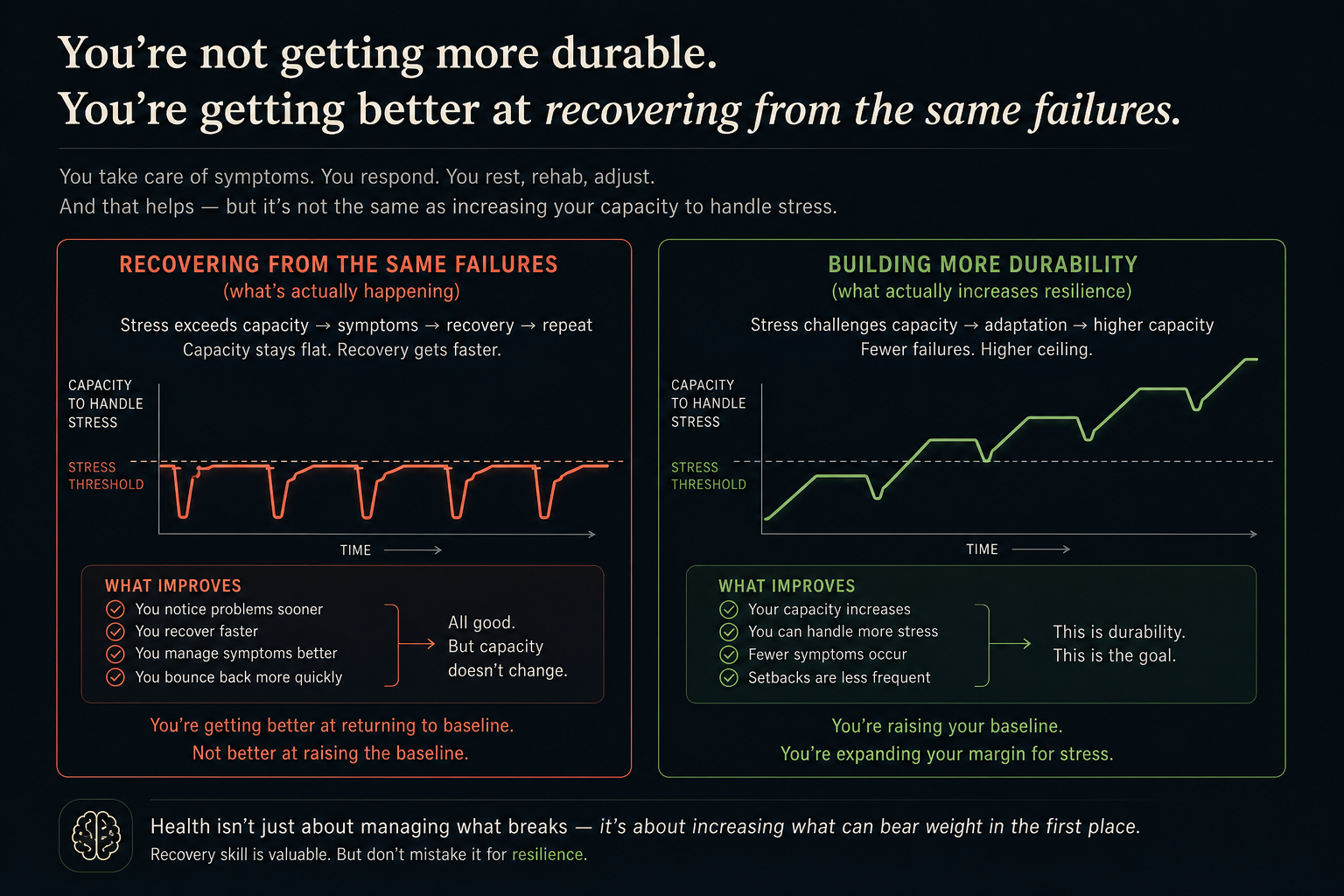
Your back went out again last month. You did the stretches, took the ibuprofen, and within a week you felt fine — so you stopped. Same story with the knee before that, and the sleep crash before that. Every time, the plan works exactly as intended: address the thing, feel better, move on. And every time, it comes back, usually a little worse than the time before.
By most reasonable definitions, you are "managing your health." You respond. You take symptoms seriously. You don't ignore pain. And yet somehow you're not actually getting more durable over time — you're getting better at recovering from the same recurring failures, which is a different thing entirely.
That's because your system was never designed to ask the question that matters: not "how do I make this symptom go away," but "what would keep this from recurring at all." Those are different targets, and a system built for the first one will never accidentally hit the second.
The Root Cause
ROOT CAUSE: The system is optimized for the wrong outputRecovery and maintenance look similar from the inside — both involve taking your health seriously, both produce the feeling of "handling it." But they are engineered around two entirely different outputs. A recovery-oriented system is optimized to eliminate the symptom in front of you as fast as possible. A maintenance-oriented system is optimized to preserve function over years, which sometimes means acting when nothing hurts yet at all.
Most people's health systems, without ever deciding to, get tuned entirely toward the first output. It's the more urgent one, it's the one that produces immediate relief, and it's the one that doesn't require action until there's already a problem demanding it. Maintenance, by contrast, has to be chosen deliberately — nothing forces it the way pain forces recovery.
The result is a system that gets very good at treating flare-ups and never gets around to addressing why the same flare-up keeps coming back. It's optimizing correctly for the output it was accidentally given. The fix isn't more effort. It's redefining what the system is actually supposed to produce.
The Mechanism: Living Longer Isn't the Same as Staying Functional
This distinction has a name in population health research: lifespan versus healthspan — the total years a person lives, versus the years they live in good functional health, free of significant disability or chronic disease burden. The gap between the two turns out to be large, and growing.
None of this means recovery care is wrong — treating what hurts is necessary and often urgent. The problem is a system with no other mode. If every health decision is triggered by a symptom, the system will, by construction, never produce the long-horizon output — sustained mobility, energy, and function — that actually matters most over a lifetime.
The Design: Defining the Output You Actually Want
Realigning a health system around maintenance doesn't mean abandoning recovery. It means adding a second track that runs regardless of whether anything currently hurts.
1. Name the real output
Instead of "feel okay," define what functional health actually means for you: being able to carry groceries up three flights without pain, sleeping through the night, sitting through a full workday without a mid-afternoon crash. That's a measurable target. "Feeling fine right now" isn't.
2. Track one leading indicator
Pick a single number that predicts future function rather than just reporting current symptoms — resting heart rate, grip strength, or a simple mobility test, checked quarterly. Leading indicators catch the slow decline that symptom-based systems only notice once it's already a problem.
3. Schedule the maintenance action, don't wait for the trigger
The mobility work, the strength training, the stretching routine — whatever addresses the actual mechanism behind your recurring issue — has to be scheduled on the calendar, not queued behind the next flare-up. A maintenance action that only happens after pain shows up isn't maintenance. It's recovery with a different name.
A system that only responds to pain will always be one step behind the problem it's trying to solve.
You don't need to choose between recovery and maintenance. You need to stop letting recovery be the only mode your health system knows how to run.
Name Your Real Output
Open a blank document and write down the recurring health issue that keeps coming back. Then answer: what function is it actually costing you, and what would "durably fixed" look like — not "pain gone this week," but sustained.
2. Name the function it costs you (e.g., "can't sit through a full workday without discomfort").
3. Write one maintenance action that addresses the mechanism, and put it on the calendar — not as a reaction to the next flare-up, but starting this week regardless.
That scheduled action is your first maintenance-mode intervention — the first time this system has run on a calendar instead of on pain.