Health Systems: Maintaining Physical Capacity
Your body isn't failing because you lack willpower — it's failing because you never built a system to maintain it.
Input
Sleep quality & duration · Nutritional intake · Physical activity · Scheduled preventive care · Stress management behaviors
Process
Consistent daily habits · Scheduled preventive appointments · Symptom tracking & early intervention · Habit review cadence (weekly/monthly)
Output
Maintained physical capacity · Disease prevention · Energy for work & life · Reduced acute care costs · Long-term health resilience
You feel tired in a way that sleep doesn't fix. You know you should exercise more. You have the gym membership, the app on your phone, possibly the shoes still in the box. Every few months something happens; a photo, a number on the scale, a comment from a doctor, and you recommit. Hard. For a while, things improve. Then life happens, the streak breaks, and you're back where you started.
This is not a willpower problem. You have plenty of willpower, you use it every single day to manage a job, relationships, finances, and a hundred other demands. What you do not have is a health system. You have intentions. You have moments of effort. But you do not have a designed, running system that produces consistent health outputs regardless of whether you feel motivated on any given Tuesday.
The difference between those two things, intention versus system, explains nearly everything about why physical health is the domain where intelligent, capable adults experience the largest gap between what they want and what they actually produce.
The Root Cause
ROOT CAUSE: No System Was Ever BuiltMost adults were never taught to manage their physical health as a designed system. We were taught to respond to symptoms. See a doctor when something hurts. Rest when sick. The concept of scheduled preventive maintenance (the same logic that keeps a car running for 200,000 miles) was never applied to the most complex machine any of us will ever operate.
The result is entirely predictable: a health management approach that is reactive by default, inconsistent by design, and expensive over time. The failure is not in you. The failure is in the system, or rather, the absence of one.
"The person who 'can't stick to a routine' doesn't have a discipline problem. They have a system design problem. The routine is probably too rigid, too punishing, and completely disconnected from any feedback loop."
Health Systems failures follow one of five patterns. Understanding which pattern applies to your situation is the first step to fixing the right thing.
| Root Cause Type | Observable Signal in Your Health | Corrective Action Direction |
|---|---|---|
| No System Built | Health habits appear only when motivation is high. Exercise happens in bursts followed by weeks of nothing. Preventive appointments are skipped until symptoms force action. No regular check-in exists. | Design a minimum viable health system: define the three non-negotiable inputs (sleep target, movement frequency, one scheduled preventive appointment per quarter) and put them in the calendar before motivation varies. |
| Inherited System | You manage your health the way your parents managed theirs: reactive, crisis-driven, avoidant of the doctor until unavoidable. The model was never examined, it was simply absorbed. | Audit what system you're actually running. List the health behaviors you currently perform with any consistency. Identify which were chosen and which were inherited. Redesign around your actual output goals, not legacy defaults. |
| No Feedback Loop | You exercise but have no idea if it's working. You feel "okay" but have not had a physical in two years. You have no metrics like resting heart rate, blood pressure, sleep efficiency that would tell you whether your system is producing the output you want. | Instrument the system. Schedule one annual comprehensive physical to establish a baseline. Add one trackable metric (sleep, steps, or resting heart rate) and review it weekly. You cannot improve what you cannot measure. |
| Wrong Output | You optimize for appearance rather than function. Your health metric is the scale, not energy levels, lab values, or cardiorespiratory fitness. The system is running, but it is producing the wrong output, aesthetic rather than physiological. | Redefine the output you're actually optimizing for. Physical capacity (energy, resilience, disease prevention) requires different inputs than appearance. Align your system's goal with the output that actually compounds over decades. |
| No Resilience Layer | Your health system works when life is calm. One stressful week, one travel disruption, one injury breaks the entire habit stack and months of progress reset to zero. There is no minimum viable protocol that survives disruption. | Build a resilience floor: a 15-minute version of your health system that you can execute on your worst days. The floor prevents full system collapse. Full recovery happens after the disruption passes and not during it. |
How the System Actually Works
Physical health operates on a fundamentally different timeline than most other life systems. The consequences of a broken health system may not be immediate. A week of poor sleep does not produce a cardiac event. A month without exercise does not end in hospitalization. This delayed feedback loop is not a feature, it is the mechanism by which small, manageable system failures accumulate silently into expensive, difficult-to-reverse crises.
Preventive health research makes this mechanism precise. A 25-year systematic review of the peer-reviewed literature identified the root-cause factors that most reliably predict whether adults adopt preventive health behavior, and none of them are motivational. The strongest predictors are structural: whether a person perceives clear benefit from specific behaviors, whether those behaviors are designed into their environment, and whether a feedback mechanism exists to confirm the system is working.
The HPBS framework is useful not just as a research instrument but as a diagnostic lens. When someone says "I can't get healthy," the HPBS tells us to ask a more specific question: which of the five behavioral dimensions is the actual failure point? A person whose nutrition behavior is strong but whose health care utilization is zero has a different system problem than someone whose interpersonal support is absent. The fix must match the failure.
Validated Instrument: Health Protective Behavior Scale (HPBS)
Ping, W. et al. (2018) · PLoS ONE · 32 items · α = 0.89 · 5 dimensionsInterpersonal Support
Whether your close relationships reinforce or undermine your health behaviors. Isolation and unsupportive environments are measurable system inputs that directly reduce protective behavior adoption.
General Health Behavior
The baseline habits that sustain physical function: consistent sleep, regular movement, and avoidance of behaviors with known harm profiles. The foundation layer of any health system.
Self-Knowledge
Your working understanding of your own body: how it responds to stress, what symptoms are meaningful, and what your personal baselines are. Without self-knowledge, the feedback loop has no reference point.
Nutrition Behavior
The consistency between your nutritional inputs and your health output goals. Most adults have nutrition intentions. The HPBS measures whether those intentions are running as a system or operating as an occasional effort.
Health Care Utilization
Proactive engagement with the healthcare system: scheduled preventive appointments, screenings, and follow-ups. The dimension most often missing in reactive-default health management. Zero utilization means zero external feedback.
The Morini et al. finding has a direct implication for how we approach health system design. The goal is not to motivate people to care about their health. People already care. The goal is to increase health literacy or in other words the ability to understand what system is currently running, what it's producing, and what a better-designed system would look like. Once that understanding exists, behavior change becomes an engineering problem, not a willpower problem.
Preventive Maintenance for Your Body
Every complex system that requires long-term reliable performance is maintained preventively. Your car has a scheduled oil change. Your HVAC system has a seasonal tune-up. Commercial aircraft undergo inspection after a defined number of flight hours and not after something goes wrong. The logic is not optional; it is engineered into the operational protocol because the cost of failure is high and the cost of prevention is comparatively small.
Your body is the most complex system you will ever operate. It will run for decades. It has no replacement. The cost of failure is chronic disease, reduced capacity, lost years — is extraordinarily high. And the cost of preventive maintenance, a scheduled physical, a consistent movement protocol, a defined sleep target, is comparatively trivial.
The mechanism that allows an aging aircraft to remain airworthy is the same mechanism that allows a 65-year-old to be functionally stronger, more energetic, and more cognitively sharp than they were at 45. That mechanism is not genetics. It is the consistent application of preventive maintenance logic over decades.
Designing Your Health System
A functional health system does not require an extraordinary time commitment, expensive equipment, or professional athleticism. It requires four things: a defined output goal, a minimum viable set of inputs, a scheduled maintenance cadence, and a feedback mechanism that tells you whether the system is working.
Step 1 · Diagnose — Define Your Current State
Before designing anything, document what system is actually running. Open a blank document and answer these questions honestly:
- What health behaviors do I currently perform with any consistency?
- What is my most recent set of lab values? When was my last physical?
- What does my sleep pattern actually look like? Not what I intend, but what it is?
- How often do I engage in intentional physical activity in a typical month?
- What health goal am I actually optimizing for right now?
Most people discover that the honest answer to the last question is "I'm not optimizing for anything specific." That is the starting point. It's not a failure, a fact. And facts are the beginning of design.
Step 2 · Design — Define Your Output and Minimum Viable System
A health system has one primary output: sustained physical capacity. The ability to perform the physical demands of your life such as work, family, recreation, without being limited by your body. This is not a fitness goal. It is an engineering specification for a system that must run reliably for decades.
The minimum viable health system has three non-negotiable components:
- A movement protocol — a defined minimum frequency of intentional physical activity that you can execute even on your worst week. Three sessions of 30 minutes is not a performance standard; it is the floor below which the system degrades. Start with the floor. The ceiling builds itself.
- A sleep target — a defined bedtime anchor (not just a goal) that creates the minimum physiological recovery your system needs to perform. The target is not aspirational. It is an input specification. Without adequate sleep, no other health input operates at designed efficiency.
- A scheduled preventive care cadence — annual physical, relevant screenings by age, and dental maintenance on a defined calendar. These are not reactive events; they are scheduled maintenance intervals. Block them in January for the full year.
Step 3 · Implement — The First 24 Hours
The best-designed health system that is never implemented is worth exactly nothing. The implementation starts not with a new gym routine or a dietary overhaul, but with a single action: scheduling the annual physical.
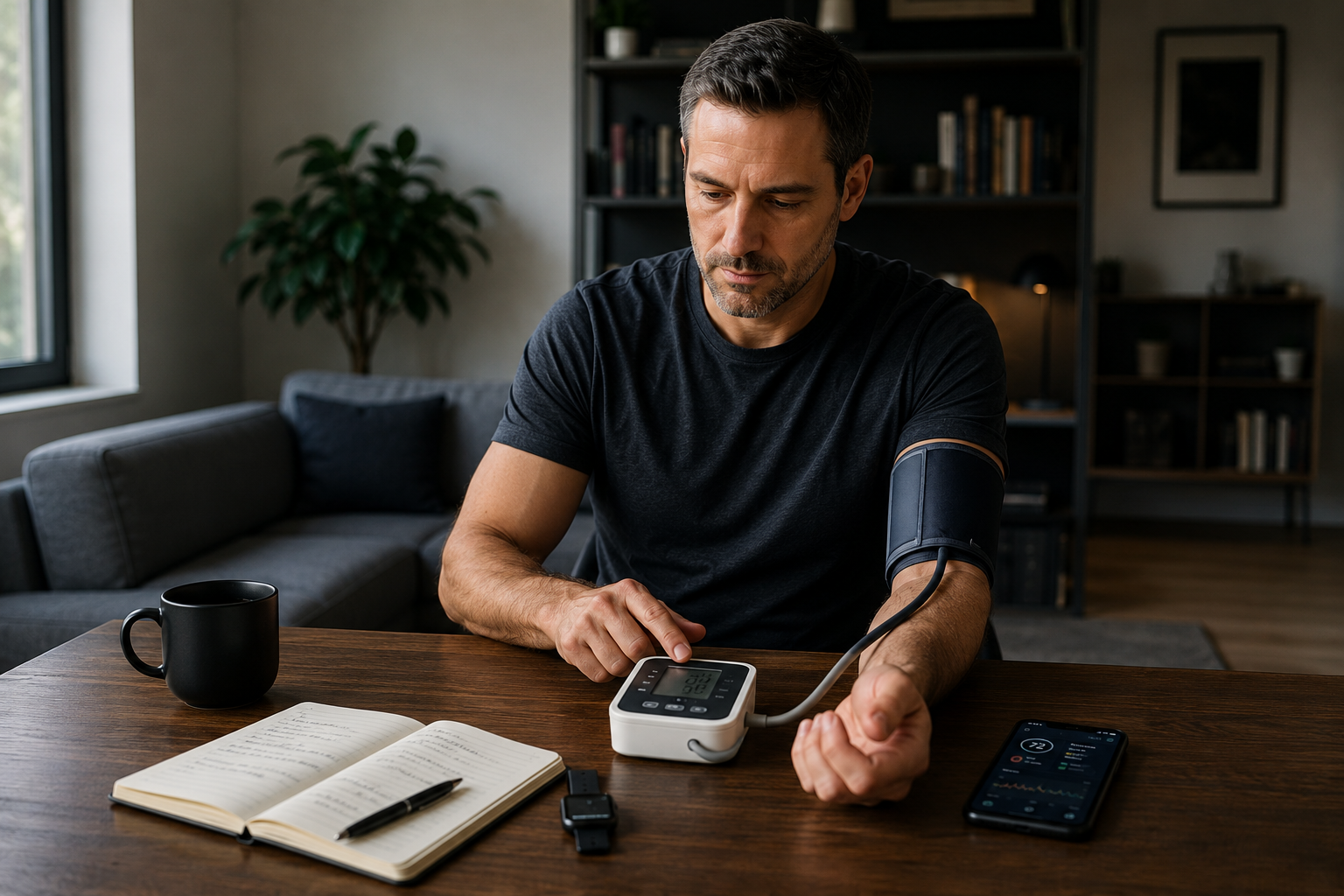
That appointment is the feedback mechanism for the entire system. It produces a baseline for lab values, blood pressure, weight, relevant screenings, etc. that makes every subsequent health decision measurable. Without a baseline, you are running a system with no instruments. The annual physical is the instrumentation layer of your health system.
Step 4 · Iterate — Build the Feedback Loop
A health system without measurement is an inherited system running on hope. The iterate step requires selecting one trackable metric and reviewing it on a weekly cadence. The specific metric matters less than the consistency of review. Resting heart rate, sleep efficiency, weekly movement sessions, or a simple energy self-rating on a 1–5 scale, any of these create the signal that tells you whether your system is trending in the right direction.
The 90-day review is the deeper iteration point. At 90 days of consistent input, a health system begins to produce measurable physiological output. Lab values improve. Resting heart rate decreases. Energy patterns stabilize. This is not a milestone to celebrate and abandon. Honestly it is the moment to examine what the data shows, identify what is working, and adjust what is not.
Your Next 24 Hours
Open your calendar right now. Schedule one appointment: your annual physical with your primary care provider. If you do not have a primary care provider, your action is to identify one and initiate the new patient intake process.
STEP 1 OF 1 — DO THIS NOW:Open your calendar. Block 30 minutes this week to call your doctor's office (or use their online scheduling portal). If you have not had a comprehensive physical in the past 12 months, schedule it within the next 30 days. That appointment is not optional maintenance, it is the instrumentation layer of your entire health system. Nothing else you build on top of it will function correctly without a current baseline.
After scheduling, write down three numbers you expect to have measured at that appointment: blood pressure, resting heart rate, and one lab value relevant to your age and history. These three numbers will become the feedback loop of your health system.