Sleep as a Performance System
You are not "bad at sleeping." You are running your recovery system with no design, no feedback loop, and no defined output — and it shows up in every other system you run.
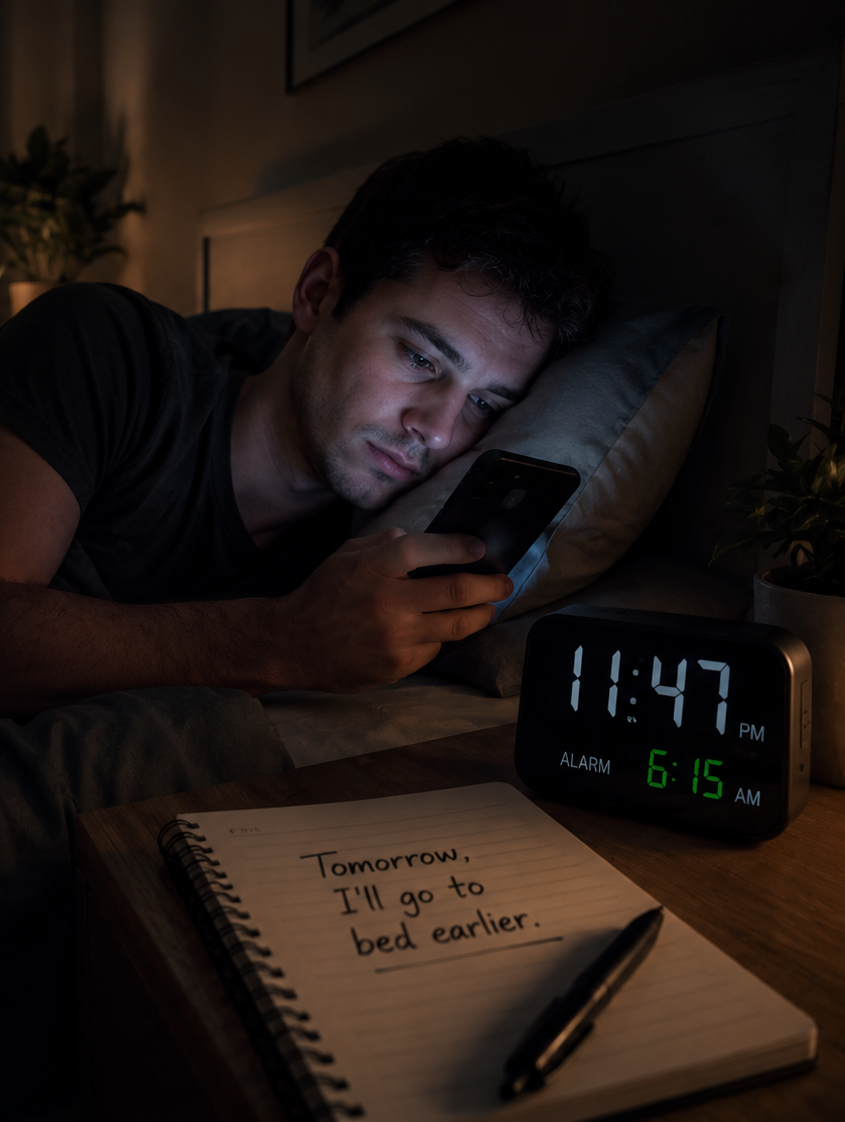
You know the math. Seven to nine hours, everyone says it, you've heard it a hundred times. And yet it's 11:47 p.m. again, you're scrolling something you won't remember tomorrow, and the alarm is still set for 6:15. You tell yourself you'll go to bed earlier tomorrow. You said that yesterday too.
In the morning you're foggy, you reach for a second coffee before 9 a.m., and by 3 p.m. you're negotiating with yourself about whether today's workout still counts if you skip it. None of this feels like a sleep problem in the moment. It feels like a focus problem, a motivation problem, a "why can't I just get it together" problem.
It isn't. Sleep is the input layer for almost every other system you run — your mood, your appetite, your decision-making, your patience with the people you love. When the input layer is undesigned, every downstream system inherits the noise. This is the same failure mode you'd find in a badly run supply chain: nothing downstream works well when the first station is unreliable.
The Root Cause
ROOT CAUSE: No system was ever builtAlmost nobody is taught to design sleep. We're taught the target (seven to nine hours) without ever being taught the process that reliably produces it. So most adults run sleep the same way they run a task they've never been trained for: reactively, from scratch, under pressure, every single night. Whatever time the day's other systems finish spilling over into the evening is the time sleep is allowed to start.
That's not a discipline gap. It's an architecture gap. A body that receives no consistent cue about when to wind down has no way to reliably produce consistent, restorative sleep on command — and no amount of "just try harder to fall asleep earlier" fixes a system that was never given a repeatable process to run.
In control-systems terms, most people's evenings have no "deadband" — what we call the Steady Zone — around bedtime: no intentional, protected window where the system is allowed to hold steady instead of reacting to whatever the day throws at it right up until the moment the lights go off.
The Mechanism: Why an Undesigned Sleep System Fails
Sleep is not a single event that either happens or doesn't. It's a system with an input (your evening behavior and environment), a process (the transition your body makes from alert to sleep-ready), and an output (restorative sleep of sufficient duration and consistency). Like any system, it degrades predictably when any of those three stages is left undesigned.
The consequences of running this system undesigned are not cosmetic. A large-scale meta-analysis pooling data across multiple populations found that short sleep duration is independently associated with meaningfully higher risk across several major chronic health outcomes, not just next-day grogginess.
Here's the part most people miss: the fix implied by that research is never "want it more." It's "build the input conditions that make the output reliable." A system doesn't need motivation. It needs a consistent process it can run on autopilot, even on the nights you're tired, stressed, or running behind.
The Design: Building a Sleep System That Runs Without You Managing It
A designed sleep system has three parts, and none of them are "try harder." They're structural.
1. A fixed wind-down trigger
Pick one consistent action that happens at the same time every night and always precedes sleep — phone on the charger outside the bedroom, lights dimmed, same short routine. The trigger is the input signal that tells your system the process has started. Without a trigger, your body has no way to know the workday has actually ended.
2. A protected window
Build a genuine Steady Zone: thirty to sixty minutes where no new inputs (work messages, emotionally loaded conversations, doomscroll feeds) are allowed to enter the system. This is the buffer that absorbs the day's leftover noise before it reaches your nervous system at 11 p.m.
3. A single feedback measurement
Track one number: what time you actually turned the lights off. Not hours slept, not sleep-tracker "scores" — just lights-off time, logged each morning for two weeks. That single data point is enough feedback to tell you whether the system you built is actually running, or whether it's quietly reverting to the old, undesigned default.
You don't fix sleep by trying harder to fall asleep. You fix it by designing the thirty minutes before you try.
This is the same Diagnose → Design → Implement → Iterate arc that applies to every other life system. You've just diagnosed the gap and designed the fix. What's left is running it — starting tonight.
Set Your Wind-Down Trigger
Tonight, pick one action that will always mean "the sleep system has started" — phone charging outside the bedroom is the simplest option. Set an alarm for thirty minutes before your target lights-off time, labeled with that single trigger action.
2. Set a recurring alarm 30 minutes before your target lights-off time.
3. Tomorrow morning, write down the actual time your lights went off.
That's the first data point in your feedback loop. You don't need the whole system perfected tonight — you need the trigger running once, so the next fourteen nights have something to measure against.