Corrective Action vs. Quick Fix: Why You Keep Solving the Same Problem
You've "fixed" this before. Several times. If the problem keeps coming back, you were never fixing the problem — you were fixing the symptom.
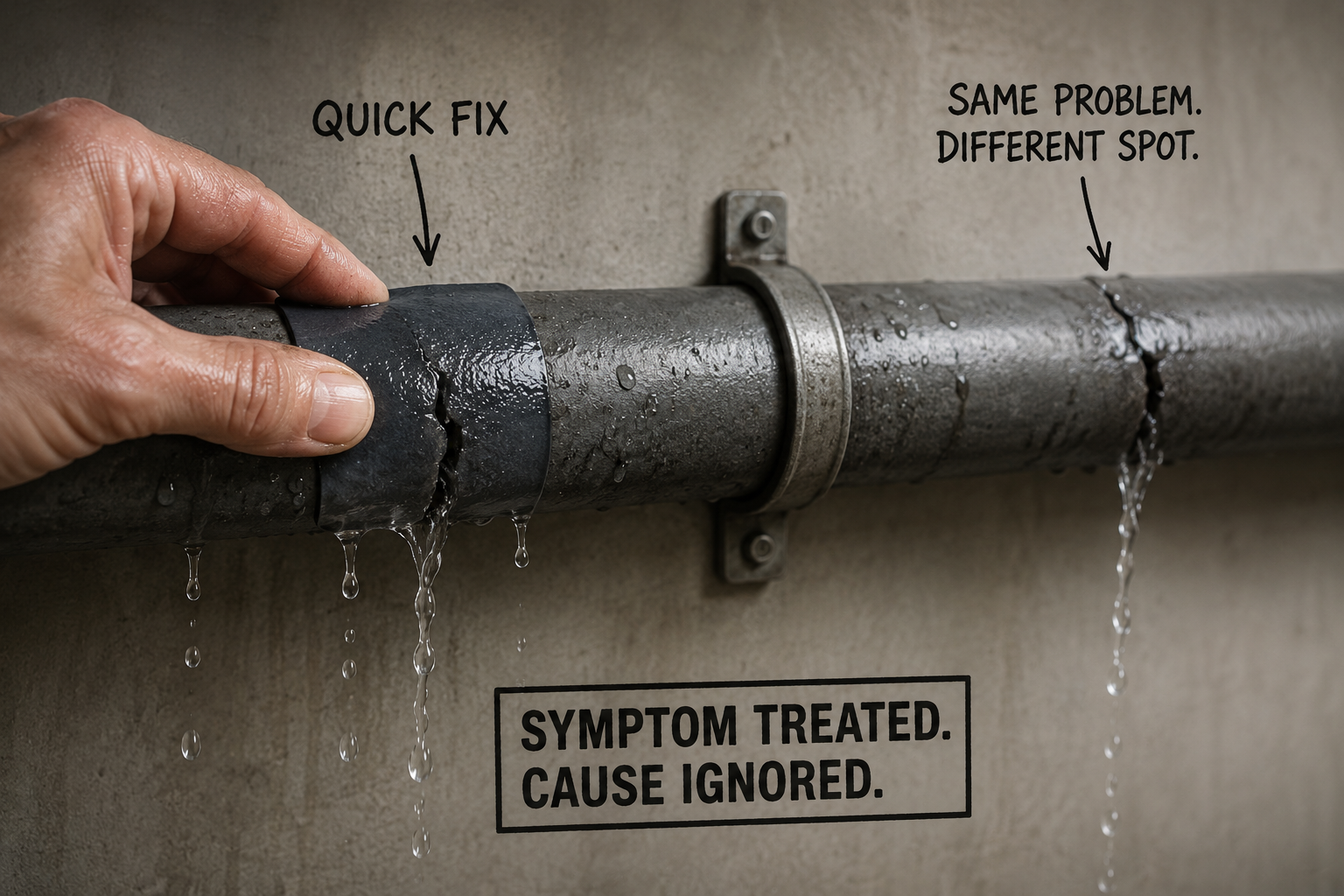
You've had this fight with your partner four times this year. Same subject, different Tuesday. Each time, you apologize, things calm down, and you both quietly agree not to bring it up again. You've also paid the same $340 overdraft fee three times since January, and each time you told yourself you'd "be more careful." You missed the gym again this week, the fourth missed week in a row, and your plan for fixing it was to feel bad about it and try harder next week.
Notice what all three have in common. You did not ignore these problems. You actively addressed every single one. You apologized. You promised to be careful. You felt bad and resolved to try harder. And yet here you are again, having the same fight, paying the same fee, missing the same workout.
That is not a willpower problem. It is a category error. You have been applying corrections to problems that require corrective actions, and those are not the same intervention wearing different clothes. They are fundamentally different tools, aimed at fundamentally different layers of the problem, and only one of them stops the problem from coming back.
Here is how to tell which one you actually need, every time.
The Root Cause
ROOT CAUSE: The system has no feedback loopIn quality engineering, this distinction has a name and a standard. A correction (sometimes called a quick fix or a containment action) eliminates a detected nonconformity in the moment. It addresses the symptom you can see right now. A corrective action eliminates the cause of that nonconformity, so the same failure cannot recur under the same conditions. The international standard governing this distinction, ISO 9000, defines them as two distinct, non-interchangeable categories of response for exactly this reason: treating a symptom and treating a cause are different jobs, and confusing them is one of the most common ways quality systems fail.
Most people never learned this distinction, so they default to corrections for everything. A correction feels like progress. It is fast, it is visible, and it resolves the immediate discomfort. That is precisely what makes it seductive, and precisely why it doesn't work as a long-term system: a correction patches the output without ever touching the process that produced the bad output in the first place. The process keeps running exactly as before. It will keep generating the same failure, on a schedule you can't predict but can absolutely count on.
A quick fix answers "how do I make this stop right now." A corrective action answers "what has to change so this never starts again."
The overdraft fee is the clearest version of this. Paying the fee and feeling guilty is a correction — it resolves this month's nonconformity. It does nothing to the process that produced it: no buffer account, no spending visibility, no review cadence. Without a change to that process, next month's transaction history is functionally guaranteed to produce the same outcome. The system was never given a feedback loop, so it has no way to know it's about to fail again until it already has.
The Mechanism: Why Quick Fixes Always Come Back
Here is the underlying engineering logic, stripped of jargon. Every recurring problem in your life is the output of some process — a spending pattern, a conflict pattern, a scheduling pattern. The problem you experience (the fee, the fight, the missed workout) is not the failure. It is evidence of the failure. The failure itself lives upstream, in whatever process generated that output.
A correction works on the evidence. A corrective action works on the process. If you only ever clean up evidence, the process is left completely untouched, still configured to produce the exact same failure the next time conditions line up the same way. This is why quick-fixed problems don't just resemble each other when they recur. They recur on a schedule, because the process generating them never changed.
Root cause analysis methodologies (the Five Whys, fishbone diagrams, fault tree analysis) exist specifically to do the upstream work a quick fix skips. ISO/IEC 31010, the risk-assessment standard, formally lists these techniques as recognized methods for identifying the cause that, if removed, prevents the failure from recurring at all. We covered the Five Whys technique itself in Article #13. The point here is narrower: root cause analysis is only valuable if its output is actually a corrective action. An organization (or a person) can run a perfect root cause analysis and then implement a correction anyway, and the problem will return regardless of how well it was diagnosed.
This same upstream-vs-downstream pattern shows up in domains far from quality engineering. Financial resilience research is a good example: the relevant outcome isn't whether someone can scrape together emergency cash once. It's whether their system can absorb a shock without one. People with stronger financial-literacy fundamentals report meaningfully higher confidence in their ability to cover an unexpected expense, which is a proxy for having a process (savings, planning, buffers) rather than a one-time correction (a payday loan, a favor from family, a fee absorbed and forgotten).
The same pattern holds in health behavior. Reactive health management, treating symptoms only after they appear, is a correction loop running indefinitely. Structured, proactive self-care behavior is the corrective action: it changes the process generating health outcomes rather than repeatedly responding to its output.
In every domain, the test is the same. Did the intervention change the process, or did it just clean up what the process produced? Only the first one is a corrective action. Everything else is a correction, and correction alone guarantees a repeat performance.
The Design: How to Tell Which One You Actually Need
You do not need a quality manual to apply this distinction. You need one question, asked consistently, every time a problem resurfaces: if I do nothing else, will this exact problem happen again under the same conditions? If the honest answer is yes, you have a correction in hand and a corrective action still to design.
Step 1 — Diagnose: Separate the Symptom From the Process
Write down what actually happened (the symptom): the overdraft fee, the argument, the skipped workout. Then write down the process that produced it: what sequence of decisions, defaults, or missing checks led there. These are two different sentences. If you can only write the first one, you've stopped at the correction layer.
Step 2 — Design: Trace the Chain With Five Whys
Use the Five Whys method (detailed in Article #13) to walk from the symptom back to the process layer. You are not looking for someone to blame. You are looking for the point in the chain where a structural change would have prevented this specific failure and every future instance of it.
Paying the fee addresses none of these five layers. A corrective action addresses Why 5: build a small buffer specifically sized to cover timing gaps, so the process itself can no longer produce a negative balance under normal conditions.
Step 3 — Implement: Build the Smallest Sufficient Change
A corrective action does not need to be elaborate. It needs to be structural. The buffer in the example above might be a single automated transfer of $200 into a separate sub-account. The fight that recurs every few months might need one explicit agreement about how a specific recurring trigger gets raised before it escalates, not four more apologies. Implement the smallest change that actually alters the process, not the smallest change that feels comfortable.
Step 4 — Iterate: Confirm It Actually Stopped Recurring
The only valid test of a corrective action is whether the original failure mode stops occurring under the conditions that used to trigger it. If the same fee, the same fight, or the same missed pattern shows up again under the same conditions, the corrective action did not reach the actual root cause, and the diagnosis needs another pass. This is not a failure of the method. It's the method working as designed.
Run the Recurrence Test on One Problem
Pick one problem you've "fixed" more than once this year. Open a blank document and answer these three questions:
2. If nothing else changes, will this happen again under the same conditions? (Be honest.)
3. What is one structural change, not a promise to try harder, that would remove the trigger entirely?
That third answer is your first draft of a real corrective action. You don't have to implement it today. You just have to stop calling the correction a solution.