How to Measure Progress When You Can't Tell If Anything Is Working
You feel busy. You don't feel like you're getting anywhere. Those are two completely different signals, and only one of them is data.
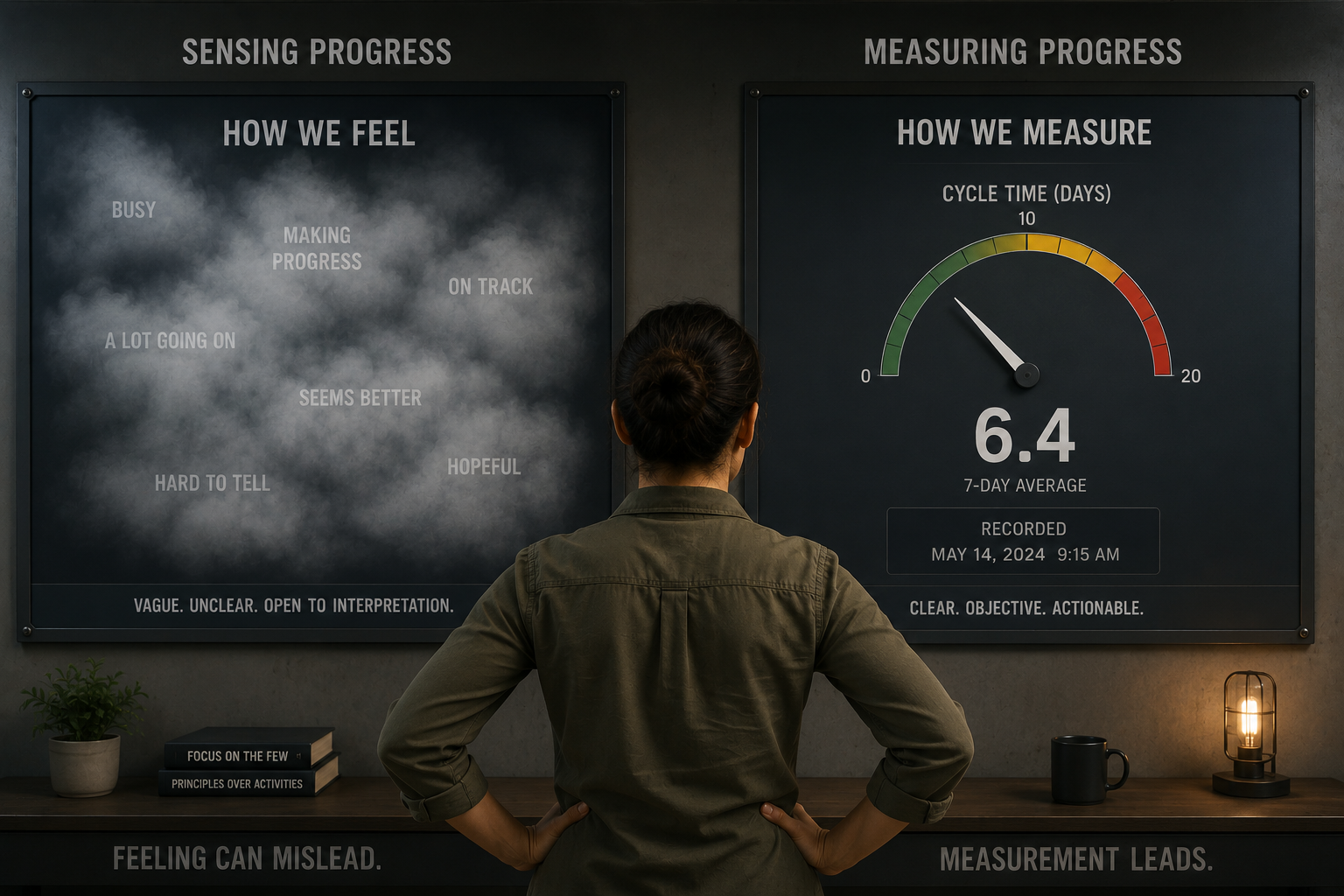
You've been "working on your budget" for two months. You've been "trying to get healthier" since spring. You've been "putting yourself out there" in your job search for weeks. Ask yourself, honestly, whether any of that has actually moved, and you'll notice something uncomfortable: you don't know. Not "it's going badly." Not "it's going well." You genuinely cannot tell, because nothing about the effort was ever set up to produce an answer.
This is one of the quietest, most common ways a designed system fails. It isn't that the plan was bad. It's that the plan never included a way to check whether it was working, so two months in, you're left going on vibes. Vibes are not data. They are not even a reliable proxy for data. You can feel like you're failing while actually improving, and feel like you're winning while actually drifting backward, because feelings respond to mood, fatigue, and how your week is going, not to the actual trend line of your system.
There is a specific, well-studied fix for this, and it isn't "try harder to notice." It's measurement, built into the system on purpose, from the start.
The Root Cause
ROOT CAUSE: The system has no feedback loopA system with no feedback loop can be running, even running hard, while producing no information about whether it's actually working. This is different from a system with no plan at all. You can have a thorough, well-designed budget, fitness routine, or job search strategy and still have zero feedback loop, because the plan describes what to do, not how you'll know whether doing it is producing the result you wanted.
The tell is always the same: when asked "is it working," the honest answer comes out as a feeling rather than a number. "I think so." "It feels better." "I guess?" Compare that to: "My average weekly spending dropped from $640 to $580 over the last six weeks." One of those answers is a guess dressed up as an assessment. The other is a measurement you could actually act on.
"I feel like it's working" and "I can show you that it's working" are not two ways of saying the same thing. One of them is a guess. Only the other one is feedback.
The Mechanism: Why Recorded Measurement Outperforms Mental Tracking
This isn't a productivity opinion. It's one of the more thoroughly tested claims in behavior-change research. A large meta-analysis published in Psychological Bulletin pooled 138 randomized studies, nearly 20,000 participants, examining interventions designed to increase how often people monitored progress toward a goal. The result: increasing progress monitoring produced a real, meaningful improvement in whether people actually reached their goals, and the effect held across an enormous range of goal types and populations.
The same review surfaced a detail that matters even more for designing your own system than the headline finding does: progress monitoring produced larger effects specifically when the results were physically recorded and when they were visible to someone else, not just held in memory. Writing it down and tracking it openly outperformed simply intending to pay attention. This is the difference between a system with a real feedback loop and a system that's merely supposed to have one. A feedback loop you don't record doesn't function as a feedback loop. It functions as a vague intention to check in, which, as the opening of this article showed, produces feelings, not information.
This finding lines up with the broader self-regulation theory underneath it: monitoring works because it reveals the gap between where you currently are and where you're trying to be, and that gap is what actually drives a correction. Without measurement, there's no gap to see, just an undifferentiated sense that things are or aren't going well. Self-regulation theorists have argued for decades that people can't effectively adjust their own behavior if they aren't paying structured attention to their own performance, because adjustment requires a comparison point, and a comparison point requires a number, a date, or a record, not a mood.
This same upstream principle, that a process needs a checkpoint to actually improve, was the foundation of the continuous-improvement loop in Article #16. Measurement is what fills that checkpoint with real content instead of an assumption. A PDCA loop with no measurement at the "Check" stage isn't a loop. It's a guess repeated on a schedule.
It's worth being honest about what the research doesn't claim. The same meta-analysis found that monitoring had a much stronger, more consistent effect on the behavior being tracked than on the eventual outcome the behavior was supposed to produce. In plain terms: tracking your workouts reliably increases how many workouts you do. It doesn't automatically guarantee the number on the scale moves the way you want, because outcomes depend on more variables than behavior alone. This matters for what you choose to measure. If you only track an outcome that's partly outside your control, a few flat weeks can look like failure even when your actual behavior is exactly on plan. Tracking the behavior itself, not just the distant outcome, keeps the feedback loop honest about what it can actually tell you.
The Design: Building a Measurement You'll Actually Keep
The research is specific about what makes monitoring effective: frequent, recorded, and visible. Here's how to build that into any system you're already running, using the same four-step methodology.
Step 1 — Diagnose: Find the One Number That Actually Represents Success
Most goals have a dozen things you could track and only one or two that actually matter. For a budget, it's not every transaction category, it's net monthly spending versus income. For fitness, it might not be the scale, it might be a specific lift number or a resting heart rate. Pick the smallest number of metrics that would genuinely tell you the system is working, not everything you could plausibly measure.
Some goals resist an obvious number, and that's not a reason to skip measurement, it's a reason to measure the behavior instead of the feeling. "Be a better partner" has no number. "Have one uninterrupted, phone-down conversation per day" does, and you can simply count it: did it happen, yes or no, each day this week. "Feel less anxious" has no number. "Number of nights this week I completed my wind-down routine before midnight" does. The rule is: if you can't measure the goal directly, measure the specific, repeatable behavior you believe drives it, and count that instead.
This is also the safest move given what the research above actually showed. Behavior counts respond reliably to monitoring. Distant, multi-causal outcomes don't always move on the same timeline, even when your behavior is correct. Measuring the behavior keeps your feedback loop telling you the truth about the one thing you actually control.
Step 2 — Design: Decide Where It Gets Recorded, Not Just Noticed
Per the research above, this step is not optional. A number you intend to keep track of mentally is not a measurement system; it's a hope with a unit attached. Pick one place, a notebook, a simple spreadsheet, a habit-tracking app, and commit to recording the number there every time, not just when you remember or when things are going well.
Step 3 — Implement: Set a Fixed Checking Cadence
Decide in advance how often you'll record and review the number, weekly is usually right for most personal systems, and put it on the calendar the same way you would a recurring meeting. This mirrors the preventive-maintenance scheduling principle from Article #18: a check that depends on remembering to do it isn't a system, it's a coin flip.
Step 4 — Iterate: Let the Number, Not the Mood, Decide the Next Move
When you review your recorded number, the question is not "how do I feel about this." It's "what does this number say, and what's the smallest adjustment that responds to it." If the trend is flat or worsening over several check-ins, that's the signal to revisit your diagnosis, possibly using the Five Whys method from Article #13, rather than waiting for the feeling of frustration to build up first.
Pick Your One Number and Record It
Choose one system you've been "working on" without a clear sense of whether it's improving. Open a blank document or spreadsheet and write down:
2. Today's value for that number, recorded right now, not estimated from memory.
3. A calendar reminder, one week from today, to record it again.
You now have a feedback loop instead of a feeling. In a week, you'll have two data points and a real trend, not a guess.