What Is Deadband Life?
A name from control engineering, a mission for real life, and a methodology for anyone who was never handed a manual for any of this.
You have read the articles. You have listened to the podcasts. You have bought at least one course that promised to change everything, and it did, for about three weeks. Your bookshelf has a personal finance book you got through half of, a health book you agreed with entirely and implemented almost none of, and something about habits you can no longer find.
You are not uninformed. You are not undisciplined. You are, if anything, somewhat tired of being handed motivation when what you actually needed was a design.
That distinction, between motivation and design, is the entire reason Deadband Life exists.
The Problem with Every Other Approach
ROOT CAUSE: The system is optimized for the wrong outputMost personal development content is optimized for one thing: engagement. It needs you to feel something: inspired, motivated, called out, seen, this is because feelings drive clicks and clicks drive revenue. This is not a moral failure on anyone's part. It is the predictable output of a system designed around attention metrics rather than life outcomes.
The result is a category that produces a lot of emotional resonance and very little durable change. You feel good after consuming the content. You feel behind again three weeks later. The cycle repeats. Not because you lack resolve! Instead it is because the content was never designed to produce a different output. It was designed to produce a return visit.
We do not simplify. We clarify. There is a profound difference. One produces false confidence, the other produces competency.
Deadband Life is built on a different optimization target: measurable improvement in how well your life actually runs. Not inspiration. Not engagement. Not the feeling of progress. The actual output of the systems you are responsible for managing every single day.
What "Deadband" Actually Means
In control systems engineering, a system that is working correctly does not react to every input. It holds steady within an acceptable range around its setpoint and only intervenes when a signal falls outside that range. The zone where no corrective action is needed? That is called the deadband.
It is not a zone of inactivity. It is a zone of stability. The result of a well-designed system doing exactly what it was built to do. The deadband is not an absence of effort. It is evidence that the system works.
The Steady Zone — the intentional, calm space where your life systems are working correctly, and the daily noise of unexpected demands cannot knock everything off course. You are not reacting. You are not redlining. You are operating.
Most adults have never experienced a deadband in their finances, their home, or their health. They are running those systems entirely in reactive mode by responding to every signal, absorbing every shock without any buffer, with no setpoint defined and no feedback loop telling them whether they are moving toward it or away from it.
The name is the mission: build a life that has a steady zone. Not a perfect life. Not a wealthy life. Not a life that matches any external standard of success. A life where the systems work. One where you are not constantly redlining, where the small disruptions do not cascade, where you are operating from design rather than from default.
What Deadband Life Actually Is
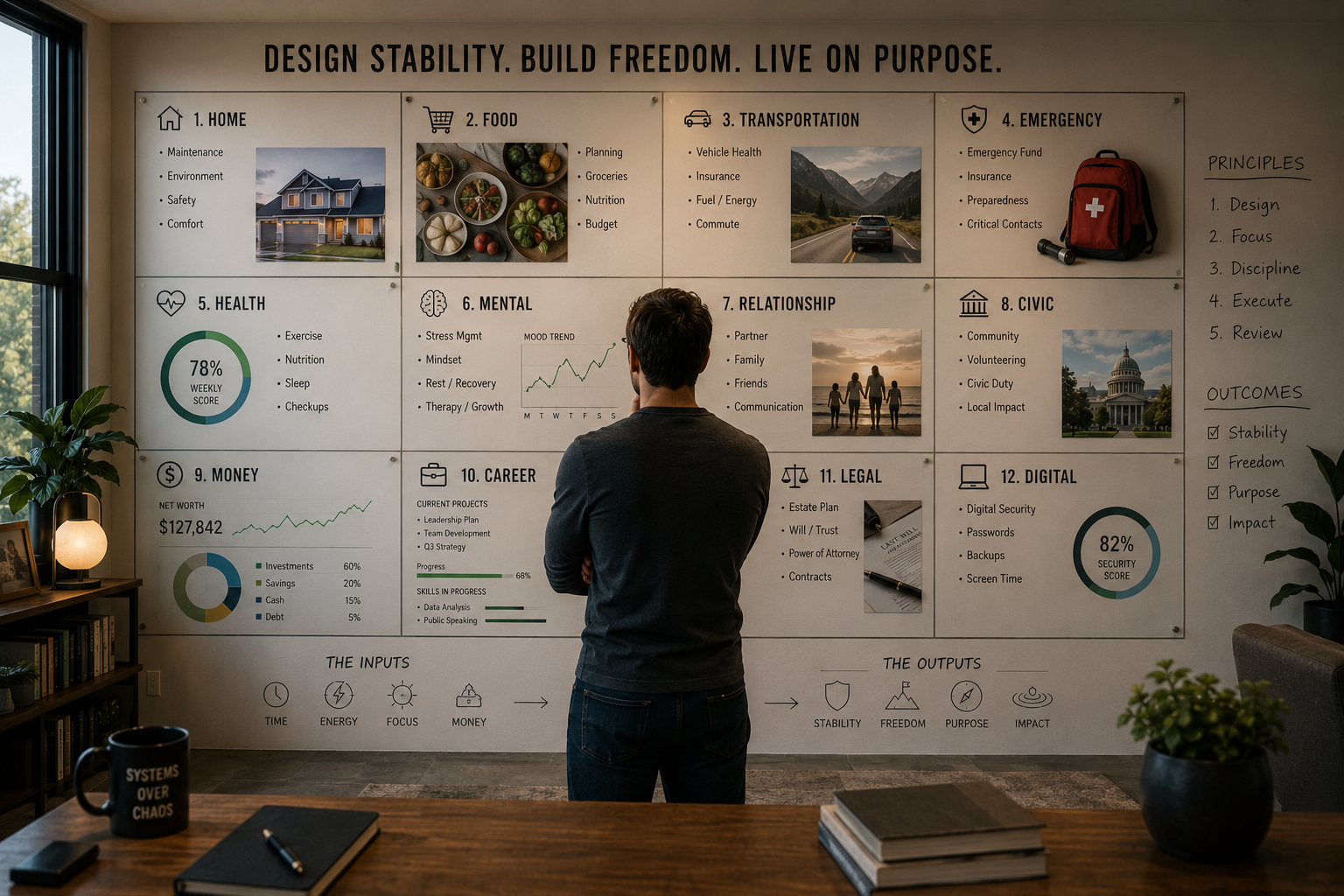
Deadband Life is a life literacy resource built on engineering discipline and quality management methodology. It covers twelve domains of adult life, from finances to housing to health to career to legal literacy, and teaches a single consistent approach to all of them: diagnose the system, design a better one, implement it, and measure whether it works.
There are three things you need to know to understand what kind of resource this is.
01: The Engineering Process
Every piece of content here follows the same four-step frame. It applies whether the topic is building an emergency fund, managing a home inspection, or navigating a difficult conversation at work. The method does not change. The domain does.
02: The Five Beliefs
These are not motivational statements. They are working hypotheses, propositions we hold ourselves accountable to in every piece of content, every product, and every design decision.
- Every person is capable of mastering their own life. This is an engineering claim, not an optimistic one. A system that is poorly designed produces poor results regardless of the operator's intelligence or effort. Fix the design.
- Root cause beats symptom treatment every time. Self-help culture treats symptoms. Can't save money? Here are ten budgeting tips. We ask why, five times, until we reach the actual mechanism. Then we fix the mechanism.
- Complexity is the enemy of action; clarity is the product. We do not oversimplify. Oversimplification produces false confidence and bad decisions. We decompose complexity into a sequence of manageable, clearly ordered steps. The result is not a simpler problem; it is a solvable one.
- Systems thinking is a life skill, not a professional tool. Input, process, output, feedback, constraint, failure mode: these are not technical jargon. They are descriptions of how the world actually works. A person who understands these concepts can apply them to any domain of their life.
- Mastery requires proof, not consumption. You can spend ten thousand hours watching videos about personal finance and still be broke. Our 24 hour action and log term follow-up requires demonstration. It is the evidence that you did the thing, not just that you watched someone explain it.
03: The Life Systems Stack
The Life Systems Stack is the intellectual backbone of everything here. It organizes adult life into twelve interconnected domains, each understood as a system with inputs, processes, outputs, feedback mechanisms, and failure modes. These twelve domains are classified into three functional pillars. The pillars are not a hierarchy of importance, but a map of function.
Food Systems
Transportation
Emergency
Career Systems
Legal Literacy
Digital Systems
Mental Systems
Relationships
Civic Systems
Your audit result determines which domain you start with and not the pillar. Two people in the same pillar may begin in entirely different places. The stack is a map, not a sequence.
Who This Is For
Deadband Life was built for three types of people, and all three share a single underlying condition: they are smart, capable adults who have been underserved by every resource that was supposed to prepare them for the systems they are now responsible for running.
The First-Generation Builder is creating a roadmap from scratch. They are the first in their family to own a home, to invest, to navigate a knowledge-economy career. They have no inherited framework. What they need is not instructions. It is the mechanism behind the instructions, so they can make genuinely informed decisions rather than following advice designed for someone with more context than they were ever given.
The Overwhelmed System Seeker has the basics, a job, stability, maybe a family, but feels perpetually reactive and perpetually behind. The overwhelming burnout is real. What they need is a reframe: this is a structural problem, not a personal one. Once the system is visible, it becomes solvable.
The Ready-to-Build Architect has stabilized. Survival mode is over. Now the work shifts from maintenance to optimization: real structure, real feedback, real competency. No interest in hacks or motivational noise. Ready for durable, high-leverage systems that compound.
If you recognize yourself in any of those three descriptions, then this was built for you. Specifically, deliberately, and without the condescension that has characterized most of what you have encountered in this space until now.
Where to Start
The entry point to everything here is the Life Systems Audit. a twelve-domain diagnostic that takes under twenty minutes and tells you exactly where your systems need the most attention. It does not produce a score. It produces a map: which domains are running well, which have active gaps, and which need a complete redesign.
From that map, every other piece of content here becomes navigable. You are not browsing a catalog. You are following a diagnosis to its prescription, which is the only sequence we believe actually works.
Take the Five-Minute Audit
If you have limited time and before you read another article, take the Life Systems Starter Audit. It covers the five highest-impact domains of adult life and tells you specifically where your systems are broken and which one to fix first.
Complete the 5-domain quick audit. (Under 5 minutes.)
Note which domain had the most boxes checked.
That is your starting point. Everything else follows from there.
The audit is free. The map it produces is yours and the first time you see your life laid out as a set of systems rather than a set of personal failures, something shifts and it does not shift back. If the concept works, you can come back for the full audit.