Career Resilience in a Changing Economy
Your job title was never the system. Here's what actually determines whether you're steady or exposed when the market shifts.
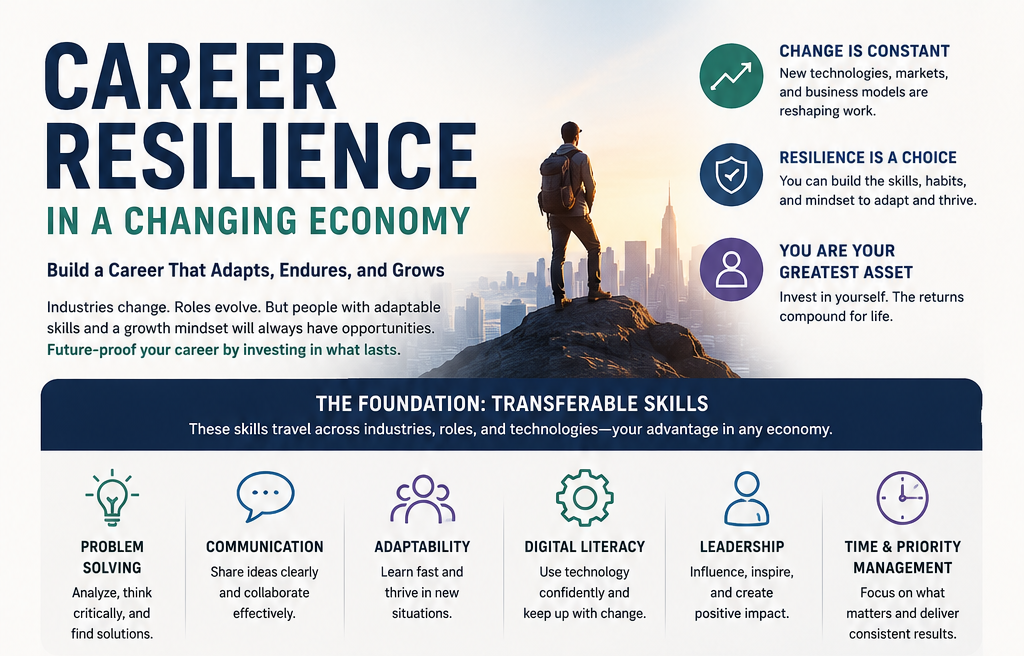
You have watched two rounds of layoffs happen to people who were, by every visible measure, better at their jobs than the people who replaced them with a reorg chart and a new tool. You have updated your resume three times this year, not because you are job hunting, but because you keep having the thought that you should probably be ready. You are good at your job. You are also aware, in a low hum kind of way, that being good at your job has stopped feeling like protection.
That feeling is not paranoia. It is a correct read of a system that was never actually built to withstand disruption. Most careers are managed the way most budgets are managed: reactively, one event at a time, with no process running underneath the day-to-day work.
The economy changing is not the problem. The problem is that your career, as a system, has no way to absorb that change without you personally absorbing all of it.
The Root Cause of Career Instability
ROOT CAUSE: No resilience layer built into the career systemCareer security is treated, almost universally, as a byproduct of performance. Work hard, do good work, and stability follows. That was a reasonable assumption inside a stable employment structure. It is a dangerous assumption inside a changing one, because performance and resilience are not the same variable.
Performance is what you produce inside your current role. Resilience is whether your career can withstand that role disappearing. A career system with no resilience layer has no buffer of transferable skill, no diversified professional network, no updated market read, and no plan for the first thirty days of disruption. When the disturbance arrives, whether that is a layoff, an industry contraction, or a role being automated out from under you, there is nothing in the system to absorb the shock. The person absorbs it instead, usually at the worst possible moment, with the least amount of runway.
This is precisely the failure mode Deadband Life calls Root Cause 5: the system cannot tolerate disturbance. It is not that people are bad at their jobs. It is that their career, as a system, was never designed with a recovery protocol.
Why "Being Good at Your Job" Isn't a Resilience Strategy
Career engagement research draws a useful distinction between how invested someone is in their current role and how actively they are managing their career as a whole, across time and across disruption. The two do not move together. It is entirely possible to be deeply engaged in a job and to have done almost nothing to prepare that career for change.
A related 2024 study extends this finding directly into disruption scenarios: professionals who actively manage their career, rather than passively performing their role, report meaningfully better outcomes when their job changes or disappears without warning. (Source behind a subscription paywall; summarized findings cited here.)
The mechanism is consistent across both sources: the failure is not personal and it is not about effort. It is about which system is running underneath the job. A career with no resilience layer treats every disruption as a personal emergency. A career with one treats disruption as an anticipated event the system was already designed to handle.
Building a Career System That Can Absorb Disruption
A resilient career is not a backup plan you write once and forget. It is an ongoing system, run in parallel with your actual job, using the same Diagnose → Design → Implement → Iterate frame that governs every other domain of your life.
Diagnose: Separate Your Role From Your Skill Set
Most people describe their career using a job title. Titles are brittle. They exist inside one company's org chart and disappear the moment that chart changes. Skills are portable. The diagnostic question is not "what is my job?" It is "what do I actually do that would still be valuable if this exact job stopped existing tomorrow?"
Design: Build the Three Resilience Components
A career resilience layer has three parts, and all three need to exist before a disruption, not after. First, a transferable skills inventory: the specific, sellable capabilities that travel with you regardless of employer. Second, a diversified network: professional relationships outside your current company, maintained continuously, not activated only when you need something. Third, a market read: an ongoing, low-effort sense of what your skills are worth and where demand is moving, so a shift in your industry doesn't arrive as a surprise.
Implement: Run the System in the Background
None of this requires quitting your job or treating your current role as temporary. It requires a small, recurring practice: a short monthly check-in with your own resilience layer, the same way you might check a budget or a home maintenance log. The system runs quietly, in the background, whether or not disruption ever actually arrives.
Iterate: Measure Readiness, Not Just Performance
The metric that matters here is not "how good am I at my job." It is "how long would it take me to be stable again if this job ended today." That number should be shrinking over time. If it isn't, the resilience layer isn't being run, no matter how strong the performance reviews look.
Run a Portability Audit
Open a blank document. Write your job title at the top, then cross it out. Underneath, list the five specific skills you use most often, described without company-specific jargon. Next to each, write one other role or industry where that exact skill would still be valuable tomorrow.