Digital Decluttering
Your closet has a limit. Your phone doesn't, and that's exactly why it never gets cleaned out on its own.
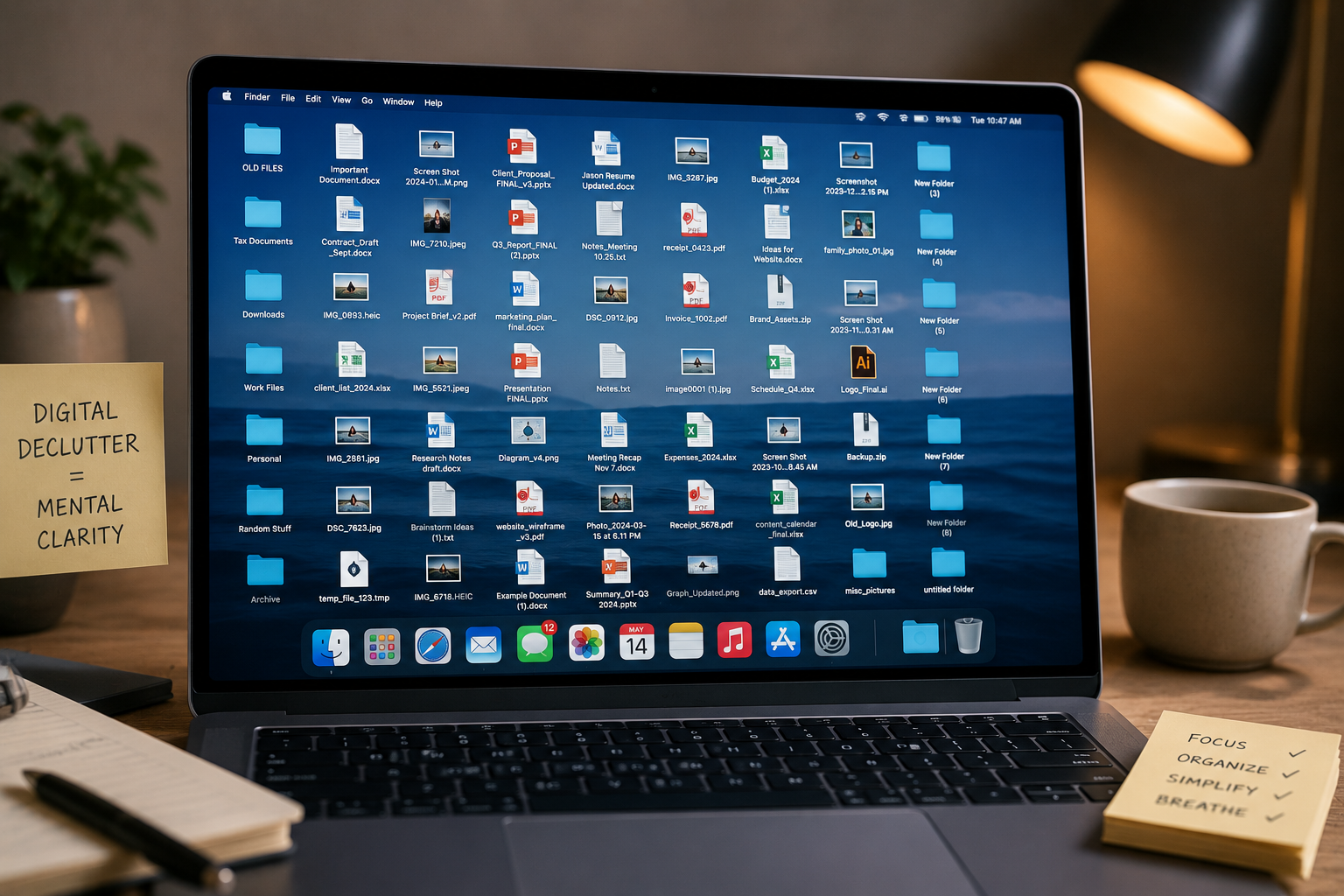
Your phone has 30 apps on it you have not opened in over a year. Your inbox has a four-digit unread count you stopped looking at months ago. Your camera roll has the same screenshot, saved three separate times, for a reason you no longer remember. None of this feels urgent, exactly. It just sits there, quietly, in the background of everything else you do on a screen.
You have probably tried to fix it. A weekend where you deleted forty apps in a row, felt briefly great about it, and then watched the clutter creep back within a month. That is not because you lack follow-through. It is because a one-time purge was never going to hold. Clutter is not a single event. It is an ongoing output of a system, and if the system has no maintenance built in, the clutter simply regenerates.
The Root Cause of Digital Clutter
ROOT CAUSE: The system has no feedback loopDigital clutter is not caused by owning too many devices, or by being disorganized as a personality trait. It is caused by the complete absence of a review cadence. Every app you install, every subscription you sign up for, and every email you receive enters your digital life through a clear process. Almost nothing exits through an equally clear one. Deletion is left entirely to chance: it happens only if you happen to notice something and happen to have a spare moment to deal with it.
That asymmetry is the whole mechanism. Physical clutter is self-limiting, because a closet, a drawer, or a garage eventually runs out of room and forces a decision. Digital storage rarely does. Cloud accounts and modern devices can absorb thousands of unused files and apps without ever presenting an obvious signal that something needs to change. Without a storage wall to force the issue, and without a scheduled review to substitute for one, accumulation simply continues, indefinitely, by default.
Why Digital Clutter Costs More Than Storage Space
It is tempting to treat digital clutter as a cosmetic issue, something to clean up when you feel like it rather than a real problem. The research on digital hoarding, a related and increasingly studied behavior, suggests otherwise.
That last point is the one most people miss. Digital clutter is not only an attention problem. An old app you stopped using three years ago, still logged in, still holding a copy of your data, and still running on outdated security, is not a neutral object sitting quietly on your phone. It is unmonitored exposure. The mess is not just visual. Some of it is a live liability.
Designing a Digital Decluttering System That Sticks
A decluttering system does not need to be elaborate. It needs exactly one thing that a one-time purge doesn't have: a recurring cadence that runs whether or not you feel like doing it.
Step 1 — Diagnose
Look at three numbers: your unread email count, the number of apps on your phone's second and third home screens (the ones you rarely scroll to), and how full your photo storage is. You are not fixing anything yet. You are just establishing where the clutter actually lives, so you don't waste your first pass tidying the wrong thing.
Step 2 — Design
Sort everything into three categories: Active (used in the last 30 days), Dormant (not used recently but still genuinely needed), and Dead (unused, unrecognized, or no longer relevant). Dead items get deleted outright. Dormant items get archived somewhere out of your daily view, not left cluttering the same space as what you actually use. Only Active stays exactly where it is.
Step 3 — Implement
Do the first pass in three short sessions rather than one long one: apps first, then email, then files and photos. Each session should take under 30 minutes. Trying to do all three in one sitting is exactly the "weekend purge" pattern that burns people out and never gets repeated.
Step 4 — Iterate
This is the step that was always missing. Set one recurring calendar reminder, once a quarter, to repeat the sort. That single scheduled review is the entire difference between a system and a memory of the time you cleaned up your phone in 2024.
Decluttering is not an event you complete. It is a cadence you maintain.
Run One 20-Minute App Audit
Open your phone's home screen and scroll to the folder or page you visit least. Go through it app by app.
2. For anything you're unsure about, check the "last opened" date in your phone's settings before deciding.
3. Set one recurring calendar reminder, three months from today, to repeat this exact audit.
That reminder is the actual system. The 20-minute cleanup is just the first run of it.