Rent vs. Buy: Making the Right Housing Decision
It isn't a referendum on whether you're a responsible adult. It's a calculation — and almost nobody was ever taught how to run it.
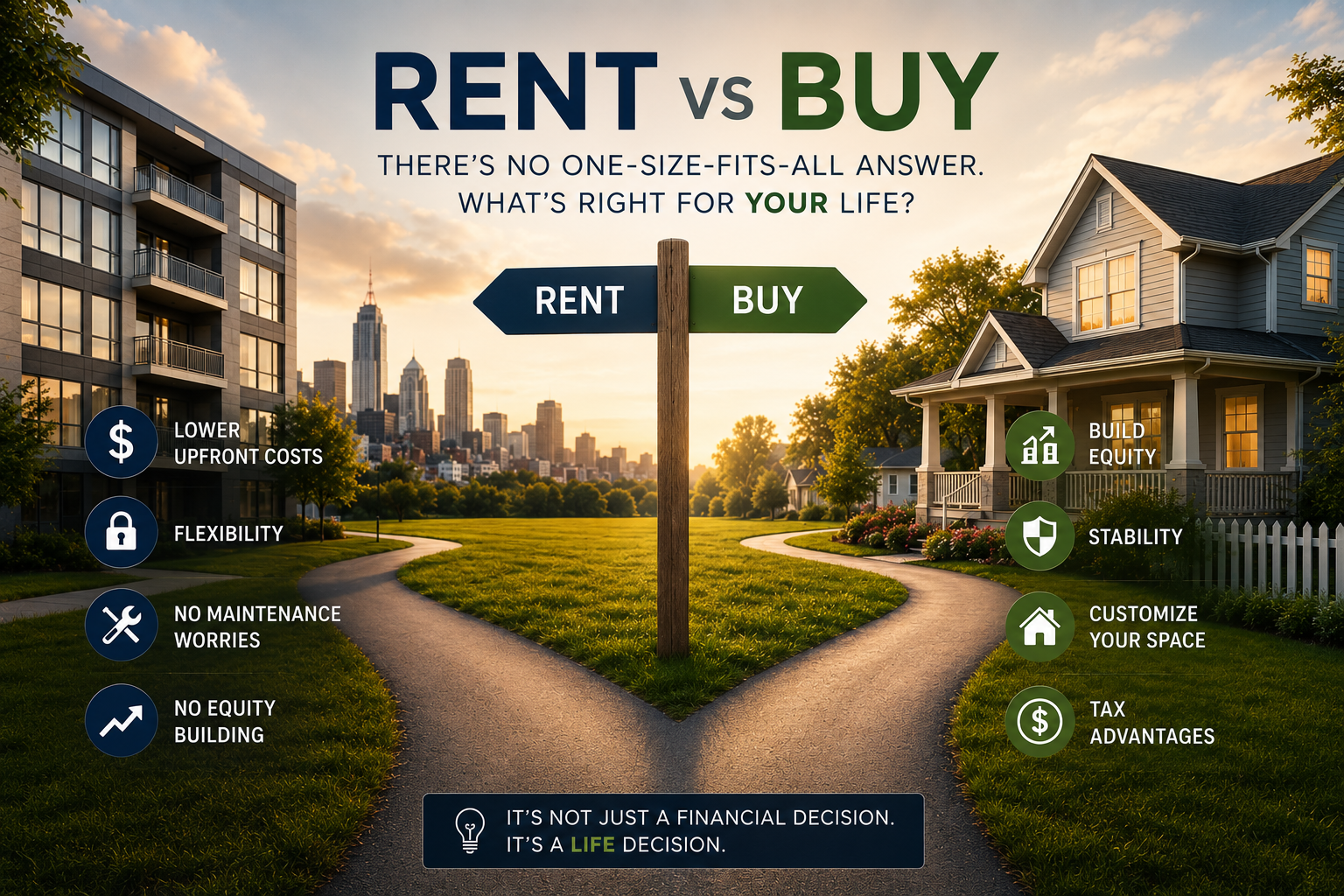
Every few months, someone at a dinner party says it: "You're still renting? You're just throwing money away." You nod, half-agree, and feel a small familiar guilt. Meanwhile your down payment fund sits at a number that would make the mortgage payment on anything decent in your area larger than what you pay in rent right now, with none of the flexibility.
You don't actually know if buying would be better for you. You just know it's supposed to be the responsible choice, the adult choice, the choice that means you've "made it." So the decision sits there, unmade, generating quiet anxiety every time it comes up, because nobody ever gave you a way to actually answer it.
Here's the reframe: rent versus buy was never a moral question. It's a math question with a personal answer, one that depends on how long you're staying, what your local market looks like, and what else that money could be doing. Most people have never run that math. They've only absorbed the guilt.
The Root Cause
ROOT CAUSE: The system is optimized for the wrong outputMost people approach this decision optimizing for a feeling — avoiding the discomfort of "wasting money" on rent, or matching what their parents did, or keeping pace with peers. None of those are the actual output that matters: your net financial position, your flexibility, and whether the decision fits the specific years you're in right now.
"Renting is throwing money away" and "buying is always the smart move" are both inherited rules of thumb, not calculations. They were true, or truer, in specific markets and specific decades. Applied blindly to your city, your timeline, and your down payment, they can just as easily point you toward the wrong decision as the right one.
The Mechanism: Why "Always Buy" Is the Wrong Rule
Two things make renting vs. buying more nuanced than the dinner-party version of the advice: how long you actually stay, and what happens to prices while you're there. Neither is guaranteed, and both change the answer completely.
That matters because the entire financial case for buying depends on staying long enough to absorb the upfront transaction costs — closing costs, moving costs, and the first few years of a mortgage payment that's mostly interest. Sell too soon, and those costs can outweigh anything gained in appreciation or equity.
Put together, the data says something more useful than a slogan: buying tends to work out for people who stay long enough to absorb the upfront costs, and it doesn't automatically work out for everyone else. The real question was never "rent or buy." It's "how long am I actually staying, and does the math clear at that horizon."
The Design: Running Your Own Numbers
You don't need a financial advisor to run this calculation. You need two numbers and an honest guess about your own timeline.
Step 1 — Diagnose
Find your local price-to-rent ratio: divide a comparable home's purchase price by the annual rent for a similar place. As a rough practitioner guideline, a ratio under roughly 15 tends to favor buying, over roughly 20 tends to favor renting, and everything in between depends heavily on your specific timeline.
Step 2 — Design
Set your honest time horizon: how many years are you actually likely to stay, given your career, relationship, and life-stage plans? Most breakeven calculators put the point where buying starts to outperform renting somewhere between three and seven years, depending on your market and financing. Below that horizon, renting usually wins even in a "should buy" price-to-rent ratio, because the transaction costs never get fully absorbed.
Step 3 — Implement
Run the calculation once, this week, with real numbers from your actual market, not a national average. Include your likely down payment, estimated closing costs, and what that same down payment could otherwise be doing if invested instead of tied up in a home.
Step 4 — Iterate
Revisit the calculation once a year, or any time your timeline shifts. Local prices, rents, and interest rates move. A market that favored renting two years ago may not favor it today, and the answer that was right for you at 26 may not be right at 31.
Run Your Price-to-Rent Ratio
Find one comparable home for sale in the area you'd actually live, and one comparable rental. Divide the sale price by the annual rent.
2. Find a comparable rental's monthly rent, multiplied by 12.
3. Divide price by annual rent. Under ~15 leans buy, over ~20 leans rent, and write down your honest best guess for how many years you'd stay.
That number, next to your honest timeline, is more useful than any opinion at a dinner party. It's the first real input into your own decision.