Relationship Systems: Building Meaningful Connections
You are not bad at relationships. You are running one without a system — and that gap is exactly what's driving the distance you feel.
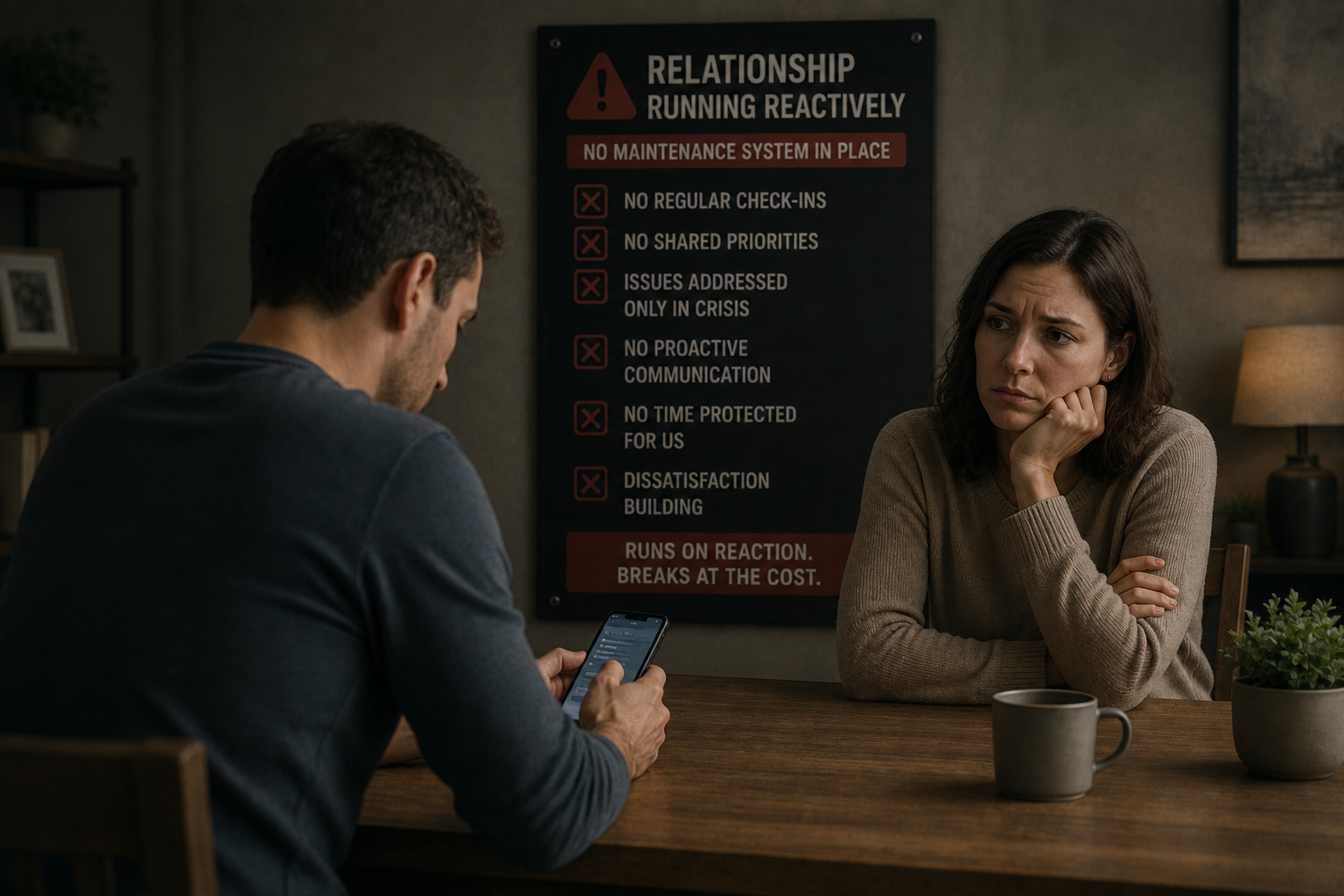
You still love them. That's not the problem, and it never was. The problem is that you and your partner are sitting in the same room, both on your phones, and you can't remember the last time you had a conversation that wasn't about logistics. Who's picking up the kids. Whether the dishwasher got run. What time the thing is on Saturday.
You used to talk for hours. Now a "good week" means you didn't fight about anything. That's not a relationship that's thriving. That's a relationship on autopilot, and autopilot has a shelf life.
Here's what nobody told you when this started feeling distant: it's not because the love faded, and it's not because you're "bad at relationships." It's because nobody ever taught you that relationships are systems, and systems that run without maintenance degrade. Not because anyone did anything wrong. Because that's what unmaintained systems do.
That is a fixable problem. And the fix starts with seeing the relationship for what it actually is: a system you can diagnose, redesign, and run on purpose.
The Root Cause
ROOT CAUSE: The system has no feedback loopMost relationships are not undermined by a single dramatic betrayal. They are undermined by drift, the slow accumulation of unspoken needs, unresolved friction, and assumptions that were never checked. Drift is invisible week to week. It's only visible in aggregate, months or years later, when two people who used to feel close suddenly feel like strangers who happen to share a kitchen.
The mechanism is almost always the same: there is no structured way for either person to surface what's actually happening inside them, and no regular checkpoint where the relationship's "output", felt connection, trust, the sense of being known, gets measured against what either person actually wants. Conflict becomes the only feedback mechanism left, which is a brutal way to run a system. By the time conflict shows up, the gap has usually been building for a while.
Here's how the five DB root causes show up specifically inside relationship systems:
Conversations only happen reactively, when something has already gone wrong. There is no recurring time set aside to check in on the relationship itself.
Build the checkpoint. Install a recurring, low-stakes check-in before there's a problem to discuss.
Conflict gets handled the way your family of origin handled it, stonewalling, escalating, or avoiding entirely, regardless of whether that pattern works for this relationship.
Audit the pattern. Name where the current conflict style came from, then jointly decide whether to keep it or replace it.
Neither partner has a clear, current picture of how connected the other one actually feels right now. Assumptions stand in for data.
Instrument the system. Ask a direct connection question on a fixed cadence, and treat the answer as real data.
The relationship is optimized for the appearance of harmony, avoiding conflict, staying agreeable, rather than for actual felt closeness, which sometimes requires friction to get there.
Realign the goal. Define what closeness actually looks like for both people, then evaluate the relationship against that, not against "no fights."
The relationship has no established repair process. One hard conversation or one external stressor (job loss, illness, a move) derails the whole system for weeks.
Build the repair protocol. Agree, in calm conditions, on how you'll reconnect after a fight or a hard stretch, before you need it.
Drift isn't a sign the relationship is broken. It's a sign the relationship has no feedback loop.
The Mechanism: Why Connection Erodes Without You Noticing
Relationship researchers have spent decades trying to pin down what actually separates relationships that stay close from relationships that quietly drift apart. The 2025 Multidimensional Quality of Relationship Scale (M-QoRS) is one of the more rigorous recent attempts: a validated instrument built specifically to capture relationship quality across several distinct domains rather than collapsing everything into a single "satisfied or not" score.
That multi-domain structure matters because it explains exactly why drift is so hard to notice from the inside. If you're only tracking one signal, "are we fighting or not?", you can miss the fact that communication quality or felt connection has been declining for months while conflict frequency stays flat. A system with only one sensor will always miss failures the sensor wasn't built to detect.
The disconnection mechanism doesn't stop at the relationship itself. It shows up at the population level as a measurable public health signal.
Put the individual mechanism and the population data together and the pattern is unmistakable: connection is not something that just happens when two people care about each other. It is an output that has to be produced, on purpose, by a system designed to produce it. When that system is absent, drift and loneliness are not the exception. They are the default.
The Design: A System for Staying Connected on Purpose
A relationship system isn't a date-night calendar or a list of love languages. It's a small set of recurring structures that keep communication, connection, and repair from being left to chance. Here's the Deadband Life methodology applied specifically to this domain.
Step 1 — Diagnose
Before changing anything, get an honest read on where the relationship actually stands across the domains that matter: communication, conflict management, felt connection, and intimacy. Most couples can tell you whether they're "doing fine" in general. Fewer can tell you which specific domain is quietly degrading. That specificity is the whole point of diagnosis. A vague sense that "something's off" is not a diagnosis. Naming which domain it's off in, is.
Step 2 — Design
Once you know which domain needs attention, design the smallest structure that produces a measurable improvement in it. If communication is the gap, that might be a 15-minute weekly check-in with two fixed questions. If repair is the gap, that might be a pre-agreed process for how you reconnect after a disagreement, decided in advance, while you're both calm, not improvised in the heat of the moment.
Step 3 — Implement
Run the structure before you perfect it. The first version of a weekly check-in will feel awkward. Do it anyway. The relationship equivalent of "preparation paralysis" is waiting for the "right moment" to have a real conversation. That moment doesn't arrive on its own. You build the structure that creates it.
Step 4 — Iterate
Measure the output, not just the activity. Having the check-in is not the goal. Both people leaving it feeling more known than they did before it started is the goal. If a structure isn't producing that, adjust it. Maybe the questions need to change. Maybe the timing does. The structure serves the relationship; it's not sacred on its own.
Schedule the First Check-In
Pick a 15-minute window in the next 24 hours. Tell your partner you'd like to talk, just the two of you, with no phones. Ask two questions:
2. What's one specific thing that would move that number up?
Listen to the full answer without defending or explaining. That's it. You've just installed the first sensor in a system that previously had none. Repeat it next week, same time, same two questions, and you have a feedback loop.