Continuous Improvement for Everyday Life: Why Small Loops Beat Big Resolutions
You don't need a New Year's resolution. You need a loop small enough to actually finish, run again, and trust.
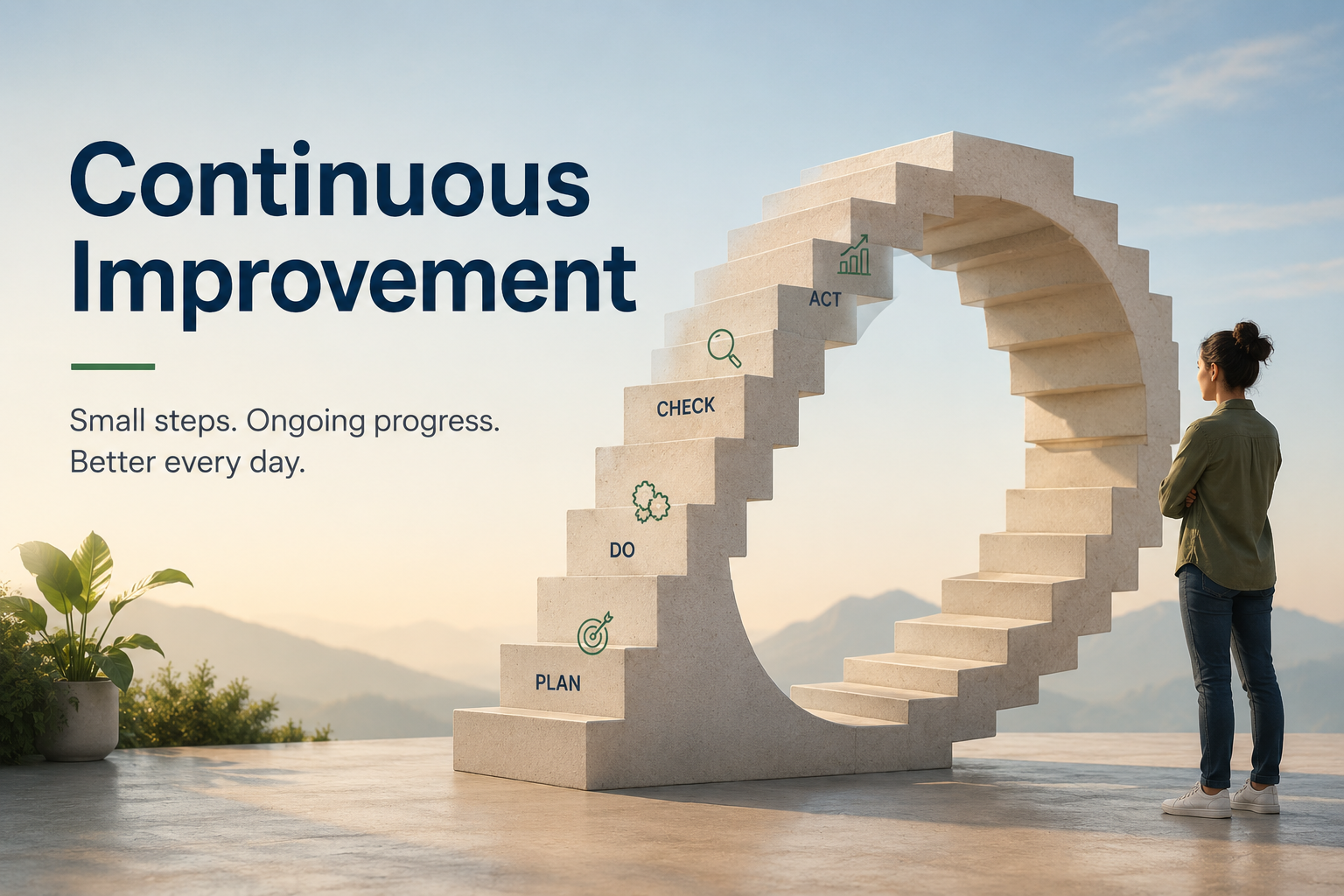
You've started the "new budget" four times this year. The "real workout plan" three times. The "actually organized home system" at least twice. Each one started strong. Each one had a plan with real ambition behind it, a fresh spreadsheet, a color-coded calendar, a complete overhaul. And each one quietly died within three to six weeks, not because you failed, but because the plan itself was too big to survive contact with an ordinary week.
Here's what nobody tells you: the problem was never your commitment. The problem was the size of the loop. You were trying to run a complete life overhaul as a single pass, when what actually works, what has worked in manufacturing plants, hospitals, and engineering teams for nearly a century, is something much smaller, much faster, and much less impressive-sounding: a tight loop you run over and over, each time a little better than the last.
That's continuous improvement. It is not a personality trait. It is not motivation. It is a structure, and once you understand the structure, you stop needing the overhaul entirely.
The Root Cause
ROOT CAUSE: The system has no feedback loopA complete overhaul fails for a predictable, structural reason: it has no checkpoint. You commit to the entire new system at once, run it for weeks without ever pausing to ask whether it's actually working, and only find out it failed when it has already fully collapsed. By the time you notice, there is no small adjustment left to make. There's only a relaunch, which means starting the exact same high-effort, high-failure-rate cycle again.
Compare that to a system with a feedback loop built in from the start: a small change, run briefly, checked against what actually happened, and adjusted before the next pass. The difference isn't ambition. The overhaul and the loop can target the exact same outcome. The difference is that one of them has a built-in mechanism for catching its own failure early and cheaply, and the other does not.
The overhaul bets everything on getting it right the first time. The loop assumes you won't, and is built to catch that early.
This is the same root cause behind most of the recurring patterns we've covered across this series: a process running without measurement, without review, without a structured point to ask "is this working?" before too much has been invested in finding out the hard way. Continuous improvement is the formal answer to exactly this gap. It does not ask you to be more disciplined. It asks you to make the loop small enough that checking in is cheap, and frequent enough that failure gets caught while it's still small.
The Mechanism: How the Improvement Loop Actually Works
Continuous improvement has a formal engineering history, and it's worth knowing because the structure is genuinely transferable. The most widely used model is the Plan-Do-Check-Act cycle, sometimes called the Deming cycle, after the quality theorist who adapted it from earlier scientific-method thinking into a repeatable four-stage loop for industrial process improvement.
The detail that matters most for everyday use is the phrase "small, controlled scale." PDCA does not ask an organization to roll out a change everywhere and hope. It asks for a deliberately small test, specifically so that if the change is wrong, the cost of being wrong is small too. That single design choice is the entire reason PDCA loops survive contact with reality better than full-scale overhauls do.
The related practice of Kaizen (Japanese for "change for better") applies the same logic at the individual level inside organizations: small, frequent, employee-driven improvements to a specific process, rather than large top-down transformations. A recent healthcare-systems study found that structuring Kaizen as a repeated cycle, paired with direct measurement of the actual process rather than assumptions about it, produced sustained improvements that were verified through ongoing monitoring, not assumed from the initial change.
Notice what both sources share with the financial and health research we've cited elsewhere in this series. The pattern is not domain-specific. People with stronger financial-literacy fundamentals show greater financial resilience not because they made one perfect decision, but because they're running an ongoing process of checking and adjusting. The same applies to health: the research consistently shows that structured, proactive routines checked over time outperform reactive, one-off corrections, which is precisely the small-loop, frequent-checkpoint structure PDCA formalizes.
The overhaul and the loop can have identical ambitions. What separates them is the size of the cycle and the presence of a checkpoint. One bets everything on the first pass being correct. The other assumes it won't be, and is built specifically to find out fast and cheaply.
The Design: Running Your Own PDCA Loop
You do not need quality-management software or a team of analysts. You need a loop small enough to run in a single week, and the discipline to actually close it before starting the next one. Here's the same four-step Deadband Life methodology, mapped directly onto PDCA.
Step 1 — Diagnose (Plan)
Pick one specific, narrow thing to change, not your whole budget, not your whole fitness routine. One variable. Write down what you expect to happen if the change works, in concrete terms you can actually check later. "I'll feel more in control" is not checkable. "I will know my checking account balance every Sunday night" is.
Step 2 — Design (Plan, continued)
Define the smallest version of the change that would actually test the idea. Not the full system. The minimum version that produces a real signal. If the idea is a weekly budget review, the minimum version is ten minutes, one sheet of paper, three numbers. Build that, not the twelve-tab spreadsheet.
Step 3 — Implement (Do)
Run it. On a fixed, short timeline, one week is usually enough. Resist the urge to expand scope mid-cycle. The entire value of PDCA comes from keeping the test small enough that the next step is actually possible.
Step 4 — Iterate (Check + Act)
At the end of the week, check: did it happen? Did it produce what you predicted? Then act on the answer. If it worked, run it again next week, exactly as is or with one small refinement. If it didn't, ask why, using the Five Whys method from Article #13, and adjust before the next cycle rather than abandoning the whole effort. This is the step most people skip entirely, and it's the one that actually makes the system continuous instead of a single attempt that quietly fades.
This is also why continuous improvement and the overhaul are not actually in competition for ambition; they're in competition for reliability. A series of small, checked loops compounds. A single large bet either pays off completely or, far more often, fails completely and leaves nothing to build on. The loop is slower to look impressive and faster to actually work.
Design Your First One-Week Loop
Pick one domain (money, health, home, or career) where you've tried and abandoned a "complete overhaul" before. Open a blank document and write down:
2. The smallest version of it you could run for exactly seven days.
3. The one concrete thing you'll check next week to know if it worked.
Put a reminder on your calendar for seven days from now to check it. That reminder is the part most plans never have. It's also the part that turns a one-time attempt into a real loop.