Creating a Personal Operating System
You are not running one life. You are running twelve systems at once, most of them on autopilot, none of them designed by you.
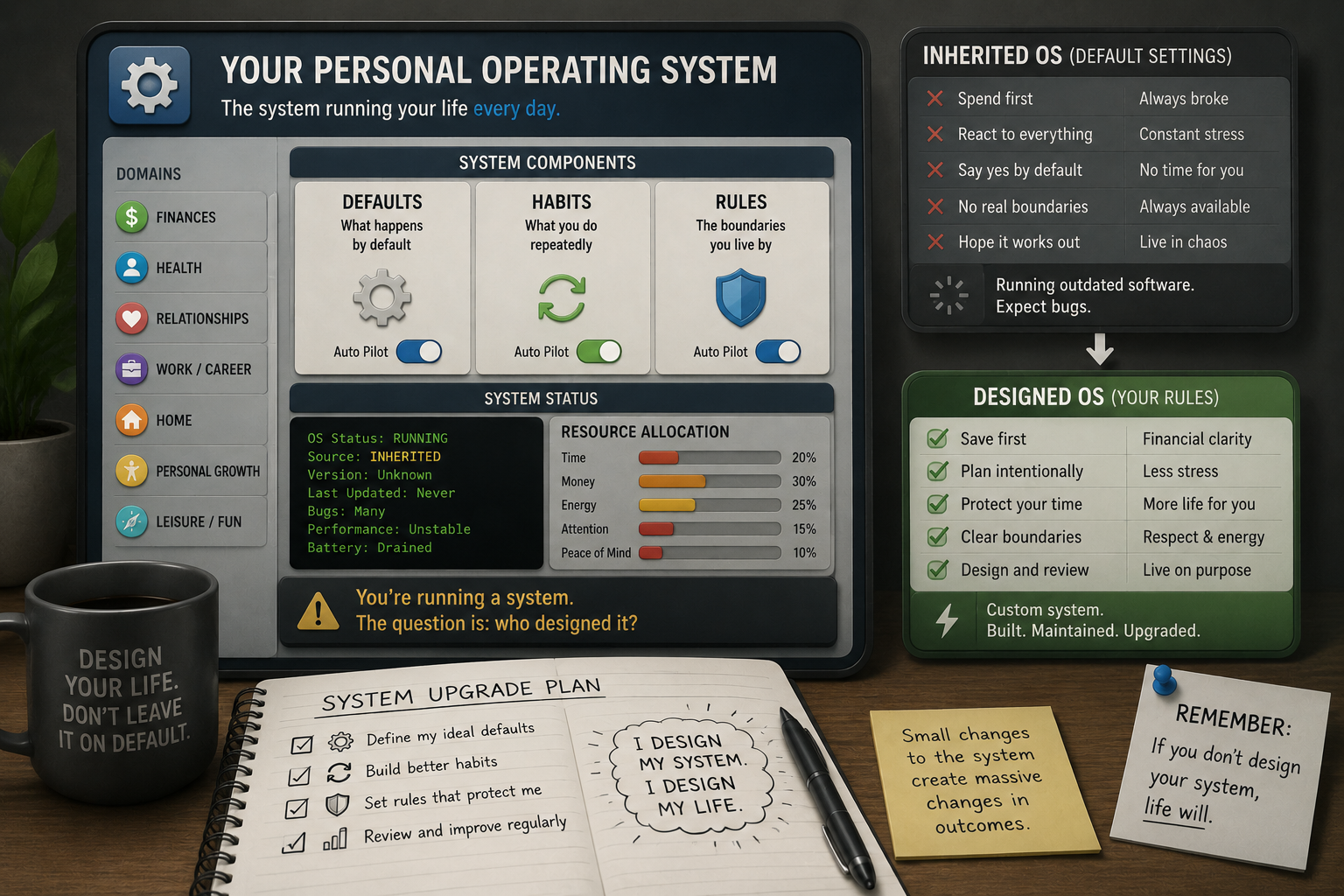
Open your phone right now. Notice how it's organized: apps grouped a certain way, notifications set to certain rules, a home screen you didn't fully choose so much as accumulate. Now ask the harder question: is your money organized that deliberately? Your health? Your career?
For most people, the answer is no. And here's the reframe worth sitting with: a personal operating system is the set of defaults, habits, and rules quietly running every domain of your life whether you designed them or not. If you never consciously built one, you're still running one. You just inherited it instead of choosing it.
That distinction, inherited versus designed, is the entire difference between a life that runs on autopilot and one that runs on purpose. Here's how to build the second kind.
Why Most People Never Build a Personal Operating System
ROOT CAUSE: The system was inherited, not designedNobody sits you down at eighteen and asks how you want to run your finances, your health routine, or your weekly schedule. You absorb a default: the habits modeled by your household, the norms of your first job, whatever pattern happened to be nearby when the pressure to "figure it out" hit hardest.
That inherited system isn't necessarily bad. It's just not yours. It was built for a different person, in a different context, optimizing for different constraints than the ones you actually have now. Running someone else's operating system rarely fails loudly. It just quietly under-performs, in ways that are easy to mistake for a personal shortcoming rather than a design mismatch.
You didn't fail to build a system. You just never got asked to design one on purpose.
The fix isn't willpower. It's an audit, followed by an intentional re-design. That's the mechanism behind a real personal operating system, and it's the same mechanism engineers use any time they upgrade a system that's still functional but no longer optimal.
What a Real Personal Operating System Actually Looks Like
In software engineering, refactoring means restructuring existing code to work better without changing what it fundamentally does. Re-tuning is the same move applied to your life: you're not demolishing your finances, health, or career and starting from zero. You're taking the system that's already running and deliberately improving its structure, one component at a time.
This is not a personality overhaul. It's structural. A personal operating system has three parts, and the same three parts show up whether you're designing a budget, a fitness routine, or a weekly schedule:
- Defaults — the decisions you've pre-made so you don't have to re-decide them under pressure every time.
- Rules — the simple if-then logic that tells you what to do when a specific situation comes up.
- Reviews — the recurring checkpoint where you look at what the system produced and adjust it.
Whether the domain is money, health, or your calendar, the shape of the failure is identical: no defaults, no rules, no review. Which means the shape of the fix is identical too.
How to Create Your Personal Operating System in Four Steps
Pick one domain to start, not all twelve. Then run this sequence:
1. Audit
Write down what you actually do right now, not what you intend to do. Most inherited systems only become visible once you describe them plainly on paper.
2. Design Defaults
Pre-decide the recurring choices: what you automatically save, what you automatically eat on a weeknight, what time you automatically go to bed. Every default removed is one less decision made under pressure.
3. Write the Rules
Turn recurring situations into simple if-then logic: if an unexpected expense comes up, then it comes from the buffer, not the credit card. Rules turn judgment calls into repeatable process.
4. Schedule the Review
Put a recurring date on the calendar, monthly or quarterly, to check what the system actually produced against what you wanted it to produce. This is the step almost everyone skips, and it's the one that keeps a personal operating system from going stale the way a New Year's resolution does.
Audit One Domain
Choose the domain of your life causing you the most friction right now: money, health, home, or career.
That's the audit step, done. Everything else in this framework builds on having an honest starting point.