How to Create a Personal Contingency Plan
You cannot predict which disruption hits you first. You can build the system that absorbs it either way.
Your car makes a sound you don't recognize. Your landlord mentions the roof "might need looking at soon." A recruiter reaches out about a role at a company that, two weeks later, announces layoffs. None of these things has happened to you yet. All of them could, this year, in some order you don't get to choose.
Most people respond to this uncertainty by trying to predict it: reading about layoff trends, researching HVAC lifespans, scrolling worst-case scenarios late at night. That effort is almost entirely wasted. You cannot forecast which disruption arrives first. What you can do is build a system that survives whichever one shows up.
That system is not a bunker, a spreadsheet of fears, or a vague sense that you'll "figure it out." It is a specific, buildable structure: a personal contingency plan. Here is how to build one in four parts, starting today.
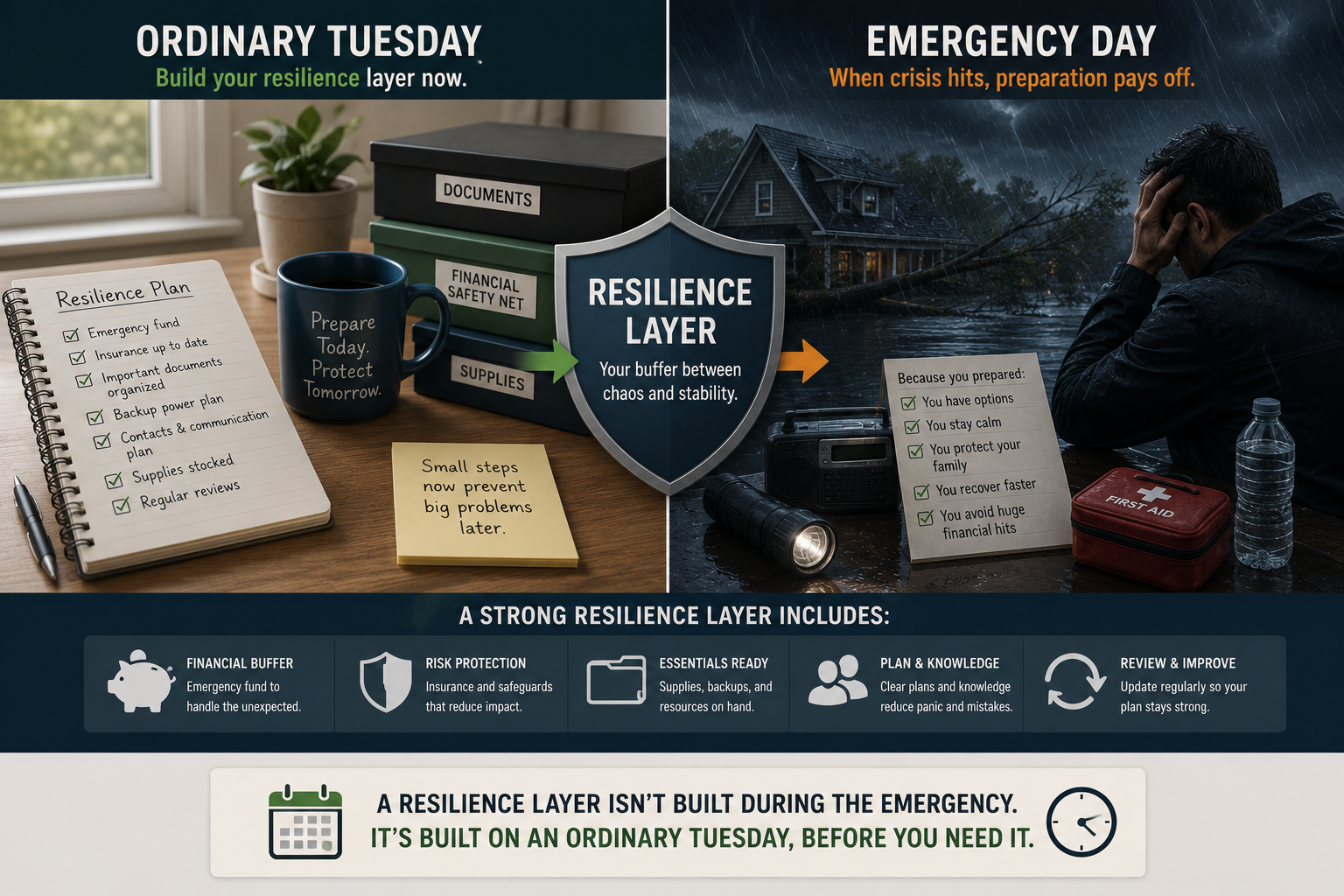
The Root Cause: No Resilience Layer
ROOT CAUSE: No resilience layer builtOf the five ways a life system fails, this one is distinct from the other four. A missing budget, an inherited habit, or a system with no feedback loop is a design flaw in the system itself. A missing resilience layer is different: the underlying system might be perfectly well designed and still fail catastrophically, because it has no slack, no redundancy, and no recovery protocol built in for the moment something goes wrong.
This is why a single disruption so often cascades. A job loss becomes a missed mortgage payment becomes a credit problem becomes a harder time renting the next apartment. Not because any one of those systems failed on its own terms, but because none of them had a buffer layer designed to absorb the initial shock before it spread.
A resilience layer doesn't prevent the disruption. It stops the disruption from becoming a cascade.
The good news is that resilience is one of the more mechanical things to design. Unlike, say, career direction or relationship repair, it does not require deep introspection. It requires four specific components, built once and reviewed periodically. That is the entire mechanism, and it's covered next.
The Mechanism: What a Buffer Actually Does
In engineering, a buffer is capacity held in reserve specifically so a system can absorb an unexpected load without failing. It is not slack that accumulates by accident. It is slack that is deliberately designed in, sized to the disruptions the system is most likely to face. In your life, Breathing Room is the same idea: the cash, the documentation, the contacts, and the decision already made, held in reserve, so an unexpected event costs you time and stress instead of costing you everything downstream.
A system without a buffer doesn't just risk failing more often. It fails harder, because every disruption gets absorbed by whatever is nearest and most flexible at the moment, which is usually your credit, your relationships, or your health. A buffer changes what absorbs the shock.
Money is the most measured buffer, which is why it shows up first in the research. But the same mechanism applies to the other three layers of a contingency plan: information, network, and decisions. A system with no cash reserve, no accessible documents, no identified first call, and no pre-made decision about what happens next isn't unlucky when disruption hits. It's undesigned.
The Design: Four Layers of a Personal Contingency Plan
A complete contingency plan has four layers. Each one absorbs a different kind of shock, and each can be built independently, so you do not need to complete all four before the plan starts adding value.
Layer 1 — The Cash Buffer
A dedicated reserve, separate from your everyday account, sized to your actual fixed costs rather than a round number you saw online. Even a partial buffer changes your options in the first 72 hours of a disruption, which is usually when the most expensive decisions get made under pressure.
Layer 2 — The Document Buffer
Insurance policy numbers, account logins, ID copies, and your healthcare directive, gathered in one place you can access without your primary phone or computer. Most people only discover this layer is missing while standing in a claims office, which is the worst possible time to discover it.
Layer 3 — The Network Buffer
One identified first call for each major disruption type: a person for a medical emergency, a person for a financial emergency, a person for a housing emergency. Not "people I could probably ask." A specific name, confirmed in advance, for each domain.
Layer 4 — The Decision Buffer
The single hardest layer to build under pressure is a decision you haven't made yet. Deciding, in advance, what you'll cut first if income drops, or which system takes priority if two things break at once, removes the most expensive part of any crisis: figuring out what to do while it's happening.
You do not need all four layers finished today. You need one of them started, measured against a specific likely disruption, and reviewed twice a year as your circumstances change. That is the iterate step, and it's what keeps a contingency plan from going stale the way most emergency binders do.
Build Your First Contingency Card
Open a blank document. List the three disruptions most likely to hit your life this year, ordered by likelihood.
That card is your Layer 3 and Layer 4 buffer, built in one sitting. It is not the whole plan. It is the first version of a system that gets better every time you review it.