Creating Effective Feedback Loops: Why Tracking a Number Isn't Enough
You've been logging your weight, your spending, your mood, for months. Nothing has changed. That's not a willpower problem. Your loop is broken, and it's broken somewhere you haven't looked yet.
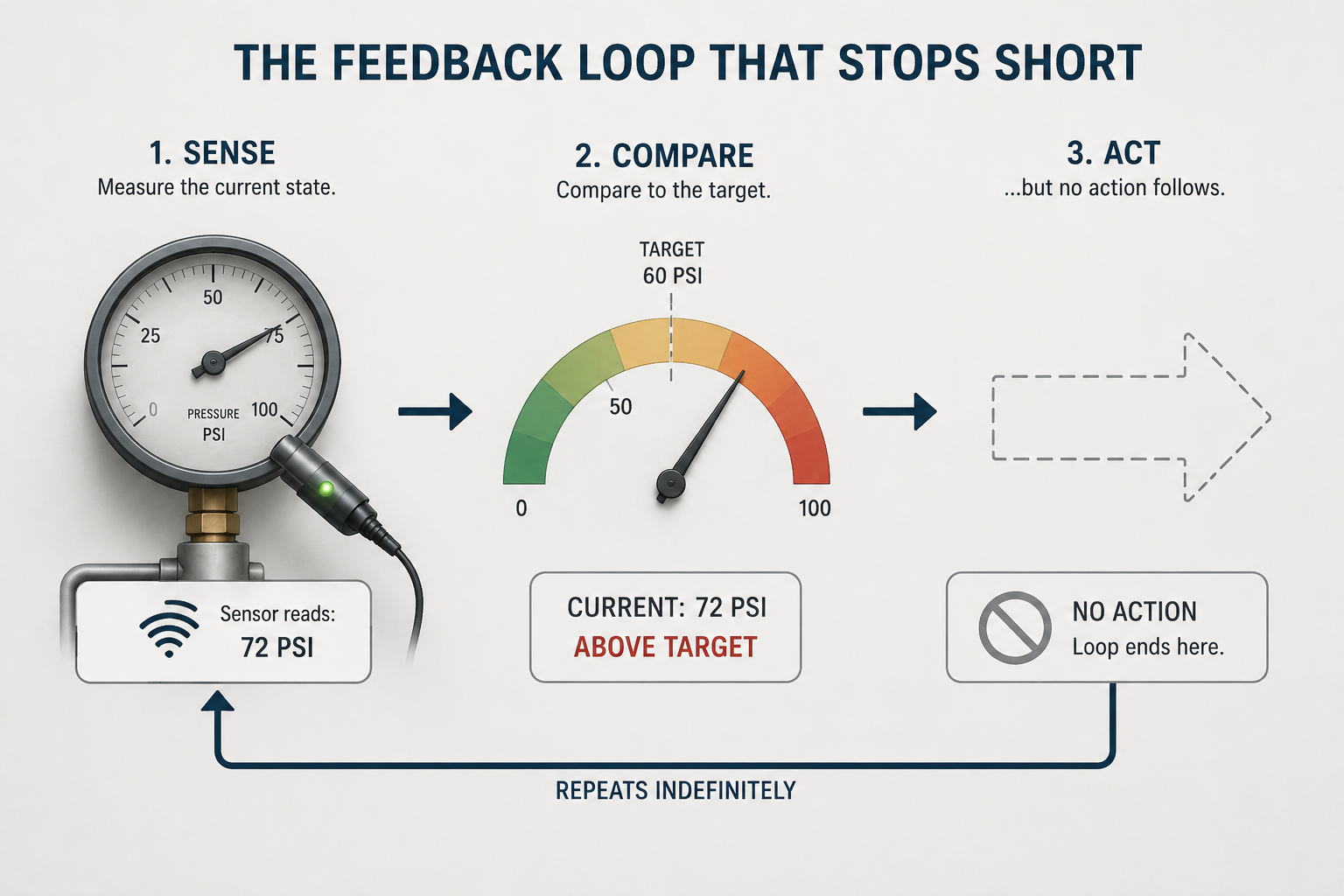
You've been weighing yourself every morning for four months. You have the app, the streak, the chart. The chart hasn't moved. You've also been tracking your spending in a budgeting app for almost as long, every transaction categorized, every month reviewed. Your savings rate hasn't moved either. You did the thing every article tells you to do, measure it, and the measuring alone didn't fix anything.
This is the part nobody warns you about: a number you track is not automatically a feedback loop. It's only one piece of one, and a feedback loop with a missing piece doesn't function at half strength. It just doesn't function, no matter how faithfully you keep the chart. You can have months of beautifully recorded data and still be running a completely open system, because the data was never actually connected to anything that changes.
Engineers have a precise name for what's missing, and once you see the actual structure of a working feedback loop, it becomes obvious which piece of yours is broken.
The Root Cause
ROOT CAUSE: The system has no feedback loopA real feedback loop, in engineering terms, has exactly three parts working together: a sensor that measures what's actually happening, a comparison against a target value, and an action that responds to the gap between them. Drop any one of the three and what's left isn't a weaker loop. It's an open loop wearing a feedback loop's clothes.
The morning weigh-in has a sensor (the scale). Does it have a comparison? Often not, beyond a vague sense of "I want it lower." Does it have an action triggered by the comparison? Almost never, beyond the same general intentions that were already in place before the tracking started. The scale is sensing into a void. Nothing downstream of the number ever changes because of the number. That's not a feedback loop with a flaw. That's a sensor with no loop attached to it at all.
A thermostat that reads the temperature but never turns on the furnace isn't a broken thermostat. It's a thermometer. Most personal tracking systems are thermometers.
The Mechanism: Sensor, Setpoint, Actuator
Control theory, the engineering discipline behind thermostats, cruise control, and every other self-regulating system, breaks a feedback loop into the same three components every time, and naming them in your own life makes the missing piece visible almost immediately.
This is the literal engineering origin of the Deadband Life name, and it's worth defining properly here, because Article #23 is where it earns its full treatment. In control theory, a deadband (what we call the Steady Zone) is the intentional range around your setpoint where the system holds without overreacting to noise. But the deadband only means anything in relation to a setpoint, the specific target value the system is trying to maintain, what we call your True North. A thermostat's deadband is the small range around 70 degrees where it does nothing on purpose. Without a setpoint to measure against, there's no deadband, no error signal, and no reason for the actuator to ever fire.
Your True North. The specific, defined state you are actually trying to maintain, not a vague aspiration like "be healthier," but a concrete value a sensor could measure against: a target savings rate, a target weight range, a target number of weekly workouts. Every functioning feedback loop needs one. Without it, your sensor has nothing to compare against, and "comparison" is the step that turns a measurement into a signal for action.
This is exactly the gap in the weigh-in and budgeting examples above. The sensor was working fine. What was missing was an explicit setpoint (a number, not a feeling) and a predefined action tied to the gap between the sensor reading and that setpoint. "If my weight is more than two pounds above target for two consecutive weeks, I reduce portion sizes at dinner for the following week" is a complete loop. "I'll keep an eye on it" is a sensor with the rest of the circuit cut.
Control engineers also pay close attention to a failure mode worth borrowing directly: the time delay between sensing and acting. A feedback loop that senses something today but doesn't act on it for six weeks behaves very differently from one that closes the gap immediately, even when both loops are technically measuring the same thing. Real control systems are tuned specifically because too much delay between the error signal and the corrective action causes the same problem in a thermostat that it causes in a person: by the time the action finally happens, the original signal is stale, and the response either overcorrects or arrives too late to matter.
Here's the same three-part structure applied to two versions of the same money system, so the difference is concrete rather than abstract. Open loop: you check your bank balance most weeks (a sensor), feel vaguely uneasy or relieved depending on the number (no real comparison, since there's no defined target), and do whatever you were already planning to do regardless of what the balance said (no actuator tied to the reading at all). Closed loop: you check your balance every Sunday (the same sensor), against a defined setpoint of $1,500 minimum (a real comparison), and if it's below that threshold, you automatically move $100 from a discretionary category into savings the following week (a real actuator). Both versions involve looking at the same number on the same schedule. Only one of them is actually a system.
The Design: Closing the Loop, Not Just Watching the Gauge
Article #21 covered choosing what to measure and recording it reliably, that's the sensor half of this. This section closes the other half: the setpoint and the actuator, the parts that turn a recorded number into something that actually changes your system.
Step 1 — Diagnose: Find Where Your Current Loop Actually Breaks
For any number you're already tracking, ask three questions in order. Do I have a sensor (am I actually measuring something real, regularly)? Do I have a setpoint (a specific target value, not a feeling)? Do I have a predefined action (something specific that happens when the gap between the two crosses a threshold)? Most broken personal feedback loops fail at question two or three, not question one. People track plenty. They rarely define the target or the response in advance.
While you're diagnosing, separate real signal from ordinary noise. A single high-spending week or one missed workout is usually noise, the day-to-day variance every system has. A four-week trend moving the same direction is signal. If your loop reacts to every single data point as though it were significant, you're not measuring against a setpoint, you're measuring against your own anxiety, and that's a fast route to the kind of constant overcorrection covered in Step 4 below.
Step 2 — Design: Write the Setpoint and the Trigger Together
Define your setpoint as a specific number or range, not an aspiration. Then write the rule that fires when you're outside it: "When [measured value] is [more/less] than [setpoint] for [duration], I will [specific action]." This single sentence is the entire missing half of most people's tracking systems. It converts a passive log into an active loop.
Step 3 — Implement: Shrink the Delay Between Signal and Action
Tie the check and the response together in time. If you only review the number monthly, the action should also be decided and taken within that same review, not "sometime after I notice." The preventive-maintenance scheduling principle from Article #18 applies directly here: a fixed cadence for checking is only useful if the response happens on the same cadence, not whenever you eventually get around to it.
Step 4 — Iterate: Watch for Oscillation, Not Just Silence
A loop that's reacting too strongly to every small fluctuation will overcorrect constantly, swinging from one extreme response to another. That's not a sign the loop is working hard. It's a sign the deadband, the Steady Zone around your setpoint, is too narrow, and the system is treating ordinary noise as a real signal. If your responses feel reactive and exhausting rather than steady, widen the threshold before tightening it further.
Close One Loop You're Already Sensing
Pick one thing you're already tracking but that hasn't produced any actual change. Open a blank document and complete this exact sentence:
Write the full sentence out, with real numbers, not placeholders.
That sentence is the actuator your loop has been missing. Put it somewhere you'll see it the next time you check the number, your tracking just became a system instead of a log.