How to Prioritize What to Fix First When Everything Feels Broken
You can't fix twelve systems at once. You can fix one, correctly, if you know which one actually matters most right now.
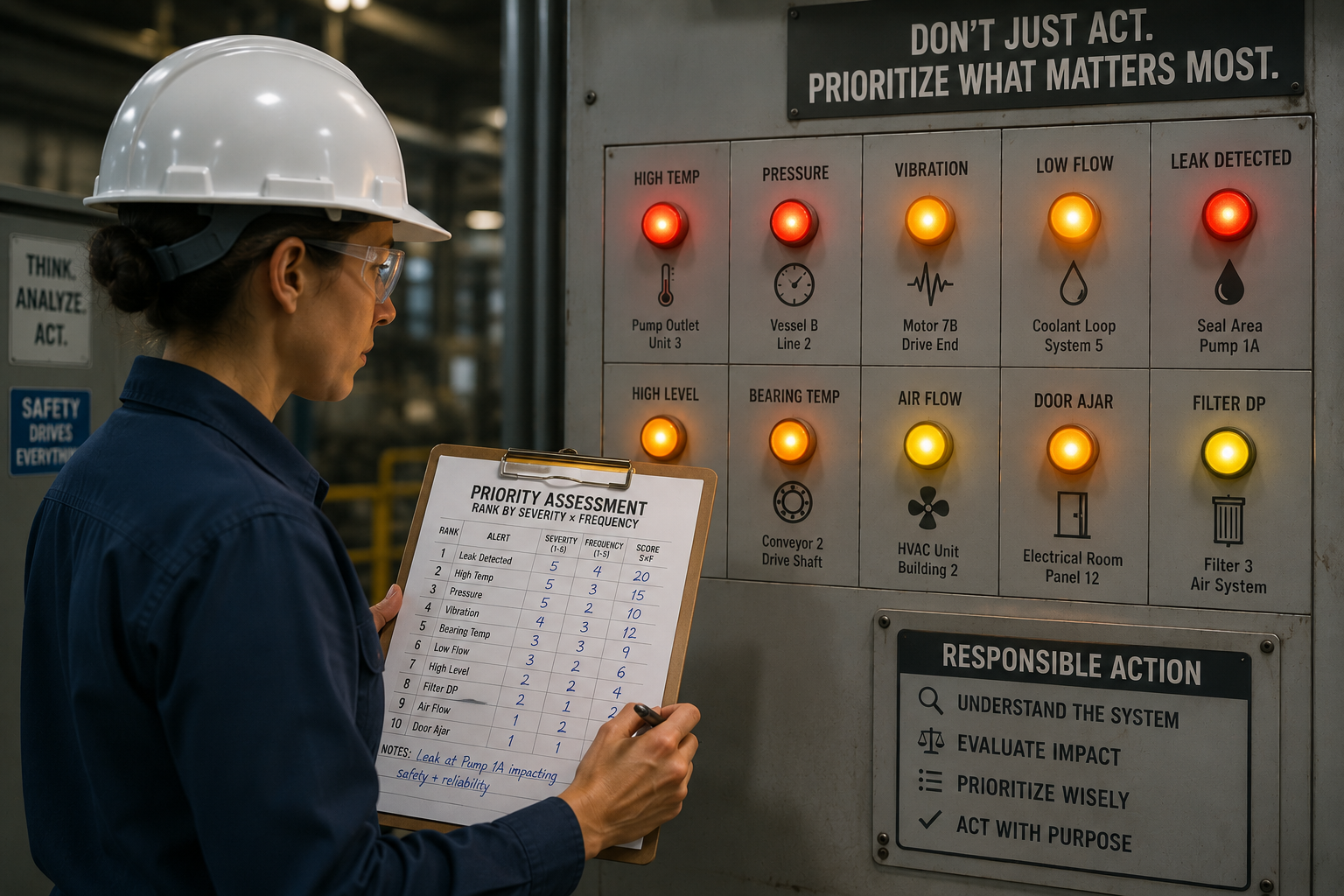
Your car needs an oil change. Your emergency fund is at zero. You haven't seen a dentist in two years. Your job search has been "starting next week" for three months. Your apartment lease renews in six weeks and you haven't decided whether to stay. Any one of these, looked at alone, is manageable. Looked at together, at eleven at night, they feel like a single, undifferentiated wall of failure, and the wall is so big that you close the laptop and do none of them.
This is not a discipline problem. It's a missing step. You jumped straight from "I have multiple broken systems" to "I should fix all of them," skipping the one decision that actually determines whether anything gets fixed at all: which one goes first, and why that one specifically.
Engineers facing a dozen simultaneous failures don't fix whichever one is loudest or closest. They rank them, using two numbers, and they fix the top of the list. You can use the same two numbers on your own list tonight.
The Root Cause
ROOT CAUSE: The system is optimized for the wrong outputWhen several things are broken at once, most people default to one of two bad ranking methods, and both produce the wrong answer more often than they produce the right one. The first is recency: fix whatever just went wrong, regardless of how much it actually costs you to leave it broken. The second is loudness: fix whatever feels most urgent in the moment, which is usually whichever problem is causing the most emotional noise right now, not whichever problem is doing the most structural damage.
Both methods are optimizing for the wrong output. They optimize for "make the discomfort stop fastest," which is a correction, not a corrective action (see Article #14). The actual output you want from a prioritization decision is "reduce the most total risk to my life systems with the resources I actually have this week." Those are frequently not the same problem at all.
The loudest problem and the most dangerous problem are rarely the same problem. Ranking by volume fixes the wrong one almost every time.
The dentist appointment you've been avoiding for two years might be quietly the highest-cost item on that list, not because it's loud, but because the cost of continued neglect compounds silently until it becomes an emergency. The emergency fund at zero might outrank everything else because its absence multiplies the damage of every other failure on the list: a job loss, a medical bill, or a car repair all become catastrophic specifically because there's no buffer. Loudness tells you nothing about either fact.
The Mechanism: Severity, Frequency, and the Vital Few
The actual engineering answer to "which problem first" comes from risk assessment, and it rests on two numbers, not one: how bad is it if this fails, and how often or how likely is it to fail. A problem that is moderately bad but happens constantly can outrank a problem that is catastrophic but extremely rare. A problem that is rare but devastating, a total loss of income, for instance, can outrank a dozen minor daily annoyances combined. Ranking on either dimension alone misses exactly the cases that matter most.
A second, related principle narrows the list further once you've ranked it: the Pareto principle, originally observed in wealth distribution and later adapted to quality management, holds that a small number of causes typically account for a disproportionate share of total impact. In practice, this means you rarely need to fix everything. You need to correctly identify the small handful of items, often two or three out of a dozen, that are responsible for most of the actual damage, and ignore the long tail of minor issues until those are handled.
This is why a system-by-system audit of your life almost always surfaces one or two items that dominate the list once severity and frequency are both accounted for. The emergency-fund example again: research on financial resilience shows that the inability to absorb an unexpected expense is widespread and severely consequential when it intersects with any other disruption, which is exactly the combination of high frequency (these disruptions are common) and high severity (the downstream effects compound) that should push a problem to the top of a properly built list.
Notice what this method does that loudness-based ranking never does: it can surface a quiet problem (a dental check-up, a missing buffer) above a loud one (a noisy car, a nagging argument) when the quiet problem's severity and frequency actually justify it. The method doesn't care how a problem feels. It cares what a problem costs.
The Design: Building Your Own Priority Ranking
You don't need risk-assessment software. You need a short list and two honest numbers per item. Here's the four-step version of the Deadband Life methodology applied specifically to choosing what goes first.
Step 1 — Diagnose: List Every Broken System, Without Editing
Write down every system currently bothering you, the car, the dentist, the emergency fund, the lease, the job search, without filtering for "is this really a big deal." The filtering happens in the next step, with numbers, not in this step, by feel.
Step 2 — Design: Score Severity and Frequency
For each item, assign two rough scores from 1 to 5: Severity (how bad are the consequences if this stays broken for another six months) and Frequency (how often does this cost you something, money, time, stress, opportunity, in a normal month). Multiply the two. The highest products are your "vital few." Everything else is the long tail you can leave alone for now.
Step 3 — Implement: Commit to the Top One or Two Only
Resist the urge to start three things because they're all "kind of high." Pick the single highest-scoring item, or at most the top two if your week genuinely allows it, and start there. Article #14 covers how to tell whether your first move on it is a real corrective action or just a quick fix in disguise.
Step 4 — Iterate: Re-Rank Every Few Weeks
A priority list is not permanent. Once the top item is genuinely addressed, its severity or frequency score drops, and something else rises to the top. Re-score the list every few weeks rather than building it once and treating it as fixed forever. This is the same continuous-improvement loop from Article #16, applied to the ranking itself rather than to any single system.
The goal of this exercise is not certainty. It's a defensible starting point. You will occasionally rank something wrong, and that's fine, the re-ranking step in Step 4 catches it. What the method actually solves is the paralysis of facing twelve problems at once with no way to choose. Two numbers and a short list turn that paralysis into a decision you can act on tonight.
Build Your First Severity-Frequency List
Open a blank document and list every system currently bothering you, five to ten items is plenty. For each one, write:
2. Frequency (1–5): how often does this cost you something in a normal month?
3. The product of the two. Circle the highest score on the list.
That circled item is what you work on next, not the loudest item, not the most recent one. You now have a ranked list instead of a wall of undifferentiated problems, and a ranked list is something you can actually start.