Emergency Planning for Families
Owning a flashlight isn't the same as having a plan. Here's the simple system that turns good intentions into a family that actually knows what to do.
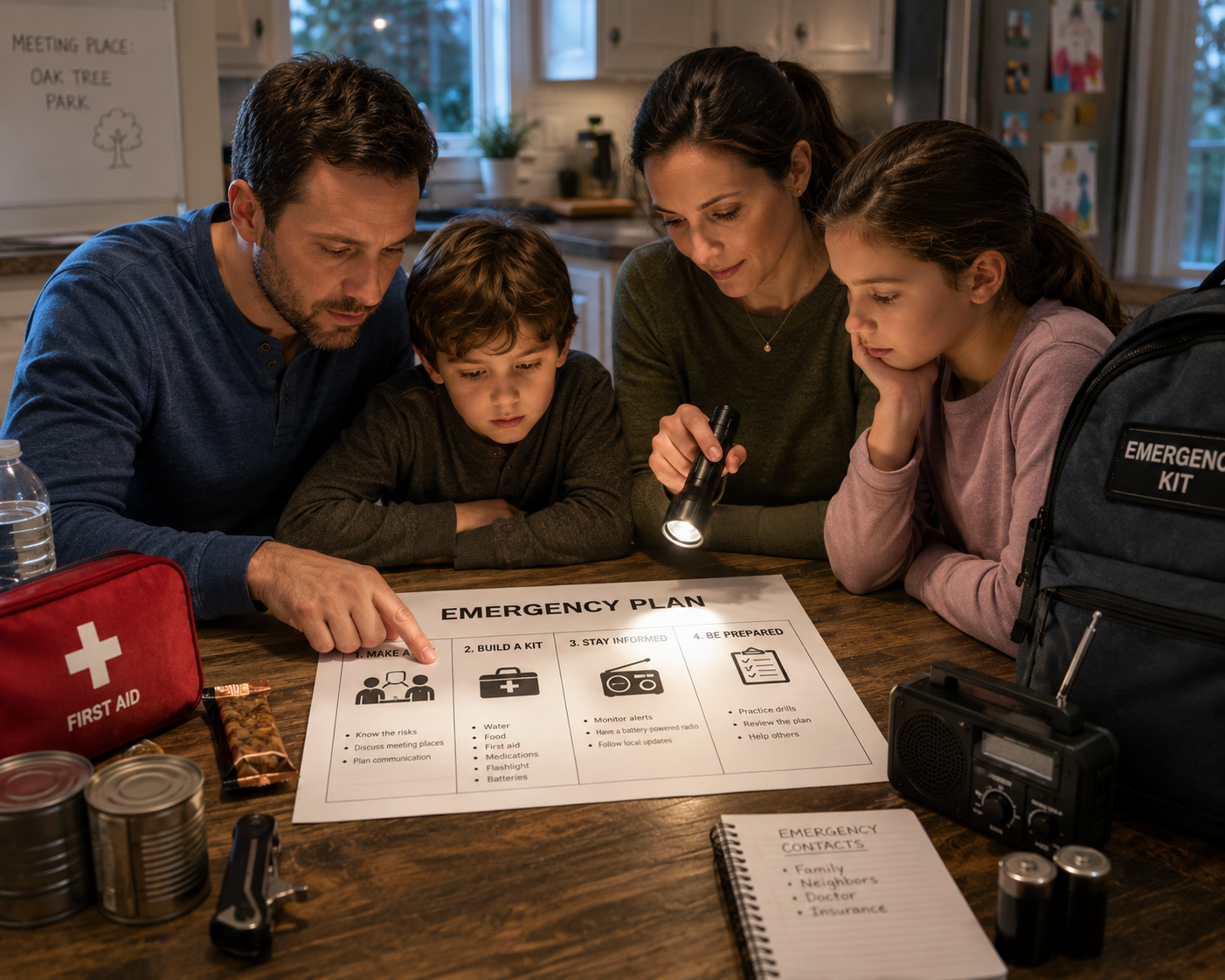
The power goes out during a storm, and for the first ten minutes, your household runs on instinct. Someone grabs a phone flashlight. Someone else asks where the candles are. Nobody knows if the water is still safe, whether to stay or go, or what the actual plan is, because there never was one. You're not unprepared because you don't care. You have a junk drawer with batteries in it. What you don't have is a system.
This is the gap between owning supplies and having a plan, and it's a gap almost every family has. The flashlight is in the drawer. The plan is nowhere, because nobody ever sat down and built it, and disasters don't wait for a convenient time to test whether one exists.
A family emergency plan isn't a binder full of worst-case scenarios. It's a short, specific answer to four questions, decided in advance, while everyone is calm, so nobody has to figure it out while the lights are out and the kids are scared.
The Root Cause
ROOT CAUSE: The system cannot tolerate disturbanceMost households' emergency readiness is built entirely around supplies, a flashlight, some bottled water, maybe a first aid kit, with no actual process behind them. Supplies without a plan are inventory, not resilience. The plan is what tells a scared eight-year-old where to meet everyone if the family gets separated, or tells a teenager what to do if a parent isn't reachable by phone. Without that layer, supplies just sit in a drawer while the actual emergency gets handled by improvisation.
This matters more for families specifically than it does for a single adult living alone, because a family's emergency response depends on coordination across multiple people who may not be in the same place when something happens. A single adult's plan is mostly about their own decisions. A family's plan has to account for a kid at school, a partner at work, and a grandparent across town, all needing to know their own next move without being able to call each other to ask.
The gap shows up clearly in national data. Even as preparedness actions have climbed in recent years, confidence hasn't kept pace, which is exactly the signature of a system built on materials rather than process.
Why Supplies Alone Don't Make You Prepared
The most rigorously validated tool for measuring household disaster readiness, the Household Emergency Preparedness Instrument, doesn't score households on what they own. It scores them across two separate dimensions: actions and planning on one side, supplies and resources on the other. The instrument's developers found these load as genuinely distinct factors, meaning a household can score well on one while scoring poorly on the other.
That's the mechanism behind the hook at the top of this article. Families default to buying the flashlight because it's a concrete, purchasable action. Building the plan is harder, because it requires a conversation, not a transaction, and conversations are easy to keep postponing until there's no emergency forcing the issue. Buying a go-bag takes twenty minutes on a Saturday and produces something you can see and touch. Sitting down with your kids to decide on a meeting spot takes the same twenty minutes but feels less productive, because there's no object at the end of it, just an agreement. That asymmetry is exactly why so many households are well-stocked and still uncoordinated.
The Design: Four Questions, Answered in Advance
A family emergency plan doesn't need to cover every possible disaster. It needs to answer four specific questions, decided together, before anyone needs the answer under pressure.
1. Where do we meet if we can't get to each other?
Pick two meeting spots: one near home, for something like a fire, and one further away, for something that makes the neighborhood inaccessible. Name them specifically. "Mrs. Carter's porch next door" works. "Somewhere safe" does not. The further-away spot matters more than people usually assume, since the near spot is useless if the emergency is the kind that affects the whole block.
2. Who do we contact if local phone lines are down?
During major disasters, local cell networks often jam long before out-of-area lines do. Pick one relative or friend who lives outside your region and agree that everyone checks in with that person if they can't reach each other directly. Write the number down somewhere that doesn't depend on a charged phone.
3. What do each of us do if we're not all together?
Kids at school, a parent at work, someone running errands, decide in advance what each person's first move is. Shelter in place where you are. Head to a specific person's location. Avoid driving toward home if roads are unsafe. The plan only works if everyone knows their own role, not just the household's. For young kids specifically, this usually means trusting their school's own emergency procedure rather than trying to get to them yourself; know what that procedure actually is, rather than assuming.
4. Where are the supplies, and does everyone know?
The flashlight in the drawer only counts if more than one person knows it's there. Walk the household through where supplies live, once, out loud, so the plan and the materials are actually connected to each other instead of existing in parallel.
Hold the Five-Minute Family Meeting
Gather everyone in the household tonight, even five minutes at the dinner table counts. Answer the four questions above out loud, together.
That card is your plan. It took less time to make than the time you've spent putting off making it, and it's already more useful than everything currently sitting in the emergency drawer.