Home Systems:
The Foundation of Stability
Most homeowners were handed the keys and handed the deed. Nobody handed them the operating manual. Here is the management system that turns your largest asset into something you actually understand and control.
There is something in your home that needs attention. You are not sure what it is exactly, maybe a sound that has developed recently, something you noticed during the last season change, a repair you scheduled mentally months ago and have not gotten to. You are not ignoring it out of negligence. You are ignoring it because the home is functioning well enough today, and dealing with it means admitting you are not sure how serious it is, how much it will cost, or who to call.
This is the specific texture of operating a home without a system. Not catastrophe, just the low-grade friction of a complex physical asset that is always somewhere on the spectrum between fine and failing, and you do not have the instrumentation to know where you currently are.
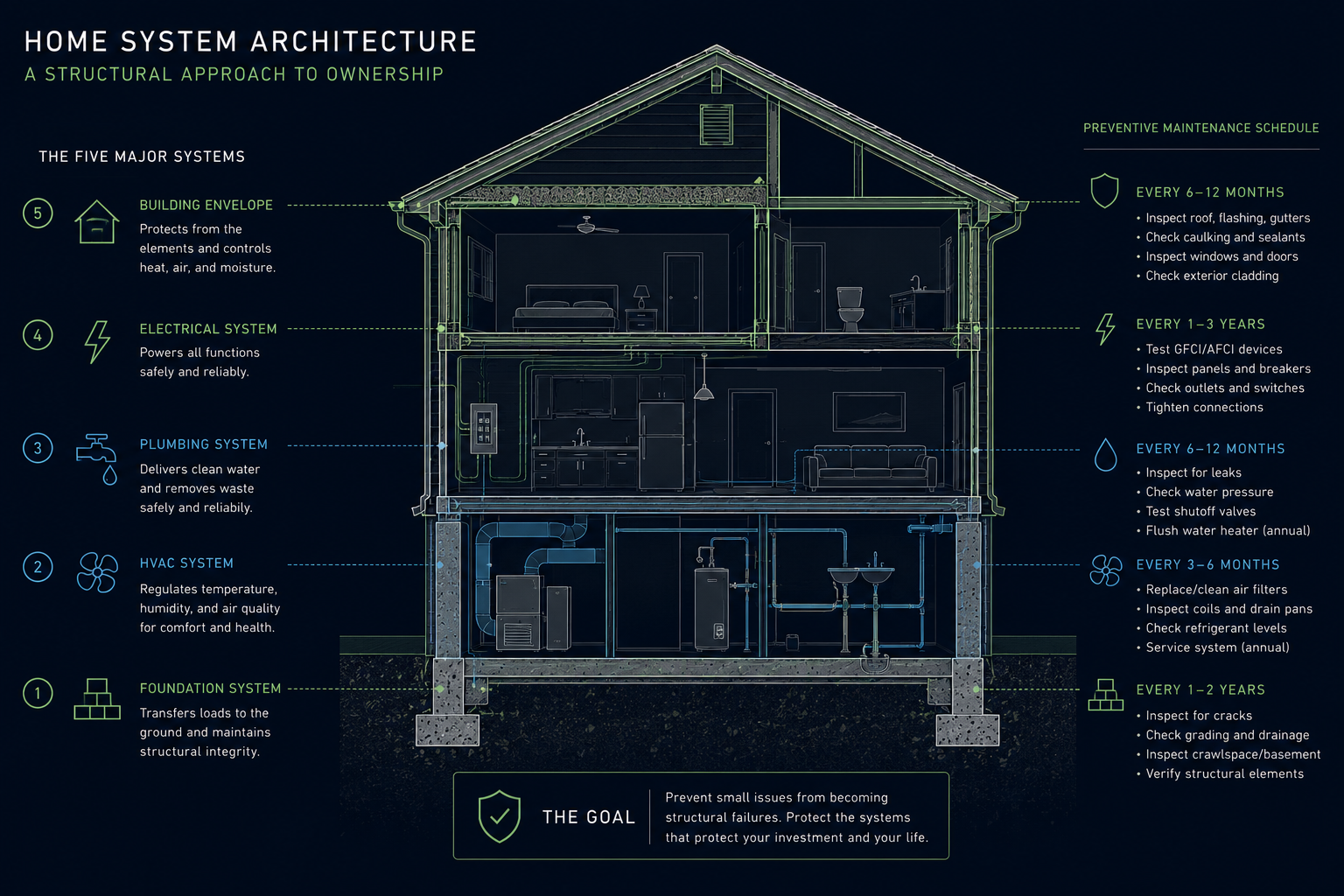
A home is not a possession. It is the largest financial asset most people will ever own, and it is a physical system with five major sub-systems interdependent with each other. Each sub-system requires active management to maintain its value, its safety, and its livability. The problem is not that homeowners do not care about their homes. The problem is that nobody teaches them how to manage one. They are handed the keys without the operating framework. This article is that framework.
The Diagnosis: The Two Failure Modes That Dominate
ROOT CAUSE (primary): No system was ever builtROOT CAUSE (secondary): The system has no feedback loop
Federal Housing Finance Agency research on first-time homebuyer sustainability identifies the behavioral predictors of homeownership stability, the factors that determine whether a household maintains and retains its home over time. The pattern is consistent: the buyers who exit homeownership involuntarily are not primarily those who cannot afford the mortgage payment. They are the ones who could not absorb the cost of maintenance and repair surprises that a proactive management system would have converted from crises into scheduled line items.
Sources: This Old House Research Team (2024) · Founding Document synthesis · FHFA Park (2024) practitioner benchmark data
Top Pain Domain: Homeownership and property maintenance ranked as the single highest source of operational unpreparedness in early target audience research.
Historic Market Low: First-time buyers have shrunk to nearly half of the historical 40% benchmark, driven by a compressed housing affordability crisis.
All-Time High Median Age: First-time buyers are entering the ecosystem a full decade later than previous generations, resulting in acute system shock when transitioning from managed rentals.
Baseline Maintenance Target: The annual industry-standard allocation of home value required to buffer structural degradation—a protocol rarely integrated into first-generation life setups.
The two dominant failure modes operate in sequence. First-generation homeowners typically arrive with no management system at all let alone the basics like a maintenance budget, inspection schedule, or understanding of what the five major home systems are or when they require service. Repeat homeowners often have a partial system they know to schedule some maintenance because of past failures but it lacks a feedback loop. They do not track the condition trajectory of their home's components systematically, which means they respond to failures rather than preventing them.
A home does not deteriorate because its owner is negligent. It deteriorates because deterioration is the default state of every physical system without active management. The question is only whether you manage it proactively or reactively, and the cost difference between those two approaches is not small.
The Home System: Anatomy and Sub-System Structure
The System Anatomy
Unlike financial or emergency systems, a home system has a physical dimension that makes its anatomy concrete and visible. That is if you know where to look. The inputs are time, money, and professional expertise. The process is a preventive maintenance loop: inspect, maintain, repair, upgrade in that sequence and at defined intervals. The output is the home's condition trajectory: its structural integrity, market value, and habitability over time. The feedback loop is the inspection cycle. That is the regular formal assessment that converts the invisible into visible and the reactive into preventive.
Time + attention
Professional services
Inspection knowledge
Repair → Upgrade
At defined intervals
Per system service life
Trajectory Structural integrity
Market value retained
Habitability maintained
Figure: Home System anatomy. Most homeowners have the inputs available. The maintenance loop is reactive, not proactive. The inspection feedback cycle is absent.
The Five Major Sub-Systems Every Homeowner Must Know
A home is not a single system. It is five major sub-systems operating in the same physical envelope, each with its own service life, its own failure modes, and its own preventive maintenance requirements. Most homeowners could not name all five. That is the knowledge gap and it is the entire reason reactive management is the default: you cannot manage proactively what you cannot name.
The five sub-systems are: the HVAC system (heating, ventilation, and air conditioning), the plumbing system (supply lines, drains, water heater), the electrical system (panel, wiring, outlets), the building envelope (roof, walls, windows, doors, foundation waterproofing), and the foundation and structure (framing, load-bearing walls, foundation). Each has a defined service life. Each has a well-understood preventive maintenance interval. And each has a predictable cost differential between proactive and reactive management.
Building the Home System: Failure Modes and Structure
The Five Failure Modes — Home Systems
The Three-Layer Home Management System
A functional home system is not a to-do list. It is three operational layers that run in parallel, each with a defined cadence and a specific output. Like the Money System's four layers, each layer here enables the ones that follow it.
Layer 1 — The Budget Layer. Before any maintenance can be managed proactively, the financial infrastructure must exist. This means a dedicated home maintenance reserve funded monthly at 1% of home value per year, held separately from the emergency fund, and used exclusively for maintenance, repair, and planned capital expenditures. Without this layer, every repair becomes a financial emergency regardless of how predictable it was physically.
Layer 2 — The Inspection Layer. An annual inspection of all five major sub-systems, conducted at minimum as a homeowner walk-through using a documented checklist, and at recommended intervals with a licensed professional. The inspection converts the home's condition from invisible to documented. It is the feedback loop. Without it, the system produces condition degradation that is invisible until it manifests as an expensive failure.
Layer 3 — The Documentation Layer. A home file (physical or digital) that contains the maintenance log, appliance manuals and warranty information, service records for all five sub-systems, contractor contact information, and permit records for any modifications. The documentation layer has two functions: it enables the inspection layer by making the history visible, and it protects the asset value by providing the evidence of maintenance that a buyer or insurer will eventually need.
Running the System: Annual, Seasonal, and Triggered
A home system without a review cadence is not a system, it is a list of intentions. The maintenance loop closes only when the inspection cycle runs on schedule and the findings are documented. Three cadences govern a functional home management system.
Annual — Full System Inspection
Once per year, all five sub-systems are assessed against their expected service life and current observed condition. For most homeowners, this means a DIY walk-through using a documented checklist for the accessible components, plus a professional inspection for systems requiring specialist access (electrical panel, roof, structural). The annual inspection produces the maintenance priorities for the coming year and updates the capital expenditure forecast for the next three to five years.
Seasonal — Systems Change-Over Review
Spring and fall are natural system transition points. Spring: HVAC switches to cooling mode, service it before peak demand. Roof inspection after winter. Drainage and exterior envelope check after freeze-thaw cycles. Fall: HVAC switches to heating mode, service it before peak demand. Weatherization check. Gutter clearing. Each seasonal review takes two to three hours and prevents the majority of weather-related failures.
Event-Triggered — After Any Significant Event
A major storm, a significant temperature extreme, a plumbing incident, or any new symptom (sound, stain, crack, or odor) triggers an off-cycle inspection of the relevant sub-system. The event-triggered review is not an emergency response. It is an early diagnostic: the difference between identifying a roof penetration after a storm and addressing it for $300, versus discovering water damage in the attic six months later for $8,000.
Map Your Home System: Three Questions, One Document
Open a blank document. Answer honestly — not what you intend to build, but what exists right now. These three questions map all three layers of your home system:
LAYER 2 — INSPECTION: For each of the five sub-systems (HVAC / Plumbing / Electrical / Roof+Envelope / Foundation+Structure) — write the last date it was professionally inspected or serviced, or write UNKNOWN. Count the UNKNOWNs. Each one is a gap in your feedback loop.
LAYER 3 — DOCUMENTATION: Can you locate, right now, the service record for your HVAC and the most recent roof inspection report? [ YES / NO / DOES NOT EXIST ]
FAILURE MODE: Which of the five failure modes best describes the dominant gap in your current home system? Write it down as a sentence you would say to someone explaining why your home is not yet fully managed.
You now have a Home System Current State Map. The most urgent priority is Layer 1: fund the maintenance reserve before anything else. Without the budget layer, every physical failure becomes a financial crisis regardless of how well the inspection layer is running. The support articles below build each layer in sequence.