Personal Risk Management: A System for Life's Bad Odds
You worry about the wrong risks and prepare for almost none of them. Here's how to fix both problems with the same system.
You've thought, more than once, about what would happen if the plane went down, or the market crashed overnight, or something dramatic and rare took everything sideways. What you probably haven't thought through with the same seriousness is what happens if your car needs a $2,400 repair the same month your hours get cut, or if a single bad diagnosis knocks out your income for six weeks, or if the one person who knows how your household finances actually work suddenly isn't available to explain it.
Those second scenarios are far more likely than the first ones, and far less prepared for. That's not a coincidence. It's a predictable pattern in how people think about risk, and it means most personal risk management, to the extent it happens at all, is aimed at the wrong targets.
You don't need to become fearful to fix this. You need a system that ranks risks by how likely and how damaging they actually are, instead of by how vivid they feel.
The Root Cause
ROOT CAUSE: The system cannot tolerate disturbanceThis is the same root cause behind a system that collapses on a bad day, but the scope is different. "Systems that survive bad days" is about ordinary daily capacity dips, low sleep, a rough week, a missed workout. Personal risk management is about the less frequent, higher-impact disruptions: the job loss, the major home failure, the health event, the death of the person who held a critical piece of the household running. Same root cause, different tier of consequence, and it needs its own structured process rather than a smaller version of a daily fallback.
Most people's approach to this tier of risk is almost entirely unsystematic. It's driven by whatever recently made the news, whatever happened to a friend, or whatever feels frightening in a given week. That produces exactly the wrong allocation of attention: high-drama, low-probability events get worried about constantly, while mundane, high-probability events, the ones statistically far more likely to actually hit you, get almost no preparation at all.
A designed system doesn't ask "what am I afraid of." It asks "what is likely, and what would it cost me if it happened," and then it builds mitigation in that order.
The Mechanism: Why We Misjudge Our Own Risk
The tendency to fear rare, dramatic risks more than common, mundane ones is well documented in risk-perception research. Foundational work in this field identified specific characteristics, dread and unfamiliarity chief among them, that make a risk feel larger than its actual statistical likelihood warrants. A plane crash is unfamiliar and dramatic. A blown transmission during a low-income month is neither, and gets almost no emotional weight, despite being the far more probable event for most people.
Meanwhile, the mundane risk that gets the least emotional attention, a sudden, moderate unexpected expense, is also the one most households are least prepared to absorb.
Feedback loop: risk inventory reviewed annually as circumstances change.
The Design: A Probability-and-Impact System for Your Own Life
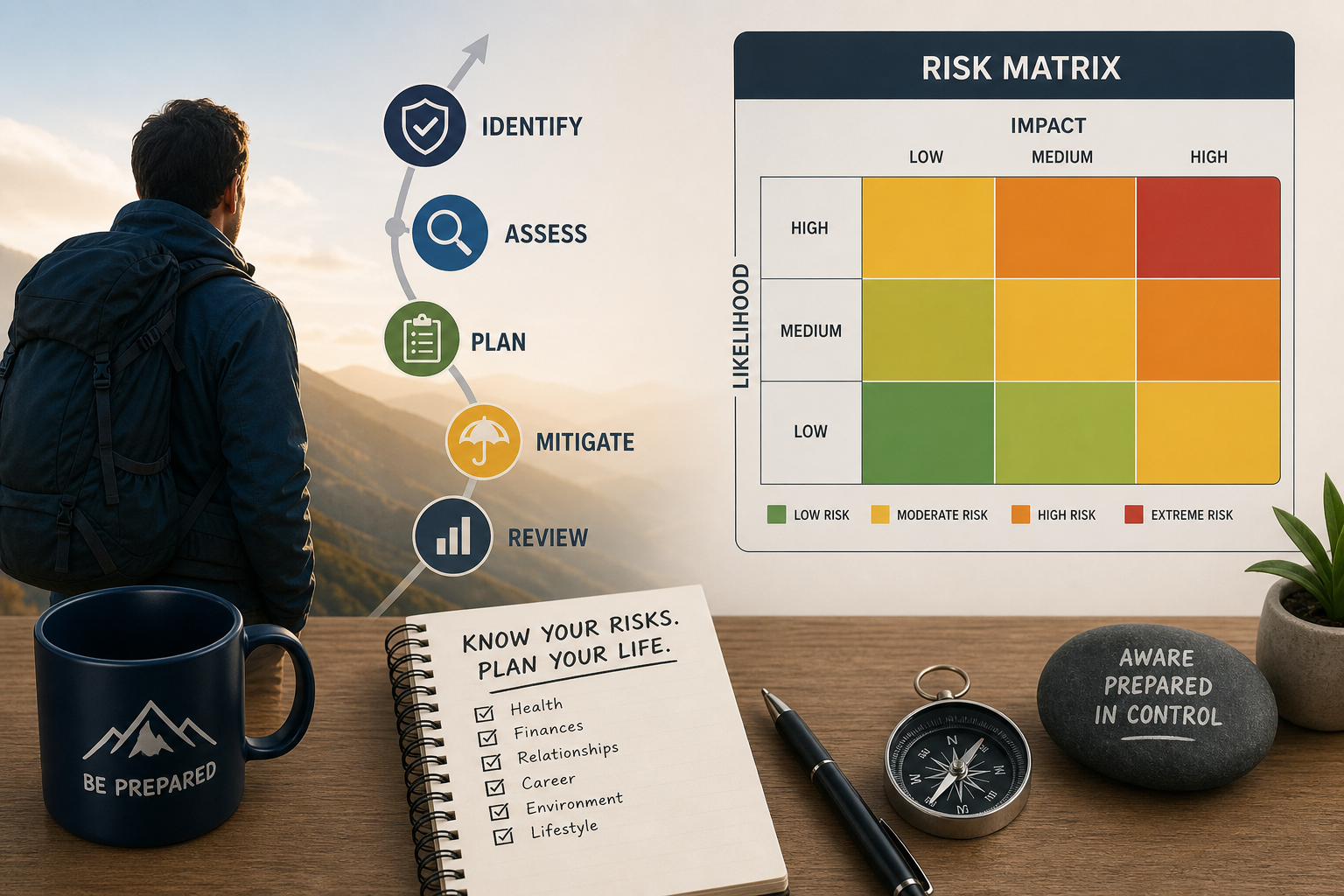
Formal risk management, in engineering and in finance, runs on one basic move: rank risks by how likely they are and how much damage they'd cause if they happened, then mitigate the highest-priority combination first. That move works exactly as well applied to a single household as it does to a company.
Step 1 — Diagnose
List the disruptions that could realistically hit each major domain of your life: income, health, home, and the people who depend on you or whom you depend on. Include the mundane ones, not just the dramatic ones. A car repair belongs on this list next to a job loss.
Step 2 — Design
For each risk, rate probability and impact on a simple scale, low, medium, or high is enough precision to start with. The risks that land high on both axes are your priority tier, not the ones that feel the scariest to think about.
Step 3 — Implement
Build the specific mitigation for your top-priority risk before moving to the next one. That might be a small emergency buffer sized to the $400-to-$2,000 range where most households actually get hit, a redundancy plan for a critical piece of household knowledge, or a coverage gap you close. Pick one and finish it before starting the next.
Step 4 — Iterate
Review the full risk inventory once a year, or after any major life change, a new dependent, a new home, a new income structure. Risks shift as circumstances shift, and a risk inventory that was accurate two years ago can be badly out of date without anyone noticing until it's tested.
Build Your First Risk Inventory
Open a blank document and list five disruptions that could realistically hit your income, health, or home this year. Rate each one's probability and impact as low, medium, or high. Circle the one risk that scores highest on both. That's your starting priority.