Building Financial Resilience
A healthy income and a resilient financial system are two different things. Here's how to build the one that survives a bad year.
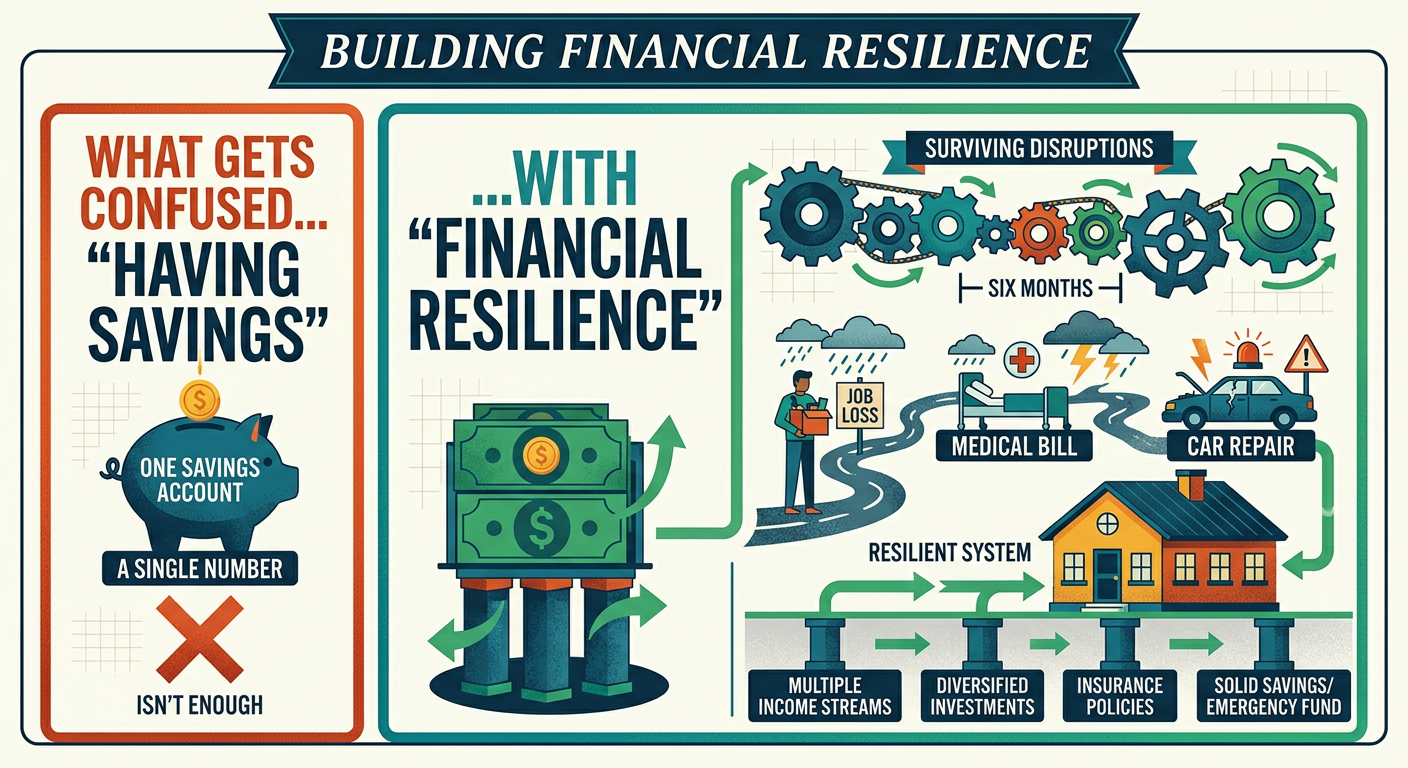
70% of U.S. adults say they couldn't confidently cover a sudden $1,000–$2,000 expense without taking on new debt. Read that again: not people who are broke. Not people without income. Just people whose financial system was never built to absorb a shock.
Building financial resilience gets confused with "having savings," but it's bigger than one number in one account. A resilient financial system has to survive a job loss, a medical bill, and a car repair arriving in the same six months, because that's how disruptions actually behave. They rarely show up one at a time.
Good news: resilience is one of the more mechanical things you can design. It's not about earning more or worrying more. It's four specific layers, built once and reviewed on a schedule.
Why Most People Aren't Building Financial Resilience — They're Just Hoping
ROOT CAUSE: The system cannot tolerate disturbanceA financial system can look completely healthy on a normal month and still have zero resilience. Income covers expenses. The budget balances. Nothing about the monthly numbers reveals that the entire system would collapse the moment one variable changed: the paycheck stops, or one large bill lands unannounced.
This is different from a budgeting problem or a cash flow timing problem, both of which we've covered in this series. Resilience is about slack: the deliberate reserve capacity that has nothing to do with your day-to-day numbers and everything to do with whether a single bad month turns into a bad year.
A budget tells you if today works. Resilience tells you if next year still will, no matter what happens between now and then.
Most people skip building this layer entirely, not from negligence, but because nothing in a normal month ever forces them to notice it's missing. That's exactly why it has to be designed on purpose, not discovered by accident during a crisis.
The Mechanism: What Resilience Actually Measures
A setpoint is the specific target a system is designed to maintain, not a vague direction, an actual number. Your True North for financial resilience is the same idea: not "save more," but a specific figure, such as three to six months of essential expenses held in reserve, that you can measure your current system against and know exactly how far you are from done.
Without a True North, "resilience" stays a feeling instead of a system. With one, it becomes a single number you can track, the same way an engineer tracks a system against a target rather than a vibe.
Notice what both sources point to: the gap isn't primarily about income level. It's about whether a specific, measurable target exists at all. That's a design problem, and design problems have design solutions.
How to Build Financial Resilience in Four Layers
Real financial resilience isn't one emergency fund. It's four layers, each protecting against a different kind of shock:
- Cash Buffer — three to six months of essential expenses, held separately from your everyday account, sized to your True North, not a round number from the internet.
- Debt Ceiling — a pre-decided limit on how much revolving high-interest debt you'll take on during a shock before you stop and reassess, decided in advance, not mid-crisis.
- Insurance Layer — the coverage that transfers a catastrophic risk (disability, major illness, property loss) off your balance sheet entirely, instead of onto your cash buffer.
- Income Diversification — even one small secondary income stream or in-demand skill meaningfully shortens recovery time after a job loss, independent of your savings.
You don't need to complete all four this month. You need to know your current status on each one, and pick the weakest layer to strengthen first.
Run this through the same four-step process every Deadband Life system uses: diagnose your current status against your True North, design the smallest layer that closes the biggest gap, implement it this month, and review the whole set twice a year as your expenses and risks change.
Calculate Your Current Runway
Add up your essential monthly expenses: housing, food, utilities, minimum debt payments. Then divide your current accessible savings by that number.
That gap is the first real target your financial resilience system has ever had. Everything else in this framework exists to close it.