Creating a Household Operating System
Your household isn't disorganized. It's running on one person's memory — and that's a single point of failure, not a personality trait.
You're the one who notices the dish soap is almost out. You're the one tracking which kid needs new shoes, when the dog's next vet appointment is, whether the filter's been changed, and what's actually in the fridge before anyone starts cooking. Your partner genuinely helps when asked. The problem is that you're the one doing all the asking, because you're the only one who ever notices in the first place.
It's exhausting in a way that's hard to explain to someone who isn't carrying it, because none of it looks like work from the outside. There's no task on a list called "notice things before they become problems." It's just a constant low hum of tracking, running in the background of everything else you're trying to do.
This isn't a "he does less than me" problem, even when that's also true. It's a design problem: your household has never had an explicit operating system. It runs entirely on the memory and attention of whoever happens to be paying attention — which means it can only ever run as well as one person's bandwidth allows.
The Root Cause
ROOT CAUSE: No system was ever builtMost households have a physical task list, of sorts: dishes, trash, laundry. What almost no household has is a system for the layer underneath the physical tasks — the noticing, planning, deciding, and monitoring that has to happen before any task even makes it onto a list. That layer defaults to whoever's brain is already scanning for it, and once someone becomes the default, the system never gets designed. It just calcifies.
The household isn't failing. It's succeeding at running on exactly the system it has: one undocumented, unshared, entirely memory-based system, held by one person. That's not a character issue on anyone's part. It's the predictable output of a household that was never given an actual operating system to run on instead.
The Mechanism: The Work Nobody Put On a List
Researchers have a name for the layer underneath the physical chores: cognitive labor — anticipating what the household needs, identifying the options, making the decision, and monitoring whether it actually got handled. It's largely invisible, and it's divided far more unevenly than the physical tasks people usually think of as "housework."
The gap in that invisible layer was consistently larger than the gap in visible chores — and it's the invisible layer, not the dishes or the laundry, that the research links most strongly to stress, burnout, and strain on the relationship. Carrying the noticing is a heavier load than carrying the doing.
Both partners can be telling the truth. One is describing the physical tasks they can see getting done. The other is describing the invisible layer underneath, the layer with no shared record, that never gets counted the same way twice.
The Design: Building the Operating System
The fix isn't "communicate more" or "appreciate each other more," though both help. The fix is making the invisible layer visible, so the household runs on a shared system instead of one person's memory.
Step 1 — Diagnose
For one week, every time you notice something before anyone asks you to, write it down: the soap that's almost out, the appointment that needs booking, the school form due Friday. At the end of the week, you'll have a visible list of the invisible work — often the first time anyone in the household has actually seen it.
Step 2 — Design
Build one shared system that captures both layers: the physical tasks and the cognitive ones — noticing, deciding, and following up — not just "who does the dishes." Assign full ownership of entire domains, not individual tasks: one person fully owns groceries end-to-end, another fully owns the car, rather than splitting every task down the middle and defaulting the noticing back to whoever usually notices.
Step 3 — Implement
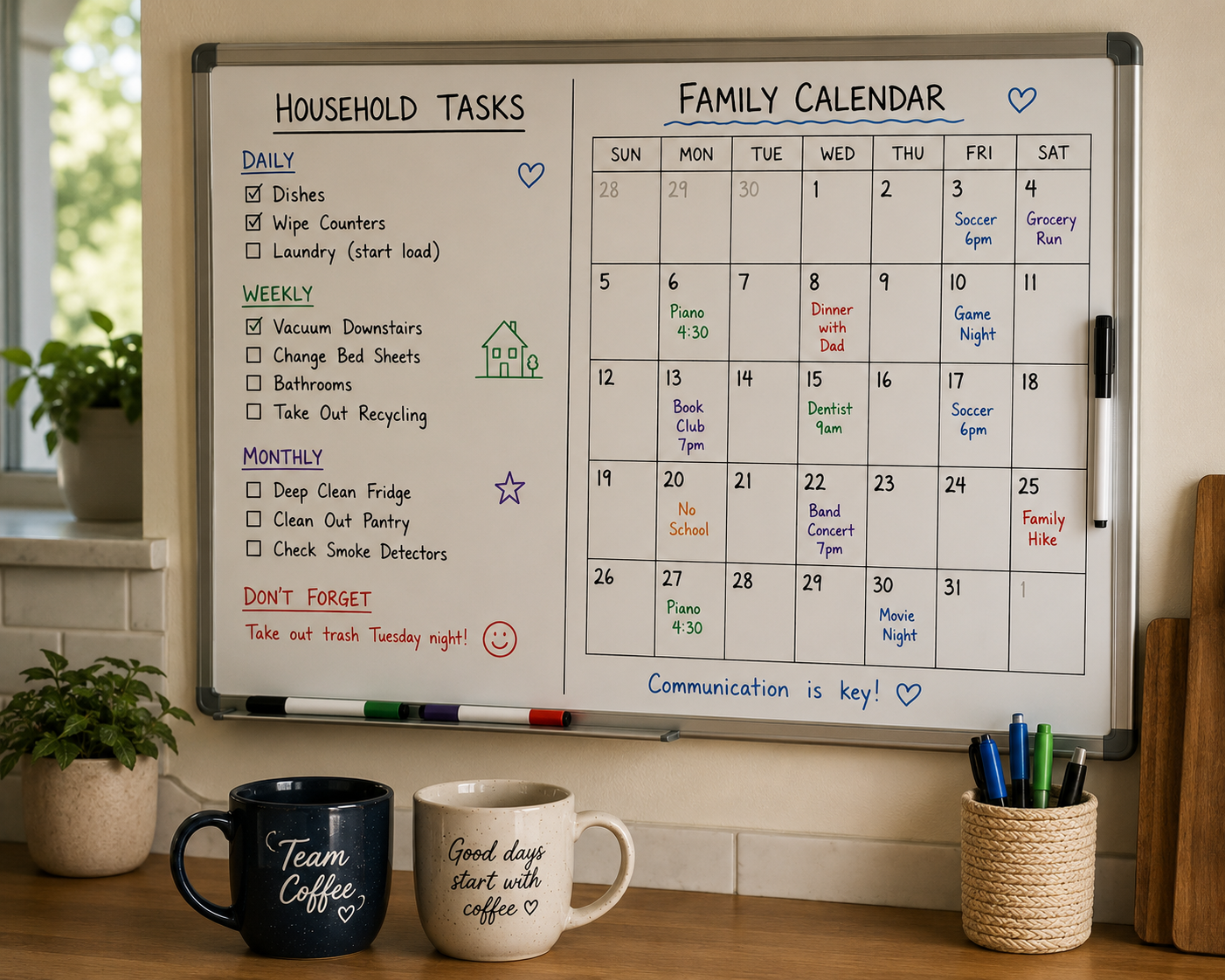
Move the system out of one person's head and into a shared, visible place — a shared list, a whiteboard, a household app, whatever both people will actually check. The format matters far less than the fact that it's shared and it's visible to both of you.
Step 4 — Iterate
Hold a short weekly check-in — fifteen minutes, same time each week — to review what's coming up and rebalance anything that's quietly drifted back onto one person. Without this recurring review, even a well-designed system slides back toward whoever defaults to noticing first.
Make the Invisible Work Visible
Open a shared note or document, titled "Household Ops," and start a running list of everything you notice, plan, or track for the household that isn't already written down anywhere.
2. Add every recurring thing you currently track from memory: appointments, restocks, deadlines, maintenance.
3. Share it with your household and set a 15-minute weekly check-in to review it together.
That list is your first operating system. You've just moved a household's worth of invisible tracking out of one person's head and into a place everyone can actually see.